Rohingya solution must be in Myanmar, dialogue urges livelihood opportunities alongside repatriation
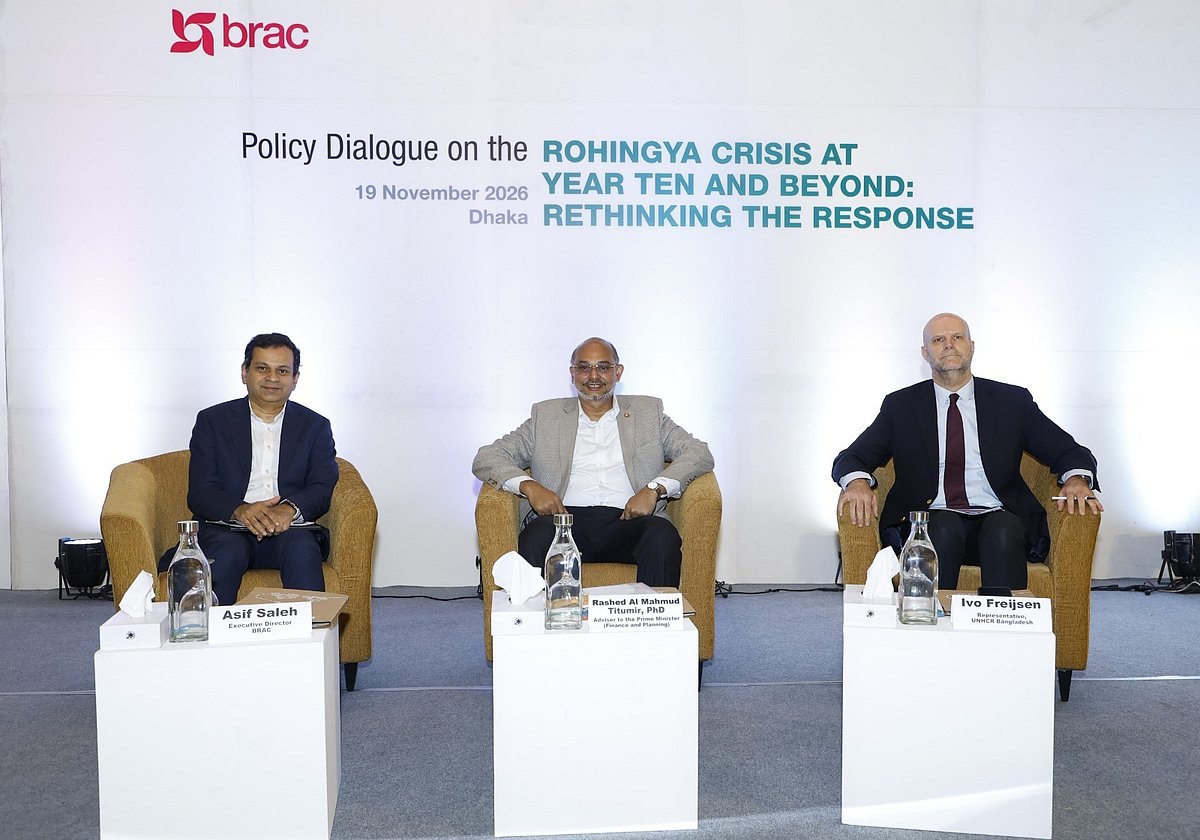
Humanitarian assistance alone is not enough for a lasting solution to the Rohingya crisis, experts said at a policy dialogue, arguing that alongside creating conditions for safe and dignified repatriation, education, skills and livelihood opportunities for the Rohingya in the camps must be expanded.
The views came at a policy dialogue titled 'A decade of the Rohingya crisis: rethinking the way forward', held at a hotel in the capital on Thursday. The dialogue was organised by BRAC.
The chief guest was Rashed Al Mahmud Titumir, adviser to the Ministry of Finance and the Ministry of Planning. He said the solution to the Rohingya crisis must be in Myanmar itself, for which the Rohingya people's political rights must be restored and a suitable environment created for their safe and dignified return home.
Professor Titumir added that declining international assistance for the Rohingya and the prolongation of the crisis are putting extra pressure on Bangladesh's limited resources. He called on the international community to play a stronger role in speeding up the process of returning the Rohingya safely to their own country with their rights and justice ensured.
Mohammad Mizanur Rahman, additional secretary at the office of the Refugee Relief and Repatriation Commissioner (RRRC), said the Rohingya did not flee their country because of poverty but because they were victims of persecution and oppression, so they should not be seen merely as aid seekers. He said refugees should be able to organise among themselves and have a say in determining their own future.
Ivo Freijsen, UNHCR's country representative, said the safe, voluntary and dignified return of the Rohingya remains uncertain, so the crisis is growing day by day. Sustainable, long-term planning is needed so that the Rohingya can live safely both while in Bangladesh and after returning home, he said, adding that this requires policy changes and greater solidarity and cooperation within the international community.
Asif Saleh, executive director of BRAC, delivered the welcome address. He said efforts are under way in various ways to ensure justice for the Rohingya, but the prospect of their return to Myanmar being created soon is slim, so they will have to spend this waiting period in Bangladesh. The development of Rohingya livelihoods and skills should therefore be seen not as a process of integration with the people of Bangladesh, but as preparation for a dignified return to their own country, he said.
Also speaking at the dialogue were Carol Flore-Smereczniak, the UN resident coordinator in Bangladesh, Nirjhar Adhikari, director of the Myanmar wing at the Ministry of Foreign Affairs, and Mohammad Nazmul Abedin, head of the refugee cell at the Ministry of Disaster Management and Relief.
Findings from two studies were also presented at the dialogue. One was titled 'Between expectation and reality: livelihoods, camp life and hopes of repatriation in the eyes of Rohingya youth' and the other 'Living in the shadow of crisis: livelihoods, gender equality and coexistence in the eyes of local youth in Ukhiya and Teknaf'. Both studies were conducted by BRAC Advocacy for Social Change.
The experts said importance must also be given to employment and improved living standards for the affected host community, and that the government, the United Nations and development partners must take coordinated initiatives for this.