Tk 996 crore Manu River embankment project in Moulvibazar stalled by obstruction, lakhs fear monsoon floods
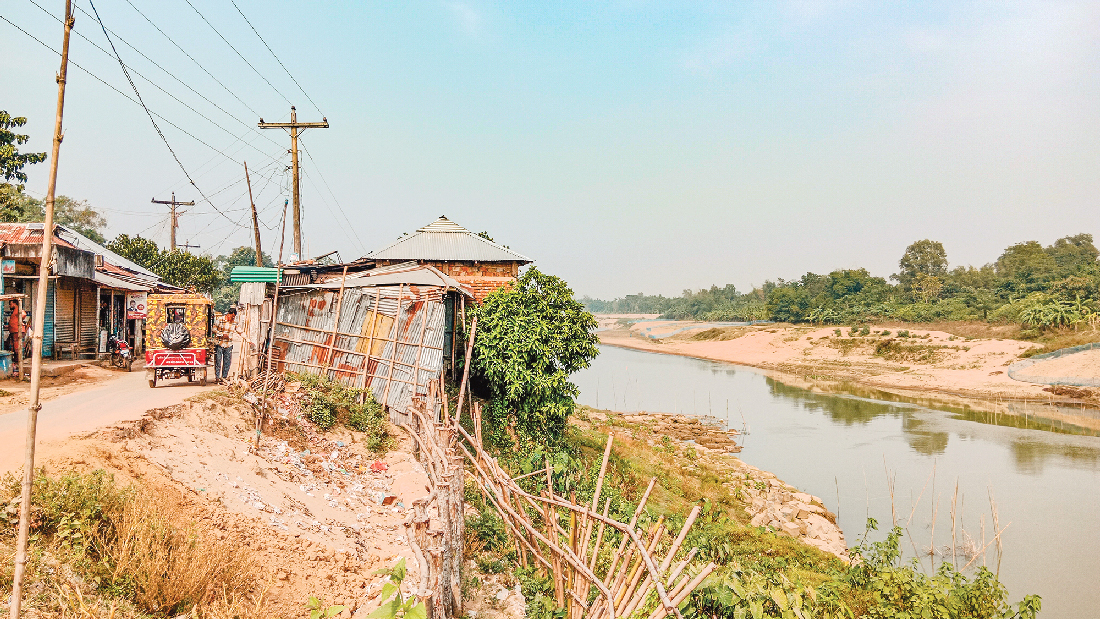
A Tk 996 crore project to protect the vulnerable embankments and banks of the Manu River in Moulvibazar was taken up in 2020 to protect local people from floods. The work was due to finish in June 2023, but even after the deadline was extended into 2026, 40 percent of the project remains incomplete.
Several packages are stalled by land acquisition complications, obstruction by local people and objections from India. In particular, work on 1,450 metres of embankment in the border no-man's land has not even started. As a result, lakhs of people along the Manu spend every monsoon in fear of floods and erosion.
According to related sources, the project worth Tk 996 crore 28 lakh was approved by ECNEC in 2020. Work began in 2021. It was due to end in June 2023, and the deadline was later extended to June 2026.
The work was to be done in 70 packages along vulnerable embankment areas of the Manu River in Kulaura, Rajnagar and Sadar upazilas of the district, but in practice, after 60 percent was completed, the project has nearly come to a halt. Officials say land acquisition complications and local obstruction are making it impossible to carry out the work.
Work in the no-man's land at Telibil, Bagjur and Nishchintapur in border areas of Kulaura upazila remains stopped.
At the century-old Kaukapon Bazar in Hajipur Union of Kulaura upazila, most of the eastern side of the market has been lost to erosion. About 40 shops have been swallowed by the river, along with part of a road. Many people have been left destitute after losing shops and homesteads. Work on 450 metres of embankment at this market has still not been possible.
In the no-man's land at Telibil in Sharifpur Union, the embankment on the Bangladesh side has broken and moved close to local homes. Residents say when the river rises, water spills over the embankment. Work with blocks was planned on 650 metres there. The contractor has kept blocks ready for three years, but no work is happening because the Bangladesh-India Joint River Commission has not reached a solution.
India claims there is a boundary pillar in the middle of the Manu River, though the barbed-wire fence is several hundred metres from the river. Next to Telibil, Bagjur has 300 metres of no-man's land where the Bangladesh side has also eroded. At Nishchintapur border, 500 metres of work was planned; a tender for it was issued once and then dropped.
The Water Development Board (BWDB) says the project to repair about 30 kilometres of vulnerable embankment in Sadar, Rajnagar and Kulaura upazilas was divided into 70 packages and about 20 contractors were appointed. Three packages in no-man's land cannot be done because of India's obstruction, and work cannot be done in several other areas including Kaukapon because of local obstruction.
Representatives of contracting firms say blocks have been kept ready for three years at border areas and several other places, but work cannot be done because of local obstruction, causing them heavy losses.
Jamal Hossain of Telibil said they live in great fear when the river rises. The contractor has brought blocks beside the embankment, but he has heard India claims the boundary is in the middle of the river and is not allowing the work. He fears the embankment will break if the river rises and it is not repaired.
Juned Ahmad, a resident of Kaukapon, said their fear grows as the Manu rises in monsoon. In the past few years most shops of Kaukapon Bazar have been lost to the river, and not only shops but roads, land and homes have also been lost.
Khaled Bin Olid, executive engineer of Moulvibazar BWDB, said local people have raised objections and the contractor has prepared blocks but cannot place them. At a work site in Rajnagar, local people beat one of their staff. He said about 60 percent of the project is complete, the rest cannot be done because of local obstruction, and there is no progress on the no-man's land work.