Government opts for political strategy, refusing to take the provocation bait on Awami League sabotage
The government is pairing administrative measures with a political strategy to confront the continuing violence and sabotage of the banned Awami League. The ruling BNP has already taken to the streets politically against the sabotage: in Dhaka and districts across the country, leaders and activists of the BNP and its associate bodies are standing guard, holding protest marches and motorcycle processions.
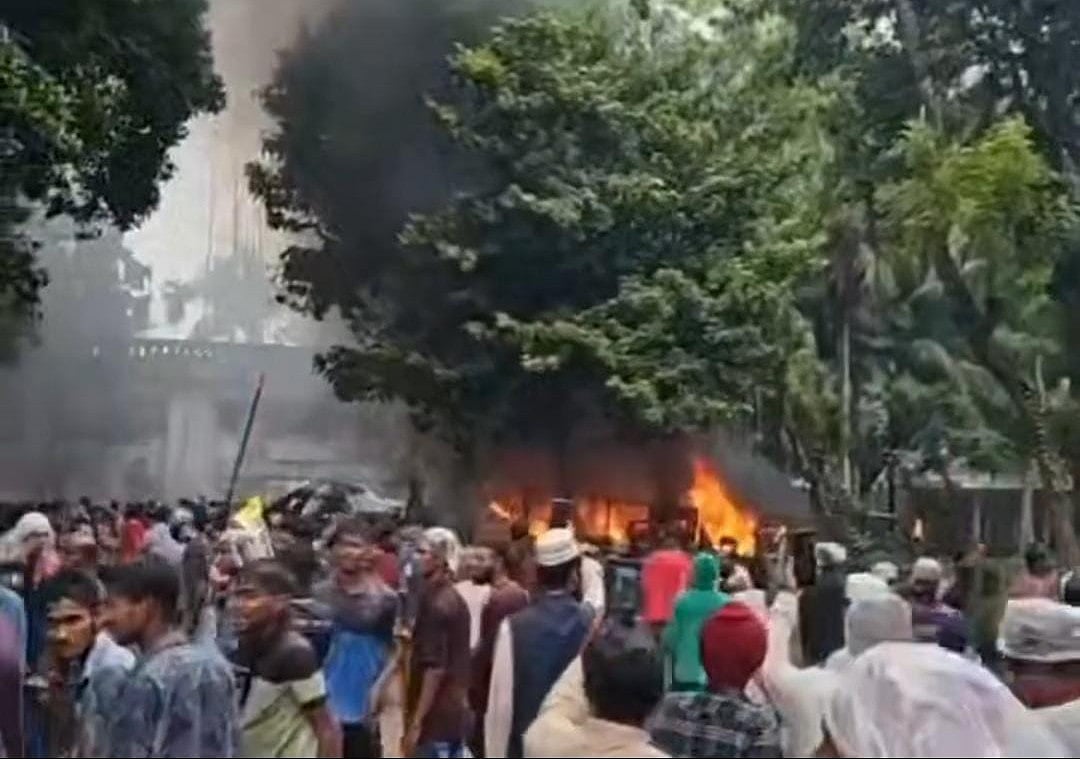
According to police figures, in the 12 days from November 7 to 18, crude bomb explosions occurred at 78 places across the country and 74 vehicles were set on fire. Three police installations and 18 police vehicles were torched or vandalised in the same period. Grameen Bank branch offices were attacked, set ablaze or hit with petrol bombs at 72 locations in different districts, and two BNP leaders were killed in Natore.
Violence has continued in Gopalganj. On Thursday, the Muksudpur police station was set on fire, and the home of Selimuzzaman Molla, the BNP member of parliament for Gopalganj-1, was also torched. Government-linked sources say that, particularly in the ongoing events in Gopalganj, there are instructions so far not to use force or lethal weapons.
Several responsible sources in the government and the BNP say the government views the Awami League's ongoing violence as provocation. The sources claim intelligence suggests the Awami League and its president Sheikh Hasina want the law enforcement agencies to open fire in suppressing the sabotage and cause bloodshed, recreating a situation like the indiscriminate shootings during the July mass uprising so that the BNP government can be put in the dock on the same charge. The government, the sources say, does not want to step into that provocation.
Government sources say the recent Awami League activities have a political objective beyond worsening law and order. Their assessment is that the party wants the government to take the path of harsh force: if the agencies fire and casualties occur, it can be used politically against the government. The government's strategy, therefore, is to take no step that causes mass bloodshed, and to let the public see for itself how much violence and destruction the Awami League can carry out. If the violence grows further, however, later measures could become tougher, the sources said.
In parliament on Wednesday, Prime Minister Tarique Rahman described the Awami League not as a political party but as a 'terrorist group', saying its head must be crushed before it can raise it. At a rally in Lalmonirhat on Thursday, the prime minister again addressed the party, saying these terrorists, arsonists and killers must be given a clear answer — enough is enough.
Asked what the government is doing about the sabotage in Gopalganj and elsewhere, Home Minister Salahuddin Ahmed said on Thursday: 'Wait and see.' He added: 'We will confront fascist behaviour democratically, politically and lawfully. We will not allow anything that harms the lives and property of innocent people. The Awami League has repeatedly revealed its character — ruling the country in an authoritarian manner, creating one-party Baksal rule, carrying out enforced disappearances and killings, and committing arson attacks. That is their character.' He also said: 'We will not step into any provocation of theirs. The people of the country and the world have seen their activities. The international community is evaluating, and will evaluate, what they have done.'
Government-linked figures also point to a political backdrop to this strategy. During the BNP's movement in 2014 and 2015, the then Awami League government levelled 'arson terrorism' allegations against the BNP over crude bomb explosions, petrol bomb attacks and vehicle arson, and used those allegations in political campaigning. Now the Awami League itself stands accused of the same kind of sabotage, and its own leaders and activists are publicising the attacks and arson from the scenes on social media.
Many BNP leaders had expected that after the July uprising the Awami League would repent for the disappearances, killings and other acts of its time in power and apologise to the nation. No such self-criticism or remorse has been seen at any level of the party's leadership. BNP leaders allege instead that after Sheikh Hasina's announcement of returning to the country in December, attempts are under way to create fresh instability through violence and sabotage. BNP acting secretary general Ruhul Kabir Rizvi said on Thursday: 'The Awami League is an unlawful force, a banned organisation. Those who carry out unlawful activities will be brought under the law by the law enforcement agencies in accordance with the law. And as a political party, we will remain alert and prepared to confront any unlawful force in a democratic environment.'
There are also moves to increase contact and unity among the political parties that backed the mass uprising. Several sources say Prime Minister Tarique Rahman and opposition leader Md Shafiqur Rahman spoke privately during the Maghrib prayer break of Wednesday's parliament session. According to the sources, the prime minister proposed an all-party mass procession of anti-fascist political parties, while the opposition leader proposed dialogue with the political parties. The government is expected to begin the process of arranging political dialogue very soon.
In his speech, opposition leader Shafiqur Rahman demanded implementation of the July National Charter in line with the referendum verdict, saying the sooner it happens, the sooner the unity against fascism and hegemonism will grow stronger.
Opposition parties including Jamaat-e-Islami have responded positively to the prime minister's unity call, but their position comes with conditions. The Jamaat-led 11-party alliance met on Thursday to review the latest political situation and decide its course. At a formal briefing afterwards, alliance leader Maulana Mamunul Haque said the government feels the need for unity, but its basis must be the July Charter, the referendum verdict and implementation of the aspirations of the July revolution. Jamaat central assistant secretary general A H M Hamidur Rahman Azad said the core of the prime minister's remarks is bringing anti-fascist forces onto one platform in the spirit of 2024, and for that the government must come onto the path of implementing the aspirations of 2024 and the referendum verdict.
The BNP and its associate bodies are already active on the ground politically. On Thursday morning, their leaders and activists were seen in alert positions and in protests in different parts of the capital, and they were present in the Sayedabad-Jatrabari area at noon as well. When a crude bomb exploded at the Jatrabari intersection at around 1:30 p.m., BNP leaders and activists carrying sticks were seen moving towards the spot.