
Cox's Bazar Debt Conference: Productive Use of Borrowed Money Is the Big Challenge, Experts Say
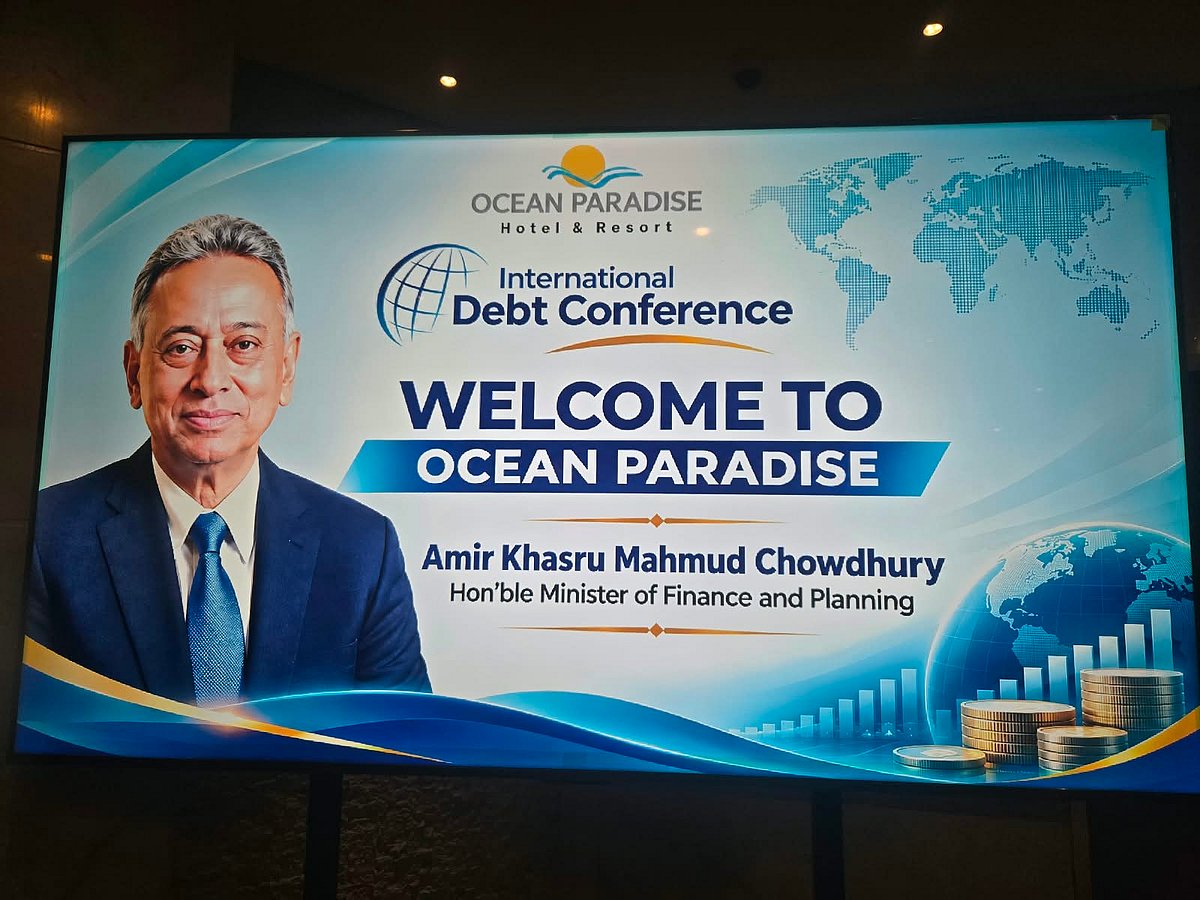
Bangladesh's first international debt conference was held on 15 and 16 November at the Ocean Paradise Hotel in Cox's Bazar. The two-day conference took place at the hotel, about 600 yards from the main beach.
Finance and Planning Minister Amir Khosru Mahmud Chowdhury, the prime minister's finance and planning adviser Rashed Al Mahmud Titumir, the prime minister's special assistant Tanvir Shahriar Gani and representatives of the International Monetary Fund (IMF), the World Bank and the Asian Development Bank (ADB) took part. Seven sessions were held over two days on the challenges of public debt management, international experience and the possibilities of alternative financing.
Over the two days, experts said that for Bangladesh the big challenge is not only raising debt but ensuring the productive use of that money. The discussions stressed expanding financing sources through bonds, sukuk and foreign investment, increasing revenue and reforming debt management.
Reducing dependence on bank borrowing by enlarging the bond and sukuk markets, attracting international investors and bringing private capital into public investment all came up at the conference. But there was also a warning that in seeking new financing sources, high interest, foreign-exchange risk and future repayment pressure must not be allowed to grow.
At the opening ceremony, Finance Minister Amir Khosru Mahmud Chowdhury said the government wants to reduce single dependence on the banking sector for financing large and long-term investment. Initiatives have been taken to strengthen the capital market and the bond market for that purpose.
Speaking to reporters after the opening, the finance minister said the government is preparing to issue Eurobonds, sukuk, Japan's Samurai bonds and China's Panda bonds in international markets. Initiatives are also being taken to increase foreign investment in the local bond market.
On the closing day, the prime minister's finance and planning adviser Rashed Al Mahmud Titumir gave an account of how much foreign debt must be repaid in which year. He said Bangladesh repaid $4.49 billion in principal and interest in the 2025-26 fiscal year. As grace periods end, annual repayments could rise to $5.5 billion, and by the 2030 fiscal year they could reach $7.6 billion.
In Titumir's view, the pressure is growing because loans taken in the past are maturing. Revenue will be raised by 2 percent relative to gross domestic product (GDP) over the next five years for that reason. He also advised using long-term bonds and sukuk to reduce repayment risk.
The prime minister's special assistant Tanvir Shahriar Gani said the IMF and the World Bank assess whether a country's debt is sustainable, but determining whether taking that debt was justified at all is the responsibility of the country concerned. He said debt policy directly affects ordinary people's lives, and that when there is a dollar crisis, ordinary people and businesses suffer the most.
After the opening session, former IMF adviser and head of its climate finance division Prasad Ananthakrishnan presented a paper titled 'Why countries borrow'. He said debt management is usually easier when economic growth exceeds the effective interest rate, and harder in the opposite situation. In his view, borrowed money must be used in productive investment that creates growth, improves public services and increases future repayment capacity.
In the second session, World Bank senior debt specialist Lilia Razlog presented Pakistan's experience. She said Pakistan had expanded financing opportunities through US dollar and Chinese currency-based programmes, taken initiatives for new instruments such as green Panda bonds, digital retail bonds and climate-related financing, and raised its tax-to-GDP ratio from 8.8 percent to 10.3 percent.
In the third session, World Bank senior financial sector specialist Zsolt Bango stressed developing a local-currency bond market. Speakers at the session said a reliable issuance calendar, a clear strategy and regular communication are needed to increase investor confidence, and that market makers and the secondary market must be strengthened to increase trading.
On the second day's first session, international sukuk specialist Lim Say Cheong presented a paper on sukuk and international bonds. He said a strong legal framework, Shariah supervision, investor protection and tax neutrality are needed to enlarge the sukuk market. He also warned that while a government can raise large amounts for long terms through sovereign Eurobonds, the interest cost can be higher.
In the sixth session, Yukun Ding, an economist on the IMF Asia-Pacific department's Bangladesh desk, joining online, said Bangladesh's LDC graduation timeline had been extended by three years. That period offers an opportunity to implement reforms in overall public financial management, especially structural reforms to increase revenue collection.
In the seventh session, ADB consultant Julian Szymanski raised the need to establish and strengthen a public Debt Management Office, or DMO. Discussants said fragmented debt management creates problems of data consistency, coordination and operational efficiency, and that an effective office needs a front office for borrowing, a middle office for strategy and risk analysis and a back office for debt data and repayment.
Several tasks emerged clearly from the two days of discussion: expanding financing sources beyond bank borrowing, increasing revenue, bringing all debt information into one place and building a strong debt management office, bringing private capital into public investment, and presenting economic plans and debt management information transparently to international investors. The most important message of the discussions was that borrowing itself is not a problem; a problem arises depending on how the borrowed money is used and how much repayment capacity is created.