Adivasi Forum demands separate ministry and land commission for plains indigenous peoples
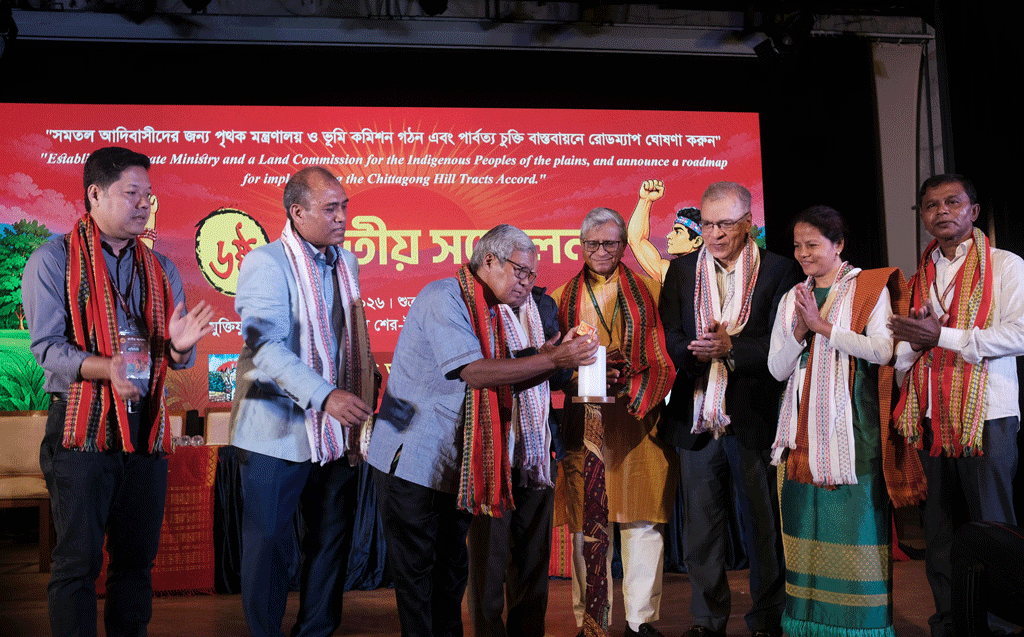
The Bangladesh Adivasi Forum has demanded a separate ministry and a land commission for the indigenous peoples of the plains, and a time-bound roadmap for implementing the Chittagong Hill Tracts accord. The demands were raised on Friday at the organisation's sixth national conference at the Liberation War Museum auditorium in the capital.
Representatives of political parties, human rights organisations and civil society spoke at a discussion chaired by the forum's vice-president Ajay A Mro. The session was conducted by sports and education secretary Ujjwal Azim and women's affairs secretary Falguni Tripura. The forum's general secretary Sanjeeb Drong delivered the welcome address.
In his welcome speech, Sanjeeb Drong said the Bangladesh Adivasi Forum has been struggling for indigenous rights for 25 years and many progressive Bengalis have joined the movement. Urging young indigenous people not to lose hope and to carry the struggle forward, he said Bengalis and indigenous peoples together must dream of building a humane and welfare-oriented state.
The written speech of the forum's president, Jyotirindra Bodhipriya Larma, was read out by information and publicity secretary Hiran Mitra Chakma. The written statement alleged that indigenous people in different parts of the country are suffering land loss, fear of eviction, false cases and insecurity, and that the Chittagong Hill Tracts accord has not been implemented even 29 years after it was signed.
Dr Iftekharuzzaman, executive director of Transparency International Bangladesh (TIB), said abuse of power and bureaucratic, state and military corruption were behind the denial of indigenous rights. He also commented that if there is no scope to use the word 'Adivasi' in the constitution, the movement for rights must be intensified.
Senior Supreme Court lawyer Subrata Chowdhury said that although election manifestos spoke of building a 'rainbow nation', in reality not all ethnic groups have been included. He called the initiative to form an anti-accord committee instead of implementing the Hill Tracts accord an act of sabotage.
Human rights activist and ALRD executive director Shamsul Huda said indigenous peoples protect a large part of the world's biodiversity, so their protection is essential. Ahead of the 30th anniversary of the Hill Tracts accord next year, he demanded a roadmap for implementing the accord and constitutional recognition of indigenous peoples.
Communist Party of Bangladesh president Kazi Sajjad Zahir Chandan said leftist parties will stand beside the rights struggle of indigenous peoples of the hills and the plains. Rajekuzzaman Ratan, assistant general secretary of the Socialist Party of Bangladesh, said the state must take responsibility for protecting land, language and self-identity.
Pallab Chakma, secretary general of the Asia Indigenous Peoples Pact (AIPP), urged talks by identifying the Hill Tracts problem as a political problem. Filimon Baske, president of the Sahebganj Bagda Farm land recovery struggle committee, demanded trials for human rights violations in the northern region and elsewhere. Flora Babli Talang, president of the Moulvibazar district branch, stressed making the organisation more active at the regional level.
The conference placed a 10-point demand including constitutional recognition with the right to self-determination, ensuring land rights, safety of indigenous women and trials for abuse, no project without free and prior consent, withdrawal of false cases, implementation of the UN Declaration on the Rights of Indigenous Peoples and the ILO convention, reserved seats in the national parliament, and quotas in education and jobs.
The day-long conference began with the national anthem, candle lighting and the reading of a condolence motion. After the discussion, cultural performances were presented by the music group Madol, the Dhaka University Jum Literature and Cultural Council and other indigenous cultural groups.