Three matchbox-style paintings bring back memories of lost Ramisa, father breaks down
A bride in a red sari against a yellow background, a groom in blue beside her. Another picture shows a cart pulled by two cows, with working people alongside. A third shows a stove fire, a cooking pot and a matchbox with a face drawn on it. Little Nawshin Jabin Huda Ramisa painted these three pictures in the style of matchbox labels.
She named the pictures herself. One is 'Bou Jamai', another 'Mojdur', and the last 'Matcher Jibon'. Under each picture Ramisa also wrote the name of an imaginary match factory of her own. One reads 'Nawshin Match Industries Ltd', another 'Amin Industries, Dhaka', and the third 'Nawshin Match Factory Ltd'. Each also says 'Made in Bangladesh'.
All three pictures now hang on the wall of a gallery at the Bangladesh Shilpakala Academy. But the girl who painted them is no longer alive.
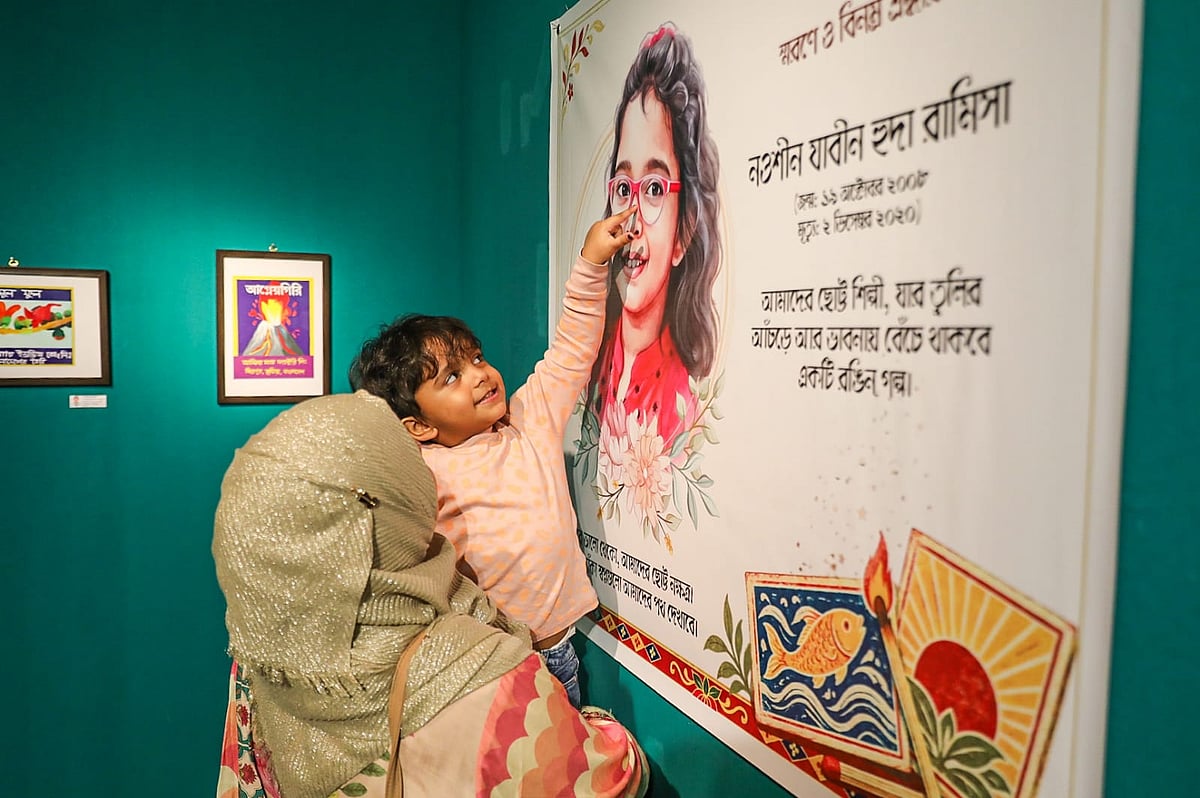
On Friday, an exhibition titled 'Diyashlaiye Bangladesh' was held at Gallery 2 of the Chitrashala at the Bangladesh Shilpakala Academy in the capital. The Bangladesh Matchbox Collectors Club (BMCC) and Monsiz Art Academy jointly organised it. The exhibition featured 43 artworks by 29 child artists, including Ramisa.
As soon as he entered the gallery, father Nazmul Huda's eyes fell on his daughter's paintings. He took out his mobile phone and began photographing them one by one, his eyes brimming. At one point he broke down in tears.
Nazmul Huda's elder daughter Ramisa died on 2 December 2020 at the age of just 12. She was then a sixth-grade student at BAF Shaheen English Medium School. Seeing his daughter's paintings in an exhibition nearly six years after losing her, the father could not hold back his emotions.
Photographing his daughter's pictures, Nazmul Huda said through tears: 'If my daughter were here today, my heart would have swelled with pride. My mother is gone, what can I say. Perhaps she was given only this much life. Please pray for my mother.'
Nazmul Huda lives with his family in Tejkunipara in the capital. He works as general manager of the marketing and merchandising department of a private company.
Ramisa was born on 19 October 2008. She had a love of drawing from early childhood and won several prizes for her artwork. Alongside placing on the merit list in her studies, she also won prizes in scout activities.
Father Nazmul Huda said Ramisa had asthma from early childhood and had to use an inhaler regularly. In November 2020, during the coronavirus pandemic, her breathing difficulties worsened in the last week of the month. Doctors were consulted, but at the time they did not report anything very serious.
On 2 December, however, Ramisa's condition suddenly deteriorated. When severe breathing trouble began, she was rushed to a private hospital. According to Nazmul Huda, doctors said there was serious damage to her internal organs, with complications in her liver and kidneys, and her pulse could not be found.
Her parents then rushed from one hospital to another with her, but could not get her admitted anywhere. In the end she was admitted to a private hospital, but by then it was too late, and doctors declared Ramisa dead. Recalling that time, Nazmul Huda said: 'I did not get even a little time. Before I understood anything, my mother was gone. She did not give me the time to care for her a little in her illness.'
Ramisa's mother Ruhina Tasmin also came to the exhibition, with her two younger daughters. The second daughter, Nahiyan Jabin Huda, now studies in the seventh grade, and the youngest, Nusaiba, is two years old. Speaking of her daughter, Ruhina Tasmin said: 'She had asthma from childhood. Even when she suffered a lot, she would not say so. She had built up endurance. My daughter was so talented; besides these, she has many more paintings. My darling mother slipped away from us.'
Ramisa had learned painting from childhood at Monsiz Art Academy in Tejkunipara. She was a favourite student of the institution's director, Sadia Sharmin. Remembering her, Sadia Sharmin said: 'She had such eagerness to learn; show her something once and she understood. Beyond these, she painted wonderful pictures.'
At the exhibition, Ramisa's younger sister Nahiyan kept returning to her paintings. When her elder sister died, Nahiyan was only seven. Beside the paintings in the gallery stood a banner carrying a condolence message and tribute to Ramisa, and Nahiyan kept looking towards it. Asked 'How did you like your elder sister's artworks?', she gave no answer, only gazed at the paintings with tearful eyes.
Friday's exhibition presented the designs, colours and artwork of matchboxes from different periods and companies of the country. Most of the participating children painted by looking at matchbox designs from 1950 to the present day, while others painted from their own thoughts and imagination. The pictures featured nakshikantha, jamdani, flowers, fruits and birds.
The day-long event ran from 10am to 5pm and became a gathering place for matchbox collectors. Many exchanged boxes from their collections there, and buying and selling took place. Old local and foreign notes, coins and various antique items were also sold. One collector brought a collection of more than 1,500 erasers.