Secret ballots and veto arithmetic: how the next UN secretary-general will be chosen
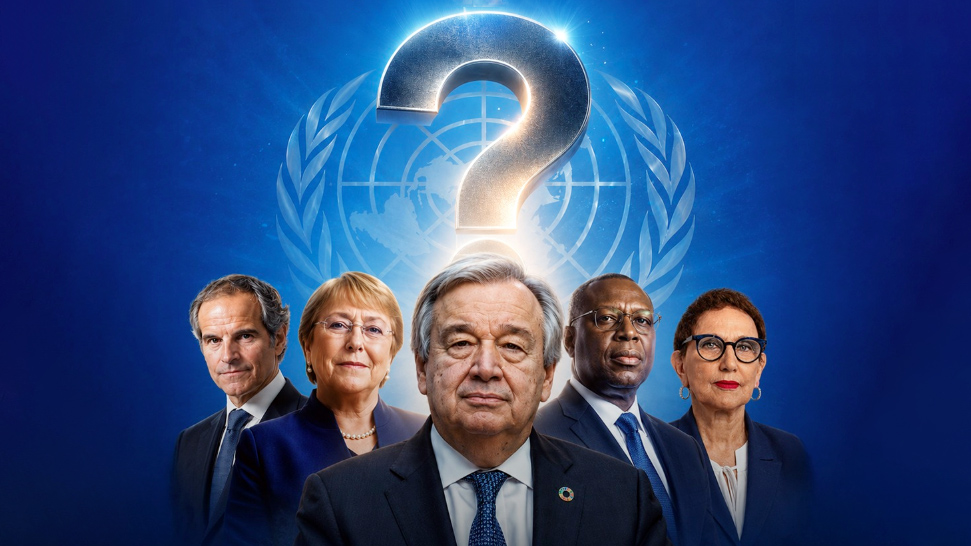
Secret voting, coloured ballots, straw polls to test opinion, and behind-the-scenes diplomatic efforts to build consensus — the whole process includes all of these. Above everything sits the veto power of the powerful countries. This is how the secretary-general of the United Nations is chosen.
At a time when international law and rules face growing challenges around the world, the process of deciding who will lead the vast international organisation tasked with upholding them is also quite complex. Diplomatic calculations are again under way over the selection of the next UN secretary-general.
In practice, it is the UN's 15-member Security Council that selects the next secretary-general. The council has five permanent members — China, France, Russia, the United Kingdom and the United States. Each of them has veto power.
The Security Council also has 10 non-permanent members elected for two-year terms. The current such members are Bahrain, Colombia, the Democratic Republic of the Congo, Denmark, Greece, Latvia, Liberia, Pakistan, Panama and Somalia.
Under Article 97 of the UN Charter, the Security Council nominates one candidate and recommends that person to the General Assembly. The candidate is then elected by a vote of all members of the General Assembly.
In theory, all 193 member states of the General Assembly have the opportunity to take part in the process. But the General Assembly has never rejected a candidate recommended by the Security Council, so in practice the council's decision becomes final.
In particular, because of the five permanent members' veto power, it is almost impossible for a secretary-general to be elected without their support. Alongside winning the support of non-permanent members, the consent of the permanent members must also be secured.
In 1950, however, when a deadlock arose in the Security Council, the General Assembly decided to extend the then secretary-general's term. In that case the General Assembly extended the term by vote without a Security Council recommendation.
To select a secretary-general, the Security Council first holds informal and secret votes. These are called 'straw polls'. In them, members indicate one of three positions on a candidate: 'encourage', 'discourage' or 'no opinion'. Although the voting is kept secret, how many encouraging, discouraging or neutral votes a candidate received sometimes reaches the media.
In later rounds of voting, ballots on coloured paper are used. This makes it possible to distinguish the votes of the Security Council's permanent and non-permanent members, giving a comparatively clear idea of both groups' attitudes towards the candidates.
If a candidate receives at least nine votes of support and faces no veto from any permanent member, the prospect of taking that candidate forward arises. The Security Council then formally votes to recommend the candidate to the General Assembly, which is expected to approve the nomination.
Jane Kinninmont, chief executive of the UK's UN Association, said the secretary-general selection process has traditionally been quite secretive. However, campaigning by civil society organisations and member states has made the process somewhat more open than before. She told Al Jazeera, 'But the Security Council still maintains strict secrecy.'
According to Kinninmont, one argument for maintaining secrecy is that if a country votes for one candidate and another candidate is elected, its relationship with the elected person could deteriorate. Voting information is kept secret to avoid such situations.
Al Jazeera's UN correspondent Gabriel Elizondo said the secrecy of the selection process is mainly due to the structural characteristics of the system. In recent years there has been discussion in the Security Council about making the selection more transparent, but the five permanent members want to keep the current system.
After several contenders withdrew from the initial race, eight candidates now remain for the post of secretary-general. Among them, International Atomic Energy Agency (IAEA) chief Rafael Grossi and UN trade and development agency (UNCTAD) chief Rebeca Grynspan are considered the leading candidates.
If Rebeca Grynspan is elected, she could become the UN's first woman secretary-general. In 2022, during the Russia-Ukraine war, she played an important role in concluding the Black Sea grain deal. That agreement made it possible to export millions of tonnes of food grain from war-torn Ukraine, much of it reaching developing countries. Rafael Grossi has led the IAEA since 2019.