Rangpur ahead of Dhaka in air pollution, research shows alarming picture in villages too

Air pollution is no longer only Dhaka's problem. Government monitoring and several studies show that harmful fine particles, PM2.5, have reached worrying levels in the north, the west, industrial areas and even rural areas.
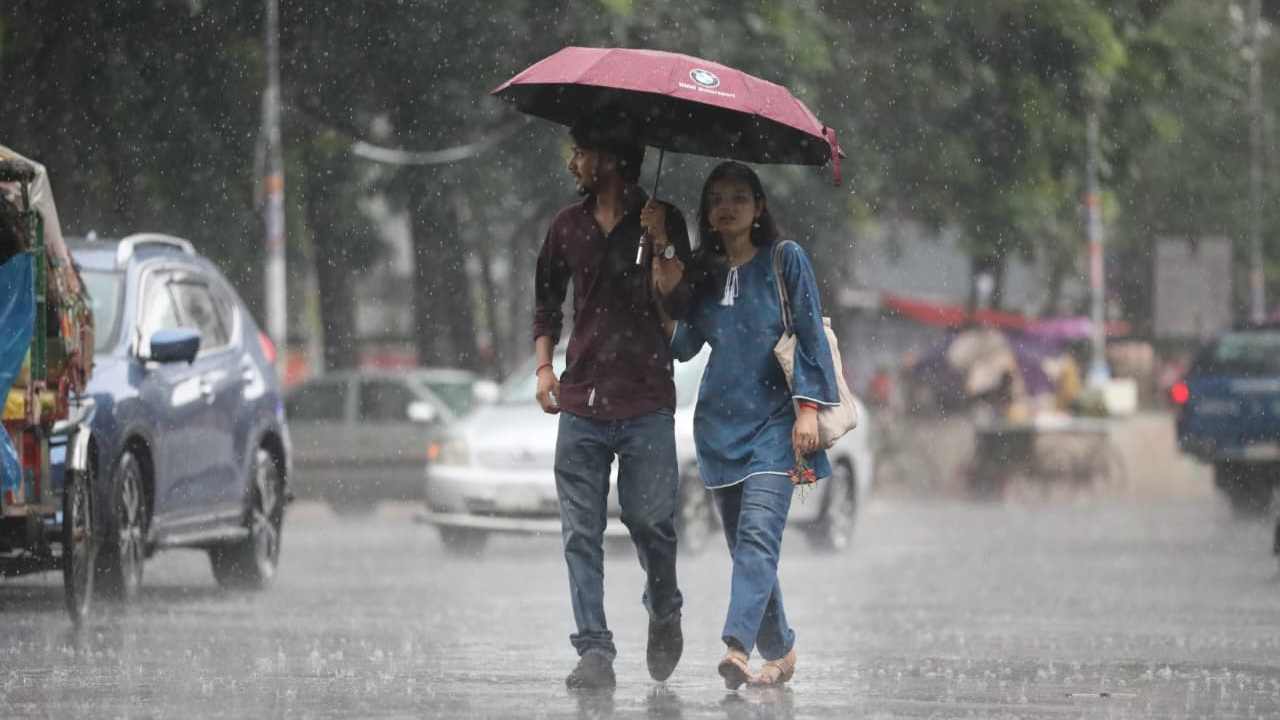
Even after three days of light rain, Dhaka ranked 11th among 126 cities in the world at around 11 a.m. on Sunday, with an air quality index of 151, which is described as unhealthy. But in Gazipur, a city with a comparatively smaller population, the index at the same time was 178, and it stays around that level almost every day.
A presentation by Mohammad Abdul Motaleb, deputy director (air quality) of the Department of Environment, shows the 2025 air pollution picture for the eight divisional cities. Average PM2.5 was highest in Rangpur, at 105.83 micrograms per cubic metre, followed by Rajshahi at 90.66 and Dhaka at 89.91.
In the same data, Mymensingh recorded 81.01, Chattogram 64.7, Khulna 63.27, Barishal 56.55 and Sylhet 50.32 micrograms. The World Health Organization's annual PM2.5 guideline is 5 micrograms per cubic metre, meaning Rangpur's average pollution was more than 21 times the guideline.
Mohammad Abdul Motaleb said one reason Rangpur's pollution is high is that it is an entry point for cross-border polluted air; the city does not have many vehicles or other sources. Not only Rangpur — this airflow also raises pollution across large parts of the Rajshahi and Mymensingh regions.
The picture outside Dhaka became clearer in a study published in February 2026 in the international journal Atmospheric Pollution Research. Researchers installed low-cost air quality sensors in Dhaka, Rajshahi, Panchagarh, Netrokona and Bhola from April 2022 to September 2023 to observe PM2.5.
Among the five locations, Netrokona had the highest average PM2.5 concentration, at 212.81 micrograms per cubic metre. Panchagarh recorded 128.6, Rajshahi 110.4, Dhaka 105.1 and Bhola 82.2 — meaning three of the five locations were more polluted than Dhaka.
Nine researchers from home and abroad, including Dhaka University researchers Shahid Uz Zaman, Shatabdi Roy and Professor Abdus Salam, were involved in the study. They used a Generalized Additive Model to analyse weather elements and air trajectories.
The study found pollution rises in the morning and evening at all five locations. Air from the northwest is linked to higher pollution, while air from the Bay of Bengal is linked to reducing PM2.5 by 20 to 40 micrograms per cubic metre. Polluted air from India's Indo-Gangetic Plain was linked to raising PM2.5 by about 50 micrograms at every location, though local sources also matter.
The Department of Environment's 'Ambient Air Quality in Bangladesh (2018-2023)' report, published in 2025, analysed data from 31 monitoring stations in 23 districts. It found annual average PM2.5 rose at most stations except Savar and Farmgate; pollution was highest in January and lowest in July in all regions, about 40 percent higher at night than in the day on average, and about 50 percent higher in winter than in summer.
The World Bank-supported National Air Quality Management Plan 2024-2030 analysed data from the eight divisions and found annual average PM2.5 between 48 and 103 micrograms — no divisional city is anywhere near the WHO guideline. A model-based estimate puts rural annual average PM2.5 at 57 micrograms per cubic metre, and the population-weighted urban figure at 77.
According to the World Bank's 2023 environment analysis, sources of pollution in the greater Dhaka region include household solid fuel burning at 28 percent, power plants 24 percent, brick kilns 13 percent, open burning of municipal waste 11 percent, road dust 8 percent and vehicle smoke 4 percent.
PM2.5 particles can travel deep into the lungs with breathing and in some cases reach the bloodstream. Long-term exposure raises the risk of heart disease, stroke, lung cancer and respiratory diseases; children, the elderly and those already suffering from respiratory illness face greater risk. The World Bank's 2024 analysis said air pollution and household air pollution caused more than 159,000 premature deaths in the country in 2019.
The Department of Environment presentation listed implementing the national air quality management plan, controlling old and polluting vehicles, using non-fired blocks, stopping open waste burning and controlling industrial emissions. Targets were also set to cut population-weighted annual average PM2.5 by 15 micrograms and greater Dhaka's by 30 micrograms by 2030.
Dhaka University chemistry professor Abdus Salam said air pollution is no longer a Dhaka- or city-centred problem; it has reached remote areas too. He said monitoring outside the capital must be expanded, local pollution sources identified and region-based control systems built.