
Special exhibition at Liberation War Museum honours French friend of 1971 André Malraux
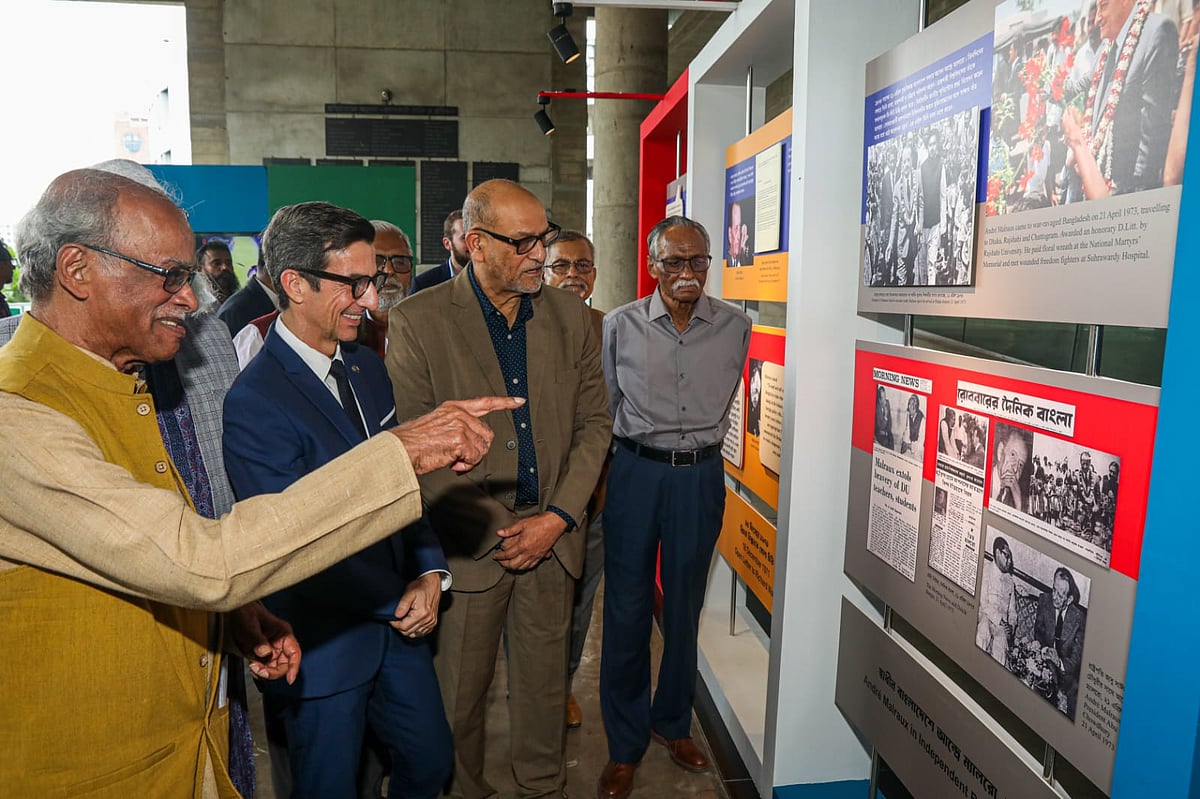
A special exhibition has opened in Dhaka in memory of André Malraux, the French philosopher, writer and France's first culture minister, who played an important role in building world opinion in favour of Bangladesh during the 1971 Liberation War. Jointly organised by the Liberation War Museum and the French embassy in Dhaka, the exhibition runs until November 30, open daily from 10am to 5pm.
November 23 marks the 50th anniversary of Malraux's death. Ahead of it, Frédéric Inza, deputy head of mission at the French embassy, inaugurated the exhibition at the museum lobby at noon on Sunday. War-wounded freedom fighter and physician Amzad Hossain attended as special guest, alongside foreign diplomats, freedom fighters, cultural activists and students from various institutions.
At the start of the opening, museum trustee Tropa Majumdar presented Malraux's background and his role in the Liberation War. Malraux was 70 years old in 1971. He did not stop at issuing statements; he announced the formation of an international brigade and prepared to take part directly in the war, although he was kept from fighting because of his age.
Malraux wrote to President Nixon sharply criticising US policy during the war and gave an interview to Time magazine. In reply to a letter from writer and filmmaker Zahir Raihan, he also reaffirmed his support for the Liberation War. After independence, he visited Bangladesh from November 21 to 24, 1973, at the invitation of the Bangladesh government. He died on November 23, 1976.
Speaking at the opening, Frédéric Inza said the role Malraux played on behalf of the French people during the Liberation War created a lasting bond of friendship between Bangladesh and France. Malraux, he said, did not see Bangladesh's darkest hour as a distant political matter, but understood it as a fundamental question of human dignity and freedom.
Recalling his own wartime experience, Amzad Hossain said Malraux's protest as a representative of the French people, and his announcement that he would join the Liberation War, greatly inspired the freedom fighters. He said he himself was seriously wounded in the war and that a friend of his was martyred.
Museum trustee Mofidul Haque said that during his post-independence visit Malraux paid tribute at the under-construction National Martyrs' Memorial, met war-wounded freedom fighters in hospital, and also travelled to Chattogram and Rajshahi. He said the exhibition would let the younger generation learn about the contribution of this friend of Bangladesh.
The exhibition is arranged on four boards in the blue-white-red of the French flag and the red-green of the Bangladesh flag, with photographs, newspaper clippings and graphics. The boards on the eastern side show Malraux's role from France during the war — his letter to Nixon, the Time magazine cover and interview, and his reply to Zahir Raihan's letter.
The western boards display photographs from his 1973 Bangladesh visit — the reception at the airport, his tribute at the memorial, his visit to wounded freedom fighters in hospital, and Rajshahi University conferring an honorary D.Litt on him — along with reports published in local newspapers at the time.
Between the boards, a documentary on Malraux is being shown on an LED monitor. At the western end stands a large photo cutout of a wounded freedom fighter garlanding Malraux in hospital; Malraux put the garland back around the fighter's neck, saying it should be given to the fighter, not to him.
