After a heart attack broke him, teacher Kazim's five-acre orchard in Fulbaria became a living storehouse of fruit
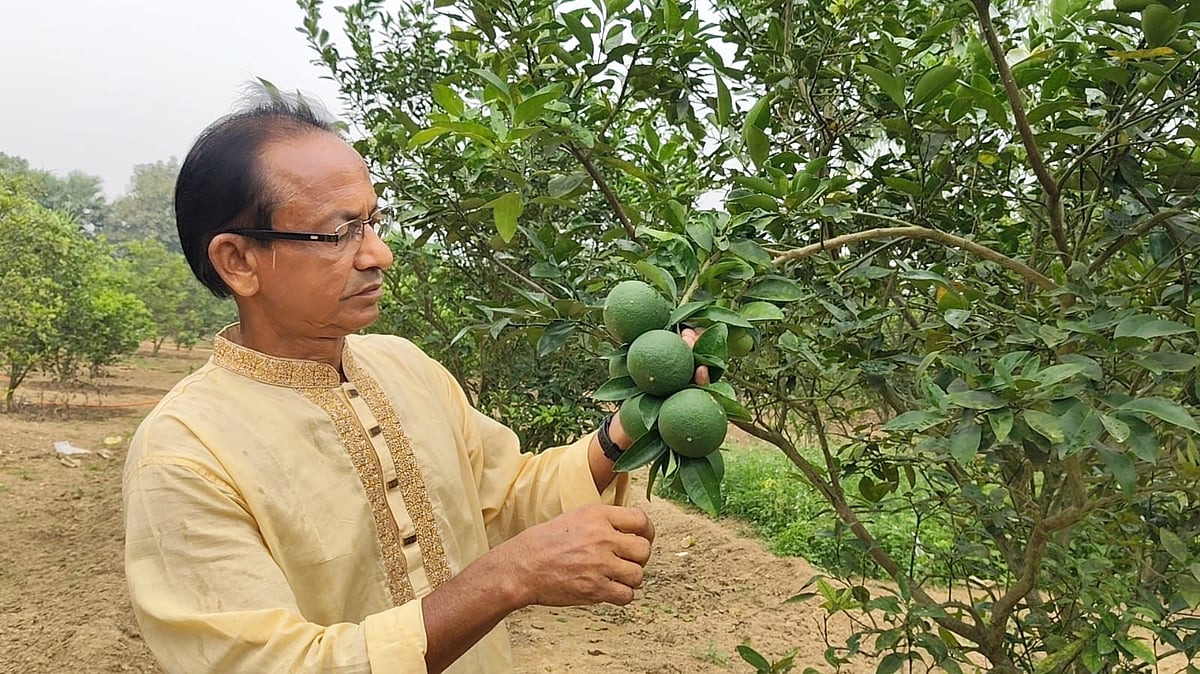
Teacher Md Kazim Uddin, 53, lives at Masterbari in Pahar Anantapur village of Rangamatia Union, about 20 kilometres from Fulbaria upazila town in Mymensingh. He is an assistant teacher at the local Babuganj Girls' High School. His orchard is named 'Masterbari Mixed Fruit Orchard'.
On 27 December 2019, Kazim Uddin suddenly suffered a heart attack. Doctors found five blocks in his heart and fitted stents in three of them. Afterwards, fear of death gripped him and he gradually lost confidence as well.
Kazim says that after the heart attack he constantly worried about his life and felt he might not survive. Abdus Sattar Bhuiya, a heart specialist at Mymensingh Medical College Hospital, then advised him to garden, saying that working at a tolerable level would keep his mind well. Kazim says that caring for the trees gradually brought his confidence back.
On the doctor's advice, he planted a few fruit trees on fallow land in his yard. That small start has now grown large. On a total of five acres of his own and inherited land, he now has more than 200 varieties of about 35 kinds of local and foreign fruit. The number of trees is between 2,500 and 3,000. In the words of local agriculture officials, it is like a germplasm storehouse for agriculture — a living store of plant tissue from which new plants can be grown.
He began with malta on two bighas of land, and from 2021 he started commercially growing Vietnamese year-round malta. Malta now covers three acres, Colombo and seedless lemons one acre, and Vietnamese and BARI-4 jackfruit 15 decimals. The remaining land holds other fruit trees.
The orchard has Thailand's year-round seedless jackfruit, Australian yellow malta, white jamun, rambutan, sweet tamarind, Saudi dates, ruby longan and avocado. It has Egyptian and Pakistani pineapples and red and black sugarcane from the Philippines. Among mangoes there are more than 20 varieties including Miyazaki, Kyujai, King of Chakapat, Amrapali and Haribhanga. There are more than 30 grape varieties. He collected the saplings from different regions of the country — travelling himself to buy some, and receiving others by courier.
Kazim is also drawn to fruits that are disappearing. His orchard has two trees of a rare fruit called 'Tanpura' or 'Dashbel', which have also borne fruit.
Alongside the hobby, Kazim has succeeded commercially too. He says Vietnamese year-round malta costs little to produce and has market demand. A tree takes about four years to mature, and a mature tree yields 120 to 130 kg of fruit a year, sold wholesale at Tk 40 to 50 per kg. Giving an account of 300 trees, he says organic fertiliser and pesticide-fungicide cost Tk 25,000 to 30,000 a year, while sales reach Tk 400,000 to 500,000. He has seven cattle — four bulls and three cows — and most of the organic fertiliser comes from their dung.
For Kazim, the orchard is not only a source of income but also a refuge for his mind. Between teaching, whenever he finds time, he goes to the trees. He says that even with five minutes to spare, he sits under one tree or another, and that he can no longer imagine anything apart from trees. Out of that love, he tells others to plant trees.
Farmers, teachers and researchers come to see the orchard. Teachers and students of Bangladesh Agricultural University also visit. Recently, a university team working on agricultural marketing and a team from the UN Food and Agriculture Organization (FAO) also visited the orchard.
Fulbaria Upazila Agriculture Officer Sukanta Dhar says Kazim Uddin is an exceptional farmer who has turned a hobby into a collection of many fruit varieties. Officials saw about 35 kinds of fruit trees in his orchard, including some local varieties that are now rarely seen in the field, he said.
Kazim hopes malta cultivation will spread further in his village in the next two to three years. Although many laughed at his initiative at first, farmers nearby are now becoming interested in orchards, he said.