BAJUS decides to strip making charges and profit from gold price, rate cut by Tk 6,182 per bhori
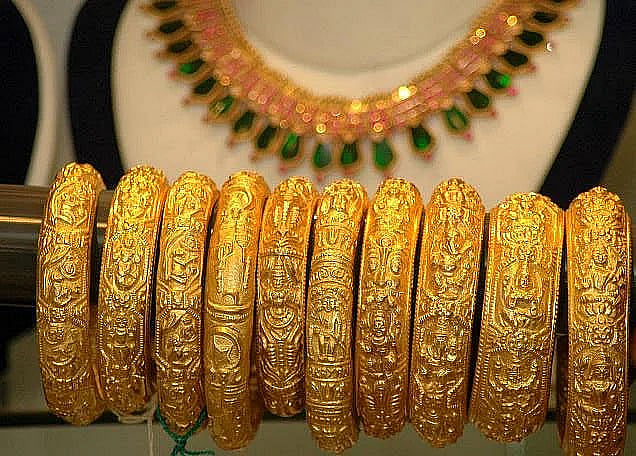
Leaders of the Bangladesh Jewellers Association (BAJUS) have decided to phase out the making-charge and trader-profit components from the price of gold. The move takes the association back to the pricing rule of nearly two decades ago.
A meeting of the association's board of directors was held on Saturday at the jewellers association's office. Chaired by president Enamul Haque Khan, the meeting was attended by 28 board members. It decided to remove making charges and profit from the gold price in phases, although some traders opposed the decision.
Following the board's decision, the association announced a gold price cut on Saturday night itself. In the first phase, the price fell by up to Tk 6,182 per bhori. As a result, the price of one bhori of 22-carat gold dropped to Tk 194,964.
Under the new decision, customers exchanging or selling old ornaments will receive 3 percent more money than before. However, buyers of new ornaments will now have to pay making charges separately.
Dewan Aminul Islam, chairman of BAJUS's standing committee on gold and silver price fixing and monitoring, said nothing else would be added to the gold price in future. In that case, customers will have to pay Tk 3,000 per gram, or about Tk 30,000 per bhori, as making charges. He noted that the jewellery business runs on this model in other countries of the world.
For more than a year, the price of gold in the country had stayed above two lakh taka. Because of the high prices, the jewellery business faced a slump throughout the year.
Recently, complaints began to surface that some businesses in Dhaka and in district towns outside the capital were selling gold at Tk 5,000 to Tk 10,000 less per bhori than the association's fixed price. Also this month, a Supreme Court lawyer served a legal notice on the government demanding that overall control of the gold market, including price fixing, be brought under the direct supervision of Bangladesh Bank.
BAJUS president Enamul Haque Khan said customers often complain that gold costs Tk 25,000 to Tk 30,000 more per bhori in Bangladesh than in India. Yet, when making charges are included in the calculation, the price in India is somewhat higher than in Bangladesh. Even so, traders are being financially harmed by this perception among customers, because many people are going abroad to buy ornaments.
Enamul Haque Khan added that the decision not to keep making charges and profit within the gold price was taken to reduce this tendency. The association expects it to create employment for two lakh new artisans in five years.
Nearly two decades ago, making charges and profit were not included in the gold price; traders then charged making costs separately. After the price of a bhori of gold crossed Tk 10,000, the pricing method was changed at the demand of some traders — their argument was that customers do not want to pay making charges separately when buying ornaments. Making charges, VAT and profit were then added to the gold price.
Domestic prices move with fluctuations in the global gold market, but pricing takes into account the rate of tezabi (99.50 percent pure) gold in the local bullion market. Last Friday, one bhori of tezabi gold was priced at Tk 181,000; that morning, one bhori of 22-carat gold had been fixed at Tk 201,146. On Saturday, tezabi gold stood at Tk 182,200 and that night the price of 22-carat gold was fixed at Tk 194,964 per bhori.
Several members of the association said that until Saturday, the gap between the making cost and the selling price of one bhori of 22-carat gold ornaments was around Tk 16,000. After the new price took effect, that gap fell to about Tk 10,000, and it may narrow further in future as a result of the new decision.