Rooppur Power Costed at About Tk 10 Per Unit as Tariff Talks Continue
The per-unit price of electricity from the Rooppur nuclear power plant is on its way to being finalised. Although there was an expectation of getting power at five to six taka per unit, electricity that cheap now looks unlikely. The plant's own calculation puts the cost at about 10 taka per unit, a little over eight cents. Experts say there is scope to reduce the cost with government policy support.
The Power Development Board (PDB) buys electricity from all the country's power plants under contract. Supply from the Rooppur plant in Pabna is due to begin soon, and power has already been supplied once on a trial basis. Before commercial production starts, the PDB will sign a power purchase agreement with Rooppur, and final talks on the price are under way.
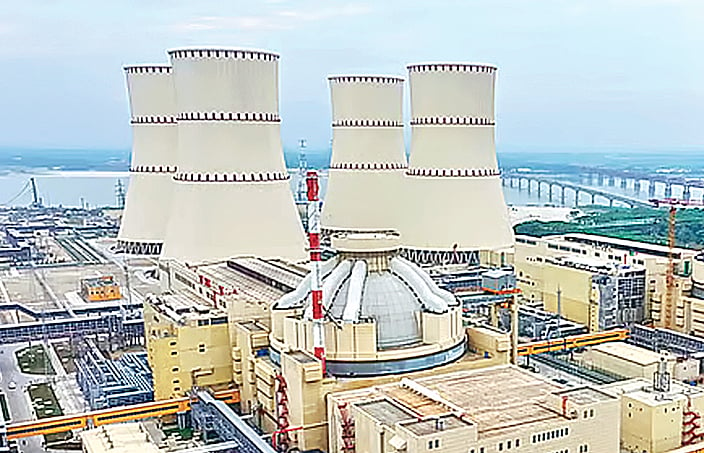
Rooppur is the largest single project in the country's history. It is being implemented by the Bangladesh Atomic Energy Commission under the Ministry of Science and Technology, and operations are handled by the state-owned Nuclear Power Plant Company Bangladesh Limited (NPCBL). Russia's Atomstroyexport is building two 1,200-megawatt units at Rooppur.
The Rooppur plant has already submitted a per-unit production cost calculation to the Atomic Energy Commission. NPCBL sources say the average cost per unit is worked out by dividing all costs over the plant's lifetime by the total electricity expected to be produced, though it can rise or fall depending on various components, so the proposal was prepared with separate calculations. The final price will now depend on the government's policy decision. A policy meeting is expected at the Ministry of Science and Technology next week.
To work out Rooppur's costs, the PDB wrote to the Atomic Energy Commission last November seeking 17 types of information. Sources say Rooppur provided most of it but could not provide some. Rooppur officials, however, say all necessary information has been given; the decommissioning cost of permanently closing the plant at the end of its life cannot be stated now, and no commercial contract has yet been signed for removing spent fuel waste, so those costs have been estimated using international standards. Since the plant's costs are in foreign currency, the price has also been set in dollars.
PDB Chairman Md Rezaul Karim said not all information has been received from Rooppur and some is still outstanding. The plant was asked to calculate costs over a 60-year life, whereas it initially wanted 50 years; using 60 years will lower the per-unit cost. The PDB's concern, he said, is to reduce the cost as much as possible.
By comparison, the 2024–25 annual report of India's state-owned Nuclear Power Corporation of India Limited shows the Tarapur plant in Maharashtra, commissioned in 1969, charging 2.73 rupees per unit, and the Kudankulam plant in Tamil Nadu, which came into production in 2017, charging 3.88 rupees. The average across the plants is 3.83 rupees per unit, sold at an average of 3.90 rupees including tax, roughly five and a half taka in Bangladeshi currency. Experts say India built its plants with commercial financing while Bangladesh invested at government level, so there is no reason for Bangladesh's cost to be higher. NPCBL officials, however, claim there is no scope for comparison with India, which came into production in 2017; the price will be set following International Atomic Energy Agency guidelines, and nuclear power costs more than Bangladesh's figure in many countries.
Other plants' costs also frame the calculation. Coal-fired power costs an average of 11 taka per unit, although the Matarbari coal plant costs 8 taka 45 paisa. Gas-fired plants cost 7 taka, and oil-fired plants more than 22 taka. The PDB's average production cost is more than 11 taka per unit, yet it sells at wholesale for 8 taka 18 paisa, so its losses grow every year and it does not want to add to them.
A responsible Rooppur official said that at the time of the 2015 agreement the per-unit cost was calculated at five to six taka. The dollar has risen by about 80 percent in the past 11 years; on that count alone the cost should rise to 9 taka. The plant factor was shown somewhat lower for lack of experience, which raised the cost a little. Beyond that, counting profits for the associated government agencies and insuring against nuclear accident risk are under consideration; if those are added, the cost will rise further.
The project deadline was December 2025; it has been extended twice to June 2028. Under the contract with the contractor, extending the deadline does not allow the project cost to rise, but the higher dollar has increased the project cost by Tk 26,000 crore. In all, building the Rooppur plant will cost Tk 1,38,686 crore.
Nuclear power experts say capital cost accounts for about 70 percent of such a plant's cost and is spent upfront, while the remaining 30 percent runs the plant. The per-unit cost therefore depends mainly on total lifetime, plant factor and discount rate. Rooppur's 60-year life could be extended by another 20 years to 80. The international plant factor is 92 percent, which Rooppur could also adopt. The discount rate is usually 5 to 6 percent, though other projects in Bangladesh use 12 percent; for Rooppur, separate calculations were made at 6 to 12 percent. Two experts said that even if everything else is right, using a 12 percent discount rate instead of 5 percent could raise the per-unit cost by more than four taka.
Russia has lent for Rooppur, with a 20-year repayment period, which will raise the company's costs at the start and require a higher price. But the government could give the company 40 or 60 years to repay; in that case the government would subsidise repayment to Russia for the first 20 years and the per-unit price would fall. Plant sources say the government must offer concessions and its own policy to keep the price in check, otherwise the PDB and NPCBL cannot resolve it.
Professor Shafiqul Islam of Dhaka University's Nuclear Engineering Department said operating, maintenance, waste removal and full closure costs can be calculated using international standards, and all costs should be analysed by experts. The dollar has raised costs somewhat; all in all, Rooppur's per-unit cost could be eight taka at most, though with government support it could be kept within six to seven taka, he believes.
Science and Technology Secretary Anwar Hossain said several parameters for setting the electricity tariff have not yet been finalised. Some contracts related to operating the plant are still pending and costs are not certain. There is an international framework for this and work is proceeding accordingly. The PDB, NPCBL and the Atomic Energy Commission are in discussion, and finalising the price will take more time, he said.