
EU Has No Formal Position on Awami League Ban, Ambassador Michael Miller Says in Dhaka
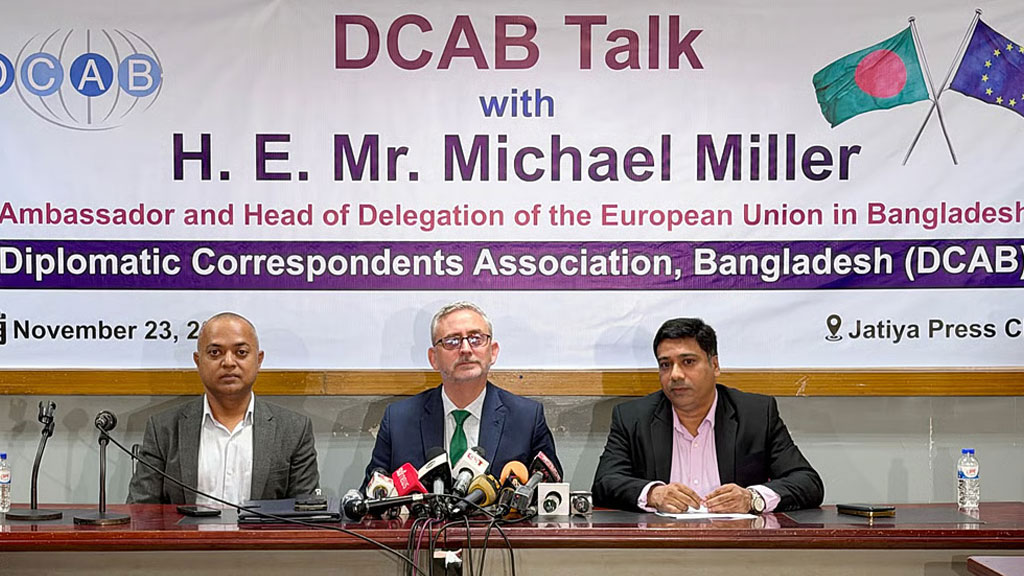
The European Union has no formal position on the banning of the Awami League, the bloc's ambassador to Bangladesh, Michael Miller, has said. Speaking personally, however, he stressed justice, accountability for past human rights violations and the rule of law.
He made the remarks on Monday afternoon while answering journalists' questions at a 'DCAB Talk' event organised by the Diplomatic Correspondents Association, Bangladesh (DCAB) at the National Press Club in the capital.
Asked about the EU's position on banning the Awami League's political activities, Michael Miller said the EU has no formal position here, and that whatever he said would be his own observation.
He said the EU wants a stable and prosperous Bangladesh. In his explanation, stability means justice, ensuring accountability for past human rights violations and showing full respect for the rule of law — and it means renouncing conflict and respecting public order and public safety.
The EU ambassador added that under the previous regime, the place of trust between Bangladesh's citizens and state institutions had been hollowed out. Restoring people's faith in those institutions is now the biggest challenge.
He also said the EU wants to help Bangladesh overcome that crisis.
On the recent programmes of the Awami League, whose activities are in the process of being banned, and on the steps taken by law enforcement agencies to prevent conflict, the EU ambassador said he believed the response had been proportionate.
Explaining the limits of peaceful expression, he said a democratic society will have dissent and freedom of assembly, but there is a limit. If any organisation or individual engages in illegal activities, destroys public order or incites conflict and hatred, that can in no way be acceptable. In his words, freedom of expression is not a licence for conflict.
Describing political transition as a highly complex and long-term process, Michael Miller said not everything can change overnight. Europe's own history also holds difficult experiences of political transition.
He said democracy does not mean only elections or a parliament; it is a matter of trust in state institutions, and extreme firmness must be shown in the reform work needed for that.
The EU ambassador expressed confidence that Bangladesh's security situation is currently fully under the government's control. At the same time, he emphasised greater national consensus among the parties represented in the post-election parliament to build a democratic Bangladesh.
Outlining Bangladesh-EU relations and future plans, the ambassador said Prime Minister Tarique Rahman is scheduled to visit Brussels in June next year.
He added that the EU has formally invited Bangladesh this December itself to open talks on a free trade agreement (FTA), and that an 'EU-Bangladesh Business and Investment Summit' will be held in April next year.
At the start of his remarks, he expressed deep concern over incidents of Bangladeshi citizens being misled or lured into joining the ongoing war in Russia.

