Warm winters and extreme weather threaten Wisconsin cranberries, scientists race to breed new varieties
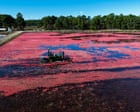
It is harvest time in rural Wisconsin in the United States. But warming winters and extreme weather have raised concern over the future of this fruit, and scientists are racing to identify and breed new varieties that can thrive on an increasingly warmer planet.
For nearly three decades, Nicole Hansen has been farming cranberries here. Wisconsin produces more than 60% of the nation's supply.
Cranberries are one of the few fruits native to North America. Contrary to popular belief, they do not grow submerged in water; instead, they thrive on low-lying vines in dry soil. But when harvest time arrives, the growing beds are flooded. Specialized machines shake the fruit loose, and the buoyant berries rise to the surface.
Hansen said they corral the floating berries. She also said, 'We are checking the weather, I don't know, five to 10 times a day because everything we do is controlled by the weather.'
Across the US, that weather is growing increasingly erratic, due in large part to the human-caused climate crisis. In cranberry-producing states such as Massachusetts and New Jersey, record-breaking summer heatwaves frequently trigger fruit scalding, in which berries literally bake on the vine before they can be harvested.
At the same time, increasingly humid conditions and heavy rainfall during the growing season create stagnant, moisture-rich environments that invite fungal pathogens, resulting in devastating crop rots.
In Wisconsin, the threats often emerge after the harvest is done. To protect the plants from winter's bitter cold and damaging winds, growers spray water over the vines, building up several inches of ice that act as a natural thermal blanket.
Amaya Atucha, a fruit scientist at the University of Wisconsin-Madison, explained, 'So if you don't protect them, they do get cold damage.'
Data from Climate Central shows that winters in the upper midwest are among the fastest-warming in the nation. Cranberry-growing regions now experience an average of 14 more warm winter days than they did in 1970, triggering erratic cycles of thawing and freezing.
Atucha pointed to recent years in which unusually warm February temperatures melted protective ice sheets prematurely, leaving vulnerable vines exposed to sudden deep freezes.
To keep this seasonal favourite on holiday tables, scientists and growers are racing to adapt. Researchers are leveraging artificial intelligence to identify and breed new, resilient crop varieties capable of withstanding extreme weather and disease. Meanwhile, growers are integrating advanced technology into their daily operations, utilising drones to precisely apply fertilisers and monitor temperatures.
Atucha said, 'When you have a system that works and then out of nowhere you change the rules of the game, then you need to adjust.'