93% of Germs Found in ICUs Resist Multiple Antibiotics, IEDCR Surveillance Shows
Ninety-three percent of the germs identified in intensive care units (ICUs) of hospitals in Bangladesh are resistant to multiple antibiotics, according to surveillance data from the government's Institute of Epidemiology, Disease Control and Research (IEDCR). The data also show that the effectiveness of powerful antibiotics used to treat severe infections is declining.
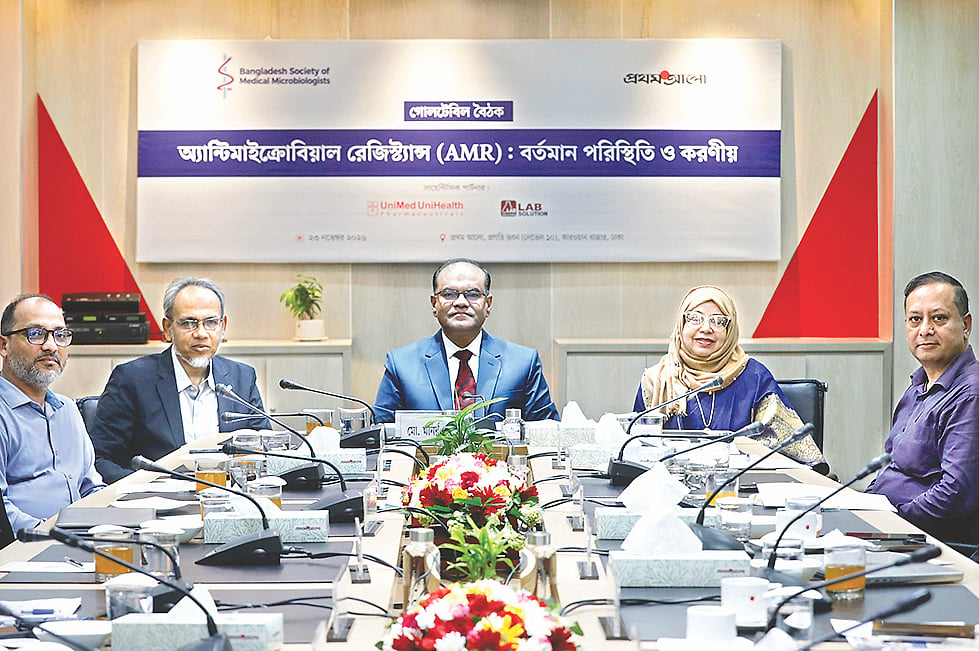
The figures were presented on Monday at a roundtable titled 'Antimicrobial Resistance (AMR): Current Situation and What Needs to Be Done', held at the Prothom Alo office in Karwan Bazar, Dhaka. Physicians, researchers and university teachers took part. The event was organised by the Bangladesh Society of Medical Microbiologists (BSMM), with Prothom Alo as publicity partner and Unimed Unihealth Pharma and Lab Solution as scientific partner.
The keynote presentation was given by Professor Zakir Hossain Habib, chief scientific officer of the IEDCR. He said germs' resistance to antibiotics is rising in the country. According to the institute's national AMR surveillance, 93 percent of germs identified in ICUs are multidrug-resistant. AMR occurs when a germ develops resistance to a drug that previously killed it or stopped its growth.
According to the surveillance, resistance of Klebsiella pneumoniae — which causes pneumonia, urinary tract and bloodstream infections — to the antibiotic imipenem was 14.7 percent in 2022 and rose to 41.3 percent in the first six months of 2026. Over the same period, resistance to meropenem rose from 16 percent to 37.8 percent.
Resistance has also risen in E. coli, which causes diarrhoea and other infections. Resistance to imipenem increased from 7.5 percent to 13.5 percent, and to meropenem from 9.3 percent to 11.1 percent.
Over the same period, germs' sensitivity to several antibiotics fell. Sensitivity to amikacin dropped from 86 percent to 70 percent, to amoxicillin-clavulanate from 54 percent to 46 percent, to ampicillin from 39 percent to 31 percent, and to ceftriaxone from 52 percent to 45 percent.
Sensitivity to ciprofloxacin fell from 50 percent to 35 percent, to imipenem from 86 percent to 68 percent, and to meropenem from 84 percent to 74 percent. Sensitivity to gentamicin, however, rose from 56 percent to 68 percent, and to linezolid from 88 percent to 93 percent.
Professor Naima Moazzam, former head of the microbiology department at Dhaka Medical College, said that although new-generation antibiotics are being developed, rising bacterial resistance is complicating treatment. The crisis cannot be tackled by controlling antibiotic misuse alone. Human health, animal health, plants and the environment are interconnected, so a coordinated initiative by experts from all related sectors — physicians, microbiologists and environmentalists — is needed under the 'One Health' concept.
Professor Mohammad Rafiqul Islam of the urology department at Bangladesh Medical University stressed public awareness, ensuring drug quality and hospital-based infection control to prevent antibiotic resistance. He said the public must be made aware so that antibiotics are not used without a physician's advice, and that the authorities must play an effective role in ensuring antibiotic quality control and quality assurance. He also believes the risk of antibiotic resistance can be reduced significantly if sources of infection in hospitals are controlled.
Professor Abdullah Yusuf, head of the microbiology department at Dhaka Medical College and general secretary of BSMM, highlighted rapid and accurate laboratory diagnosis and diagnostic stewardship in preventing AMR. He said proper treatment can be ensured through rapid identification of germs and selection of effective antibiotics, which requires regular communication and coordinated work between microbiologists and physicians.
Proposing the introduction of modern diagnostic technology and multiplex testing, Abdullah Yusuf said some infection-causing germs can be identified much faster this way than with conventional methods. He added that quality reagents and chemicals must be supplied, government allocations used properly and laboratory infrastructure developed to ensure testing reliability.
The meeting was moderated by BSMM vice-president Brigadier General Md. Monirul Haque. He said many people are dying prematurely because of AMR and that these deaths are deeply painful. He blamed the sale of antibiotics without a physician's permission, 'like puffed rice and candy', as one cause, and asked when this practice would stop.
Mohammad Nayeem Goldar, director (in charge) of the Directorate General of Drug Administration, said the directorate is implementing various legal and regulatory activities to tackle antibiotic resistance. Initiatives have been taken to expand bioequivalence testing to ensure drug quality and to make data-based policy. Data on human antimicrobial use and consumption have been collected since 2022, and on veterinary antibiotics used in livestock since 2023; work is under way to formulate an effective policy to control antibiotic use by analysing this data.
Others who spoke included Dhaka University microbiology professor Muhammad Manzurul Karim, Jahangirnagar University professor Md. Salekul Islam, Mugda Medical College microbiology department head Professor Adnin Mourin, Uttara Adhunik Medical College professor Mahfuza Nasrin, Dhaka Medical College surgery professor Ahmad Sami-Al-Hasan, senior consultant of the infectious diseases hospital in Dhaka Ariful Basar, and Fahmida Chowdhury, head of the AMR research unit of icddr,b's infectious diseases division. Prothom Alo assistant editor Firoz Chowdhury gave the introductory speech.
At the meeting, experts stressed stopping the misuse of antibiotics, rapid diagnosis and coordinated initiatives by the related sectors.