Fake firms' lucrative job ads used as a trap to extract US secrets, CNN investigation finds a vast network
An investigative report by the US news outlet CNN has uncovered an extensive operation using lucrative online job advertisements as a trap to extract United States secrets. According to the report, suspected Chinese spies are creating fake firms and advertising job openings.
Their main goal is to lure current and former US government officials into a trap and try to draw out secret information from the US government. Some of this activity had been suspected before, but the scheme uncovered by CNN's investigation is far more extensive than previously understood.
CNN spoke with 12 people who fell into this recruitment trap. Analysing the suspicious fake websites, the outlet also learned that an even larger group is now being targeted for sensitive US information: the thousands of federal workers recently laid off by the Trump administration.
Several former officials said these federal workers lost their jobs without adequate guidance or protection against espionage traps. As a result, they have become potentially valuable assets for Beijing, and a major point of vulnerability for Washington has been created.
The suspected operation does not resemble conventional covert espionage; ordinary job websites such as LinkedIn are being used to contact potential targets. Alongside government employees, journalists, business consultants and many others have also been targeted by the scheme.
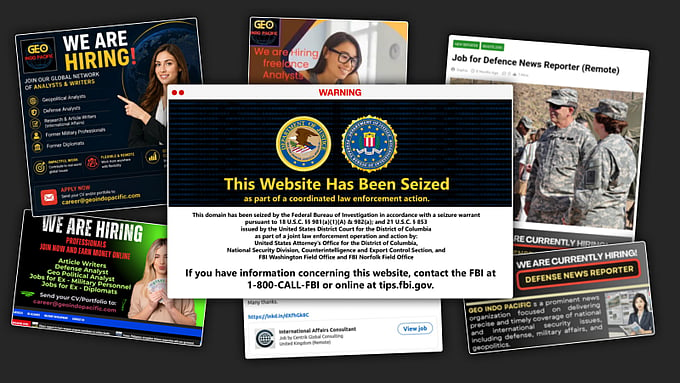
In June this year, the FBI shut down 13 such websites. US officials claim the websites were linked to fake consulting firms, which gives some idea of how the fraudulent recruitment operation was run.
China has denied allegations that Chinese agents tried to recruit US officials. CNN contacted the Chinese embassy in Washington DC for comment. An embassy official said: 'I am not aware of the matter you asked about. Beijing opposes smearing China by spreading the narrative of so-called "Chinese espionage".'
However, beyond the websites shut down by the FBI, CNN found several more websites whose nature and content resemble those that were closed.
Max Lesser, a senior analyst at the research organisation Foundation for Defense of Democracies, found two more websites and gave their details to CNN. The two websites share similar web infrastructure with the sites seized by the FBI, and other links were also found.
In total, Lesser found more than 100 web domains, many of which resemble the websites shut down by the FBI. Lesser told CNN that the activity of this extensive network clearly bears the hallmarks of a Chinese intelligence operation.
Even after Lesser made the information about these domains public in November 2025, most of the websites remained active for several months and continued business operations. However, he said several of them were shut down last month.
Referring to the 13 domains shut down by the FBI in June, Lesser told CNN that those 13 domains were only the tip of the iceberg, and that when such domains are flagged, the US government should step up efforts to act quickly. Experts said US authorities have so far shut down only a small part of this fraudulent activity.
An FBI official said the agency's investigation into this activity is continuing.
The investigation also brought forward the experience of former Pentagon worker Wes Bryant. In January 2025, he suddenly received an email from someone identifying himself as an employee of a Malaysian research firm called MRDA. The email read: 'I was truly impressed by your experience and background in the military field. We are interested in working with leading experts to help strengthen security in Malaysia and the wider region.'
Bryant initially ignored the email; he was still working at the Pentagon at the time. But two months later he needed a new job. He decided to try working with the supposed research firm, while also asking former Pentagon colleagues about it. He prepared a general report on what steps the Trump administration might take regarding security agreements with Australia and the United Kingdom, including only unclassified information.
For this work, an MRDA representative named 'Lily' paid Bryant $1,200. Lily later told him that an unnamed client who read the report felt there was 'room for improvement'. Bryant came to believe he was being coaxed in this way to draw out more sensitive information.
Around the same time, Bryant's former colleagues told him that no firm named MRDA existed. They also said 'Lily' had contacted several other Pentagon workers. Bryant then tried to surveil Lily herself and gather intelligence on her; after that, Lily did not contact him much again. CNN attempted to contact Lily and MRDA for comment.
According to Lesser's analysis, MRDA's website used Chinese-language fonts. In addition, a photo posted by a representative of the firm carried the watermark of RedNote, China's popular social media platform.
In the first year after President Donald Trump returned to the White House for a second term, several hundred thousand US government workers lost their jobs through layoffs, resignations and other causes. It was the first time in decades that so many government workers lost their jobs at once, suddenly swelling the number of unemployed people in the Washington DC area who held security clearances.
Referring to the mass layoffs, a former senior US intelligence official told CNN: 'We created a vulnerability that did not need to exist. Without the preparation and protections needed to confront China, we created an opportunity for them to reach our thousands, even hundreds of thousands, of people.'
Holden Triplett, who served as director of counterintelligence at the US National Security Council during Trump's first term, believes the US government is not doing enough to protect former employees from such espionage traps.
The fake firms follow a specific method. According to court documents, they often use artificial intelligence (AI) and stolen identities to build attractive, professional-looking corporate websites. They then post job advertisements on sites such as LinkedIn with vague descriptions for consulting roles on various China-related topics, offering attractive salaries.
When a former US government official or private consultant applies for such a job, in some cases they prepare research papers for the fake firm without knowing who the real client behind the hiring organisation is. The report notes that with dozens or hundreds of such research papers on topics of interest to Beijing, it becomes possible to gain a much clearer picture of US national security policy and its weaknesses.
CNN previously reported that foreign powers such as China and Russia try to exploit such situations, directing their intelligence agencies to step up efforts to recruit people working in the US national security sector, especially those who have lost their jobs or are at risk of losing them.