From Kitchen Waste to Fertiliser and Neem-Leaf Pesticide: Sarma Rani's Poison-Free Farming Success
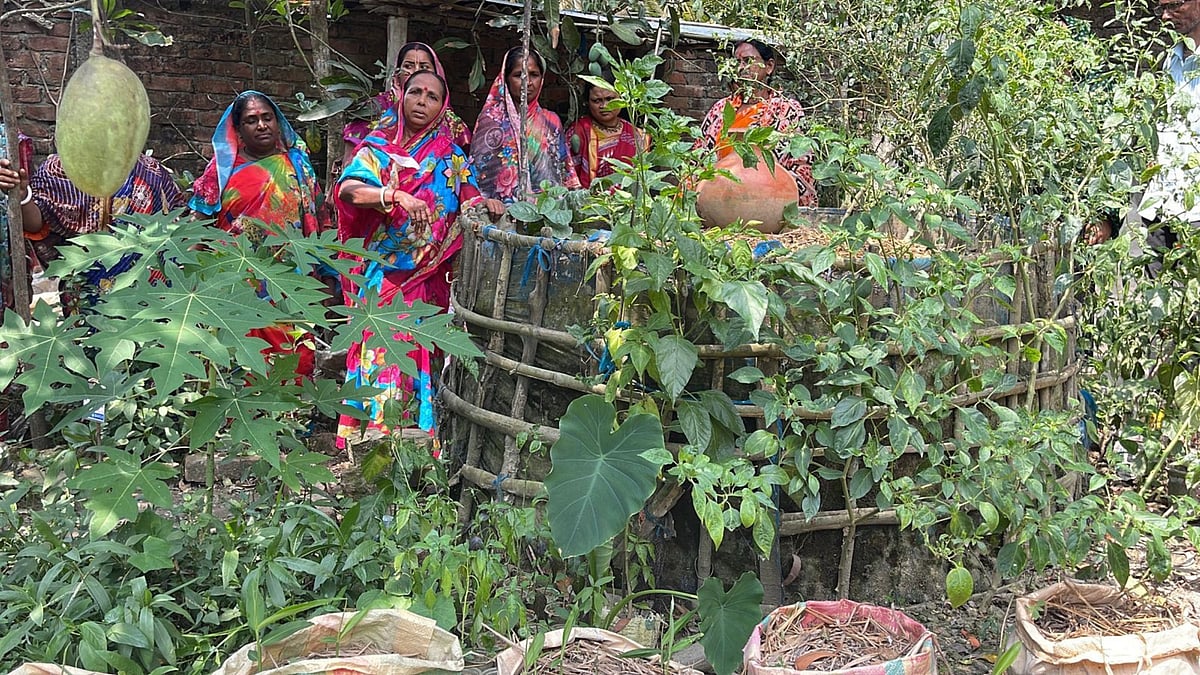
In a corner of the yard of Sarma Rani (48), in Mathurapur village of Munshiganj union under Shyamnagar upazila in Satkhira, there is a pit. Inside a round bamboo fence on the ground, kitchen waste, vegetable peels and grass have been left to rot into chemical-free fertiliser. On the other side, Sarma herself is grinding neem leaves and garlic into a pesticide. All around are rows of vegetables and fruit trees, and many varieties of chilli. The seeds of these crops are also preserved in this very house.
The scene was seen on a visit to Sarma Rani's home last Sunday. She grows poison-free vegetables on the 33 decimals of land of her homestead.
Sarma's husband, Bimal Mondal, is physically weak and cannot work, so the responsibility of the household rests on Sarma's shoulders. The regret of her own schooling ending in class ten drove her resolve to educate her children. Sarma says: 'I have three daughters and one son. My eldest daughter has passed her BA, the youngest has passed secondary school, and I educated my middle daughter up to class nine. They are married. My son is now studying for his master's.' At one time her family believed education had no tradition in their lineage; she says she educated her children as best she could in order to change that idea.
Sarma also explained why she turned to poison-free farming. As the use of chemical fertilisers and poisons rises in the country, so do various diseases, with the elderly, women and children affected the most. She felt that to escape this, people must return to producing poison-free vegetables.
There are no cattle or goats at home, and therefore no cow-dung fertiliser. Sarma found the solution herself. She says: 'There are no cattle or goats at home with which to make dung fertiliser. So I rot kitchen waste and vegetable peels to make organic fertiliser. This way I do not have to buy chemical fertiliser, and the cost falls a lot too.'
Sarma's home grows many kinds of vegetables, including puishak, datashak, lalshak, palongshak, radish, beans, borboti, taro, ol, chilli, ginger and big taro. She has also preserved 16 varieties of leafy greens that grow naturally on field ridges and fallow land, among them kulekhara, matifora, thankuni, boutuni and adabaran.
Sarma's journey began in early 2018 with the support of the Bangladesh Resource Centre for Indigenous Knowledge (BARCIK). After taking training from the non-government organisation, she eventually became a trainer herself. From 2019 to now, in about 40 training sessions, she has taught around 600 women in the area how to make organic fertiliser, use natural pesticides and preserve indigenous seeds.
To spread her initiative, Sarma has set up the 'Mathurapur Bakul Krishi Nari Unnayan Sangathan' at her own home. A small bank of indigenous seeds built under the organisation preserves about 80 types of seed. She regularly exchanges seeds with more than 200 women farmers. Her home preserves seeds of 30 types of vegetables, 20 types of fruit and 12 species of chilli. She earns about seven thousand taka a month selling vegetables.
Farmer Dipti Rani of Fultala village spoke of the benefit of Sarma's training. She says: 'I learned to grow crops organically after training from Sarma didi. Earlier my papaya trees did not bear much papaya. Now I am getting a good yield.'
Sarma wants to spread this poison-free farming from her own yard much further. She says: 'I grow and eat poison-free vegetables myself, and I feed others too. If we can move forward this way — first one village, then ward by ward and union by union — poison-free vegetable farming will one day spread across the whole country.'
Shyamnagar upazila agriculture officer Oliul Islam said Sarma Rani's initiative of producing poison-free crops using local seeds, organic fertiliser and natural pesticides is commendable, and that she has set an example in safe farming practice. He said the agriculture department would provide the necessary advice and technical support to spread her experience among other farmers.