Abandoned while pregnant, Gaibandha's Asiya built a business by hawking cloth — and gave work to more than 50 women
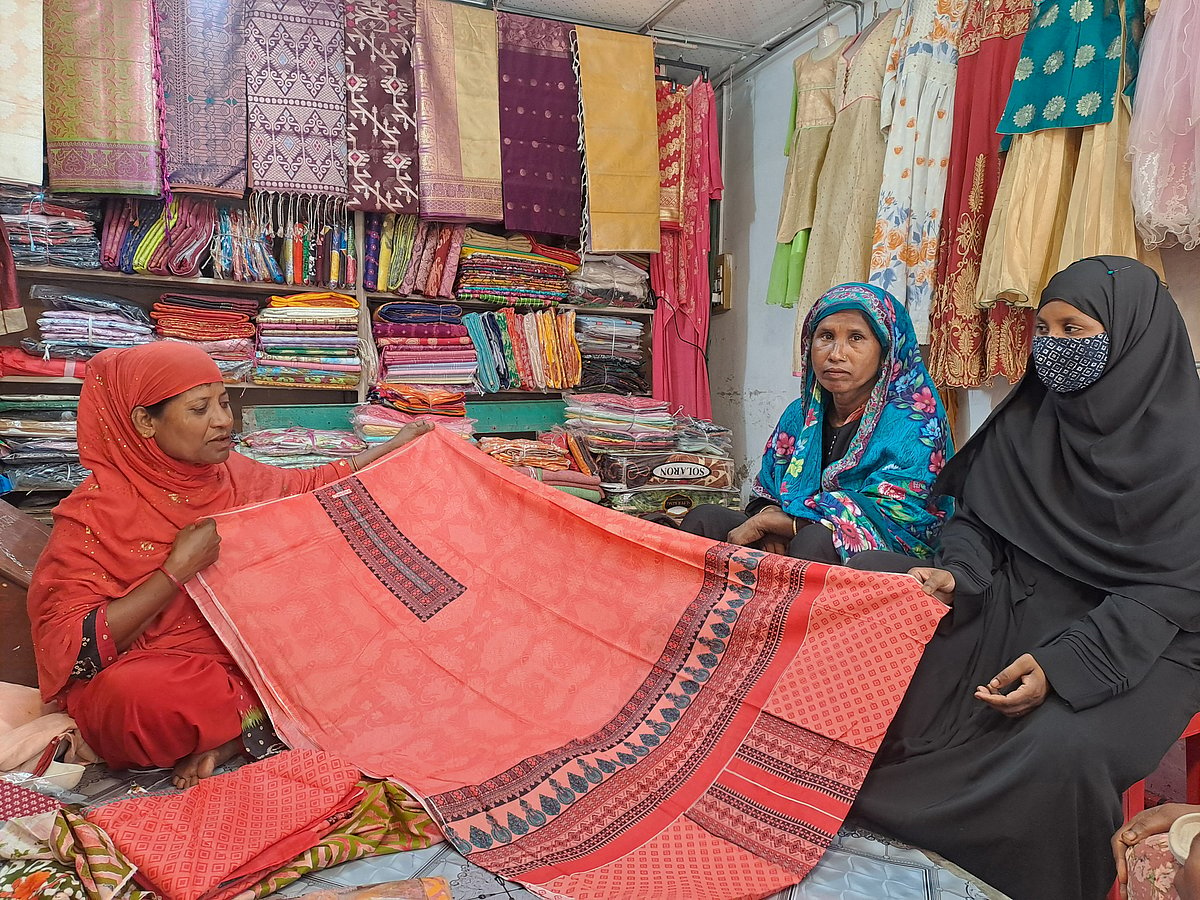
Asiya Begum was married at just 13. Her husband was already a father of three children. A year after the marriage, Asiya became pregnant. When the unborn child was four months old, her husband Nuru Mia left her and moved to Dhaka.
Darkness descended at the very start of the life of this teenage bride from Taluk Falgacha village in Sundarganj, Gaibandha. After her husband left, Asiya became a burden in the household of her day-labourer father. With no other option, she took work as a domestic worker while pregnant. She did that work for four years.
But Asiya's household could not run on it. She then took work as an earth-cutting labourer, which she did for six years. Asiya knew her fortune would not change this way. So she saved a little from her daily wages. In six years, her savings stood at 15,000 taka.
Leaving the earth-cutting work, Asiya started a business in saris, lungis and piece cloth with her 15,000 taka in savings and some borrowed money. She began hawking cloth from village to village. After that, she never had to look back.
After 22 long years of hawking, Asiya Begum rented two shop rooms in Bamandanga Bazar. She named one 'Asiya Bastralaya', where she sells quilt and mattress cloth and cotton. The other she named 'Jui Sari Palace'. At this shop on Station Road she sells saris, lungis, three-pieces, piece cloth and all kinds of clothing.
Asiya buys her stock wholesale from Baburhat, Sadarghat and Islampur in Dhaka. Her monthly income is now 30,000 to 35,000 taka, and the two shops hold goods worth about 10 lakh taka.
Alongside the two shops, Asiya Begum has taken five bighas of land on mortgage. She grows bananas on one bigha, vegetables on another, and paddy on the rest. She has built a semi-pucca house on her one-and-a-half-decimal ancestral homestead. The house has a solar power connection. She also keeps a cow, earning a little from selling milk. Her income supports a seven-member family including her elderly mother Josna Begum.
The son Asiya was carrying when her husband left her, Nazmul Huda, is now over 40. He helps his mother in the business with his wife Shikha Begum. Nazmul took driving training after passing class nine but did not get a job, so he looks after his mother's business. Nazmul said: 'I never saw my father. I am proud of my mother. A mother's debt can never be repaid. And the sacrifice she made for me can never be repaid.'
Asiya Begum's father Abbas Ali was a day labourer; he died 18 years ago. Her mother Josna Begum, 80, lives with Asiya. Josna Begum said they were poor people who could not marry their daughter into a good family, and then her husband left her; her daughter had no education, but she used her wits to start a business and removed the want from their home.
Bappi Chowdhury, manager of Asiya Begum's business, said everyone in the area respects Asiya for becoming self-reliant through hard work. Her shop does not only sell wholesale; clothing worth four to five thousand taka is also sold at retail every day.
Asiya Begum is now 55. She did not want to stop at becoming self-reliant herself. After starting her business, she gave work to more than 50 poor divorced and widowed women in Haripur, Kapasia, Tarapur, Bamandanga, Dahband, Chandipur, Ramjiban and Belka unions of Sundarganj upazila. They buy saris, lungis and piece cloth wholesale from Asiya's shop and hawk them from village to village. She has named these women 'Aparajita' — the undefeated.
Asiya Begum said: 'I was born in a day labourer's home. I know what poverty is. That is why I have given work to more than 50 poor women like me. They buy saris, lungis and three-pieces wholesale from my shop and sell them hawking from village to village. They are self-reliant now too.'
In the early days, more than 50 Aparajitas bought cloth wholesale from Asiya. Now 10 to 12 buy from her. The others have become self-reliant and now buy wholesale themselves from the district town and other places.
Nur Banu, 55, an Aparajita from Taluk Falgacha village in Bamandanga union, said: 'I buy goods from Asiya Apa and sell them from village to village. I have been doing this work for 20 years. I earn about 20,000 taka a month. There is no more want in my family.'
Hasina Begum, 52, an Aparajita from the same village, said: 'One day a week we buy cloth and other things wholesale from Asiya Apa's shop. If we fall short of money when buying cloth, she often gives us cloth on credit.'
Sabiron Nesa, 55, an Aparajita from Charkhordda village in Tarapur union, started her business 10 years ago with 1,000 taka taken as a loan. She said she has repaid that loan and saved 50,000 taka — whereas before she worked as a domestic worker in other people's homes. Fulmati Begum, 55, another Aparajita from the same village, said hawking saris and lungis is more profitable, but she cannot grow the business for lack of capital.
Speaking of the success of these marginalised women, Asiya Begum said: 'Anyone can succeed if they use their wits and work hard. Women are no longer helpless. We too can play a role in the country's development — I myself am proof of that.'