US school bus drivers fall 5% in a year and are down nearly 34,000 from 2019 levels
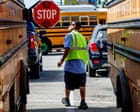
The number of school bus drivers in the US has dropped 5% over the last year, according to a new report, as drivers continue to experience low pay, poor working conditions and school budget shortfalls.
According to an analysis from the Economic Policy Institute, the total number of school bus drivers is down 15%, or nearly 34,000 drivers, compared with 2019 levels.
The 5% decrease from 2025 to 2026 represents a loss of nearly 10,200 drivers and was the largest single-year decline since 2022 for a workforce that transports an estimated 26 million children daily, the largest mass transit program in the US.
Dawn Freedenburg, who has been a school bus driver for 16 years in Chicago, Illinois, said the long process to be trained and licensed can deter new drivers. New drivers must get the proper commercial driver's license (CDL) and undergo extensive training and background checks, a process which requires weeks of unpaid work.
Freedenburg said it is not easy for most people to put that much time into a new job without being paid, especially in this economy.
Once they get the job, wages typically range from $19 to $27 an hour, but most drivers do not average 40 hours per week during the school year and receive no pay during school breaks. She added that few contractors or school districts provide additional benefits such as health insurance.
Freedenburg said her current district guarantees five hours per day for 174 school days a year, but the work can fall anywhere between 5:45 am and 5 pm depending on route assignments. She said there is the possibility of extra work like field trips sometimes, but there are typically more drivers wanting them than trips available.
The decline and ongoing shortages have often forced school districts to cut and consolidate bus routes. According to a 2025 report from the Associated Press-NORC Center for Public Affairs Research, 80% of school districts in the US have been affected by bus driver shortages, with 73% experiencing shortages from budget shortfalls.
Higher diesel costs amid the war with Iran and Russia's war on Ukraine have worsened budget issues, costing school districts an estimated $1.1bn more from November 2025 to October 2026 compared with the previous year.
Wages for school bus drivers dropped in September 2026 by 0.7% from September 2025 after accounting for inflation, while pay for other bus drivers has remained steady. Median hourly pay for school bus drivers was $22.49 in 2026, compared with a median hourly pay of $23.89 for all bus drivers. School bus drivers comprise 39.4% of all bus drivers.
Drivers also say student behaviour has worsened since the Covid-19 pandemic, and school bus drivers are often caught in between the administration and parents, making it difficult to address behavioural issues.
Peter Sandler began working as a school bus driver in 2020 in Connecticut after retiring in 2016, noting that many bus drivers are retirees, which contributes to high turnover rates. As a result of driver shortages, his former contractor consolidated bus routes and increased the number of children per bus.
Sandler said that made buses filled to capacity, which makes the driver's life a nightmare. He also said that with only 5.5 hours of paid work a day and little work when school is out of session, it is economically unfeasible to make ends meet as a school bus driver.
Sandler said that if you add in summer work and charter work, it is difficult to get past $40,000 annually. He said that is not a lot of money, especially in a region where a one-bedroom apartment would cost $1,600 to $1,700 a month in the cheapest communities and over $2,000 a month in better areas.
Antonia Namnath, a school bus driver in the Beaverton school district in Oregon, explained that the shortage is not an issue in her school district because the drivers are paid good wages, with starting wages ranging from $26 to $33 an hour, with annual increases tied to a union contract with the Oregon School Employees Association (OSEA Chapter 48).
Namnath noted that they get a good wage and incredible benefits, including health benefits, vision and dental. She said the drivers have to be greatly compensated for the responsibility they are taking on, which is to transport children safely from point A to point B and manage the students in a safe way.
Melissa Fay France, a school bus driver outside Kalamazoo, Michigan, said the lack of medical insurance and low pay often make leaving the profession an attractive option for drivers. She said that with the responsibility of being a driver and maintaining a CDL, the wages need to match that, and the schools are not living up to their end.