Shenzhou-24 launch succeeds, Pakistan's first astronaut Zeeshan Ali heads to Tiangong station
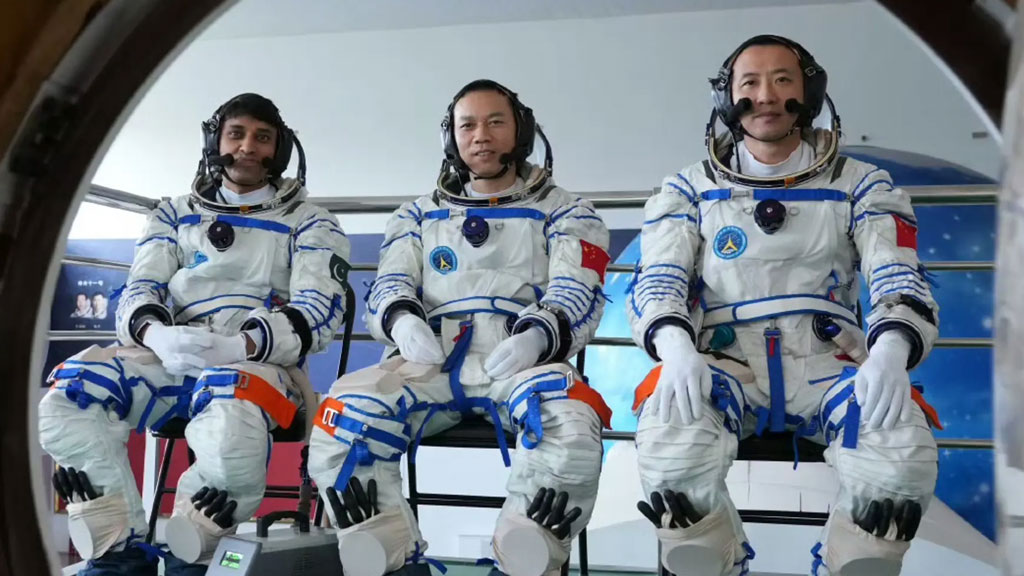
Forty-year-old Zeeshan Ali has made history as Pakistan's first astronaut by travelling into orbit aboard China's 'Shenzhou-24' spacecraft. On Wednesday, the spacecraft successfully entered its designated orbit after launching from China's Jiuquan Satellite Launch Centre.
Video footage from China's state broadcaster CCTV showed a 'Long March 2F' rocket lifting off with the spacecraft at 8:18am Beijing time (5:18am Pakistan time), creating a plume of fire and smoke in a pink-tinged sky.
About 10 minutes after launch, the spacecraft successfully separated from the rocket and entered orbit, the China Manned Space Agency (CMSA) confirmed. An official at the launch centre declared the mission 'completely successful'.
The Shenzhou-24 spacecraft is travelling to China's own space station, 'Tiangong'. Once the spacecraft docks with the station, Zeeshan Ali will become the first foreign national to board Tiangong.
China's Tang Hongbo is serving as commander of the three-member mission, Wu Yi is the pilot, and Pakistan's Zeeshan Ali has joined as payload specialist.
Pakistan's space research agency SUPARCO said Zeeshan Ali would stay in space for about a week and conduct various scientific experiments together with the Chinese astronauts. These include cultivating 'microalgae' as a possible source of food and oxygen for future space missions and testing the effect of space travel on quinoa seeds. The CMSA said the astronauts would conduct about 90 scientific experiments during the whole mission.
Pakistan's planning minister Ahsan Iqbal, who is visiting China, was present in person at the launch ceremony. In a message on social media platform X after the launch, he wrote, 'This morning, 25 November, the launch of Shenzhou-24 carrying Pakistan's first astronaut Zeeshan Ali has begun a new era in Pakistan's space programme. Pakistan's flag is flying in orbit with him, carrying the hopes and aspirations of 260 million Pakistanis.'
He also wrote, 'From highways to information highways and now the skyway — Pakistan-China friendship and CPEC have reached higher than the sky. This is Pakistan's “flight” in space, only the beginning of a bright future.'
Earlier, at a press conference in Jiayuguan on Tuesday, Zeeshan Ali expressed deep gratitude to the Chinese government for helping fulfil his dream of going to space. He said, 'This mission is not a final frontier, but a launch pad. I hope the next chapter of China-Pakistan space cooperation will grow from one astronaut and one flight into joint missions to the Moon, Mars and beyond.'
Addressing the people of Pakistan, he said, 'I am not flying for myself; on my shoulders are Pakistan's name and the dreams of 250 million people. When I am in orbit, let the children watching me look up at the sky and remember that I am there with their dreams.'
Under a cooperation agreement signed in February 2025 between Pakistan's SUPARCO and China's CMSA, Zeeshan Ali and Khurram Daud were selected last April for training in China. Zeeshan Ali was finally chosen from the two for this mission.
China's 'Tiangong' (meaning heavenly palace) space station, fully operational since late 2022, can host up to six astronauts during crew changes. This crew change, however, has an exception. Zhu Yangzhu, commander of the previous 'Shenzhou-23' mission, is not returning to Earth yet; he will stay on the station to assist Beijing's research into how the human body adapts in space. At the end of the mission he will set the record as the Chinese astronaut to have stayed the longest in orbit alone (one year). The other Shenzhou-23 members will return to Earth with Zeeshan Ali.
Notably, China is investing billions of dollars in its space programme with the goal of sending astronauts to the Moon before 2030, where the United States is also competing through its 'Artemis' programme.