Many Women Are Leaving Online Spaces After Cyber Violence, Study Finds
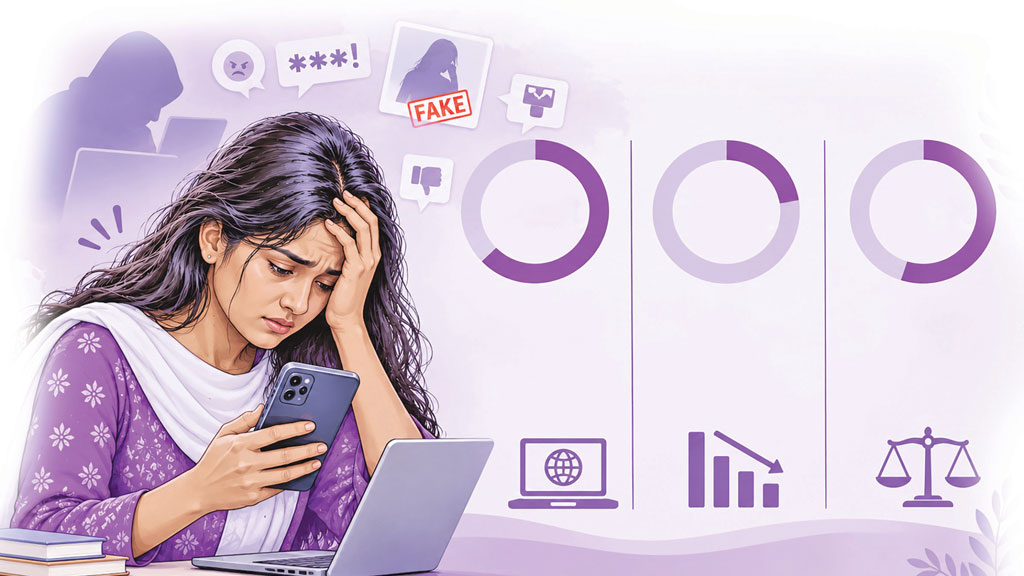
University student Maksuda Elahi (not her real name) posted her opinion on a political issue on Facebook. What followed was a stream of sexually suggestive comments, abuse and rape threats in the comments under her post. Strangers collected her photos from unknown accounts, morphed them and spread them online; the images were even sent to the phones of her family and friends. When her own family began blaming her, she eventually deactivated her social media account, thinking of her peace of mind and safety.
Her experience is far from unique. A study titled 'Abuse Beyond the Screen' by the Bangladesh Mahila Parishad and Digitally Right has found that after facing online violence, a section of women are reducing their participation on social media and in other online spaces. Among the women surveyed, 45.5 percent said they had experienced technology-facilitated gender-based violence (TFGBV). Among active internet users, the rate was 63.7 percent.
One of the study's most alarming findings is that after experiencing online abuse, 21 percent of women reduced their use of social media out of fear, 20 percent cut back their participation in online spaces altogether, and 4 percent were forced to change their studies, jobs or homes. In other words, after becoming victims of an online crime, it is often the victims who must change how they live.
Dr Fowzia Moslem, president of the Bangladesh Mahila Parishad, said violence against women is no longer confined to the home or the street; online spaces have become a new arena for it. New forms of online abuse against women keep emerging, she said, and the violence is affecting women's personal lives, education, professions and freedom of expression.
Abdullah Titir, head of research at Digitally Right, said the study found that many women believe being harassed online is a normal part of using the internet. Society also blames the women who are victimised for the online violence they face. That social attitude, too, forces abused women to stay silent or withdraw from online spaces.
In another case documented in the study, Tamanna (not her real name) worked at a government institution in Pirojpur. Over a personal conflict, a friend of hers spread objectionable photos of her on social media and began blackmailing her with threats to release more photos and videos. She eventually became mentally ill, and her marriage ended in divorce.
According to the study, Facebook and Messenger have become the main venues for online violence in Bangladesh. Among the victims surveyed, 39.7 percent faced violence in Messenger conversations and 36.7 percent on Facebook.
The most common form of violence was harassment and gender-based exploitation, reported by 52 percent of victims. Economic exploitation and fraud accounted for 37 percent, sexual and image-based abuse for 24 percent, and identity misuse and fake-account violence for 17 percent.
The study also found that morphing photos with artificial intelligence, creating deepfakes and blackmailing women with personal photos are all on the rise. Some former partners are using these technologies as tools of control.
The path to remedy is narrow. Among women abused online, 56.5 percent blocked the perpetrator on social media, but only 4.6 percent sought help from the police. Of those who did go to the police, 81.8 percent said their cases had seen very little progress or none at all. And 56 percent of women who reported abuse to the platforms said no action was taken afterwards.
The study also exposed gaps in online safety awareness. Although 71 percent of the participants use the internet actively, 67 percent have never received any institutional guidance or training on online safety. Only 9 percent use two-factor authentication and 5 percent use a password manager.
Among the limitations of law enforcement and the remedy system, the study cited failures to protect complainants' confidentiality, mobile phones being seized for long periods for investigation, and limited digital forensic facilities outside Dhaka. Some victims were even asked to print out sensitive photos and submit them when filing a general diary, the study found.
Miraj Ahmed Chowdhury, managing director of Digitally Right, said: 'We see many women withdraw after becoming victims of this kind of violence. Especially those who work actively in the public sphere—some practise self-control or censorship. Some leave online platforms entirely. As a result, their freedom of expression, participation in social activities and exercise of other rights are obstructed.'
The 16 days of activism against violence against women are observed worldwide from 25 November to 10 December. Women's rights activists say online violence against women must be part of the discussion during this period—because keeping women safe does not mean advising them to stay off social media, but building an environment where a woman can express her views, share her photos and carry on her work and studies without fear.