Garment prices must rise 4-5 percent if Tk 17,000 wage takes effect, seminar hears
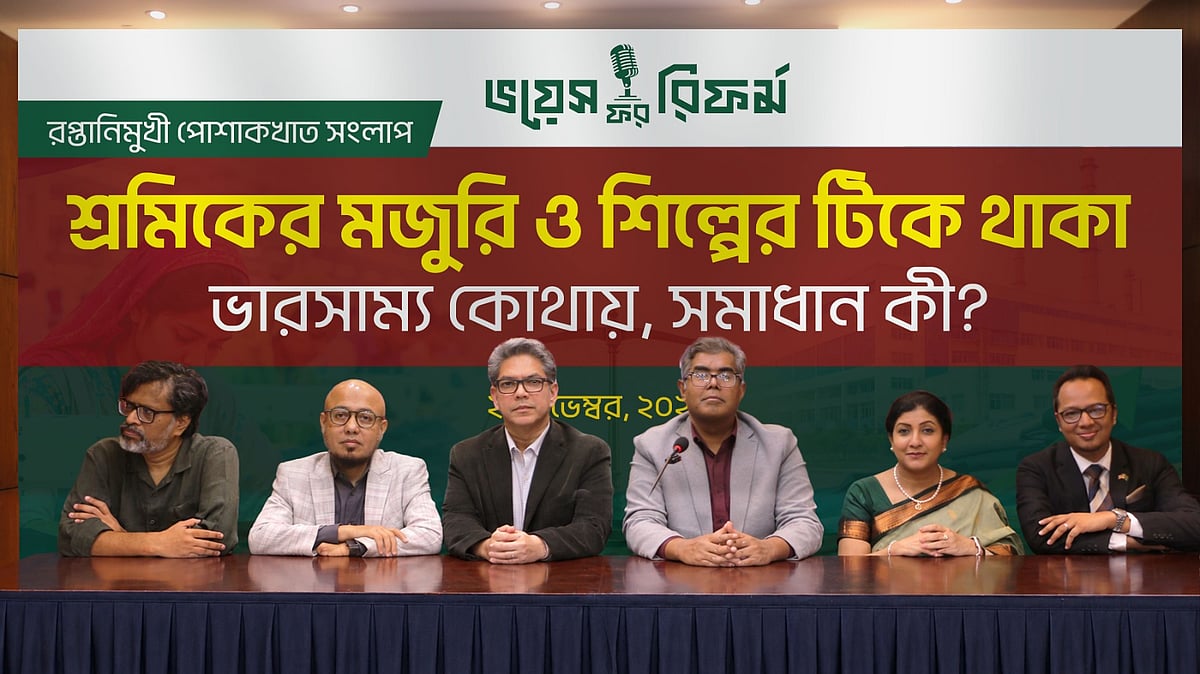
If the new minimum wage of Tk 17,000 takes effect, garment prices will have to rise by 4 to 5 percent, otherwise the industry will struggle to survive — that calculation was presented by researchers and industry figures at a discussion in the capital. The discussion, titled ‘Workers’ wages and the survival of industry: where is the balance, what is the solution’, was organised by Voice for Reform on Wednesday at the BDBL Bhaban in Dhaka’s Karwan Bazar.
M A Razzaq, chairman of the private research organisation Research and Policy Integration for Development (RAPID), said at the event: ‘We have calculated that if a wage of Tk 17,000 takes effect, garment prices will have to be raised by 4-5 percent. Only then can the industry stay where it is now. So keeping this calculation in mind, we must bargain with foreign buyers to raise garment prices.’
Rubana Huq, former president of the Bangladesh Garment Manufacturers and Exporters Association (BGMEA), commented that an unhealthy politics is going on over the labour and industry sector. She said why workers are repeatedly taking to the streets, who is bringing them out and why that cannot be identified is a major weakness of those concerned.
Joining virtually, Rubana Huq said many entrepreneurs’ factories remained closed for 20 to 23 days during the recent unrest in the garment sector, yet entrepreneurs will get no concession when it comes to paying wages — so who will bear the responsibility for this loss, she asked. In her words, the new wage is fine for workers, but nobody is talking about where the extra money to pay it will come from. Foreign buyers are not raising garment prices either. In such a situation, many entrepreneurs may be forced to leave the business within the next few months.
Expressing concern over the survival of small and medium garment factories, she said factories exporting less than $50 million a year account for 51 percent of the country’s total garment exports. If these factories close, a large part of the country’s garment exports will be directly harmed.
Noting that a wage increase is not the only way to improve workers’ living standards, M A Razzaq said that instead of only raising tension between the two sides in the wage discussion, thought must be given to how the process can be modernised and how workers can get more benefits. He believes there is scope to increase workers’ benefits beyond wage increases as well.
Naznin Ahmed, executive director of the Centre for Policy Dialogue (CPD), said a wage board was formed on November 1 and a wage was set by November 25. It should not have happened this way, she said; the announcement of the wage board should have come much earlier, and then worker unrest could have been prevented. Dissatisfaction remains on both sides over the new wage as well, she noted.
BGMEA vice-president Md Shihab Uddoja Chowdhury said: ‘Meeting workers’ existing salaries, bank interest and other costs has put the industry in a very critical state. On top of that, we will certainly try to bear the new burden of cost that has come. But there is a question over how long this industry will ultimately survive.’
Presenting a comparison of workers’ wages in different countries, Panam Institute trustee Rubaiyat Sarwar laid out figures from the international ‘Anker Living Wage’ method for determining a living wage. He said when Bangladesh’s garment workers’ minimum wage was Tk 12,500, they received 56 percent of a living wage without overtime and 69 percent with overtime. With the new minimum wage of Tk 17,000 in effect, workers will get 76 percent of a living wage without overtime, and with overtime it will reach 100 percent, he claimed.
BGMEA director Faisal Samad said that if the new wage takes effect from December, even a small factory’s monthly wage bill will rise by Tk 20 to 25 lakh. In some factories the cost will rise by Tk 1 to 1.5 crore, and for large factories the monthly wage cost will rise by up to Tk 4-5 crore.
To avoid the unrest that erupts every few years over wage fixing, Rubana Huq proposed forming a permanent wage council. She said the council could include entrepreneurs and researchers, and wage adjustment in view of workers’ needs should be kept within an ongoing process.
Agreeing with the proposal, Naznin Ahmed said a move towards a permanent solution is needed, and a system of adjusting workers’ wages every year on the basis of a specific formula could be introduced. Writer and analyst Firoz Ahmed said if wages were adjusted regularly through a healthy and continuous process, society could be freed from the culture of unrest or violence that arises every now and then.
Moderated by Voice for Reform co-coordinator Fahim Mashroor, the discussion was also addressed by RAPID chairman M A Razzaq, CPD executive director Naznin Ahmed, BGMEA vice-president Md Shihab Uddoja Chowdhury, director Faisal Samad, Panam Institute trustee Rubaiyat Sarwar and writer-analyst Firoz Ahmed.