Government prioritising turning livestock sector into an export-oriented industry: PM Tarique Rahman
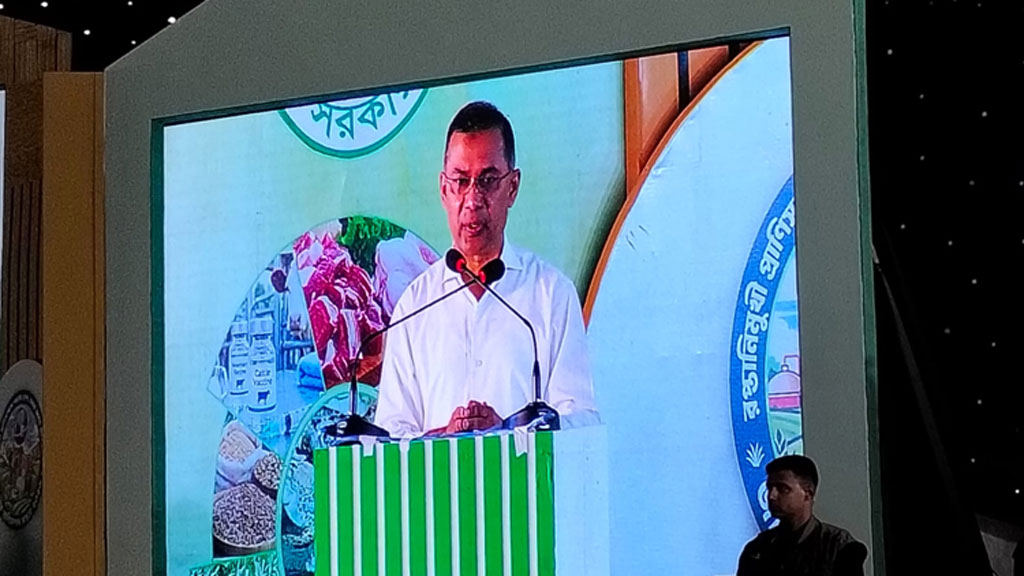
Prime Minister Tarique Rahman has said the government is giving importance to transforming the country's livestock sector into a modern, science-based, production-oriented and export-oriented industry. He said emphasis is being placed on modern technology, improved breeds, artificial insemination, vaccination and better feed and farm management to raise the sector's productivity and economic potential.
The prime minister made the remarks as chief guest at the inauguration of National Livestock Week 2026 at the old trade fair ground in Sher-e-Bangla Nagar in the capital at 11am on Thursday. He had joined the event at 9:30am.
Tarique Rahman said the livestock sector plays an important role in meeting the people's nutritional needs, creating employment, reducing poverty and strengthening the rural economy. Agriculture, fisheries and livestock are among the main driving forces of the country's farm and rural economy. Meeting nutritional demand through domestic production and turning that production into an industry would make building a self-reliant and prosperous economy achievable, he said, adding that it requires goodwill, sound planning and proper implementation.
The prime minister said a nutritionally strong generation develops greater learning capacity, work efficiency and innovative strength. Over the past four decades, countries that ensured nutrition for their people have also made notable progress in physical capacity as well as intellectual and other fields, he said.
Tarique Rahman said the government is working to ensure nutritional security to build a self-reliant and talented nation, and that animal protein is a key precondition. About 65 percent of the animal protein people in the country consume currently comes from milk, meat and eggs, he said.
Outlining the sector's present state, the prime minister said it is no longer limited to rearing cattle and poultry; it is rapidly becoming a commercial, nutrition-safe and export-oriented industry. At constant prices in the current fiscal year, the livestock sector contributes 1.81 percent of gross domestic product (GDP), with a growth rate of 3.30 percent. Its share of agricultural GDP is 16.56 percent.
The prime minister said the sector is gradually becoming export-oriented alongside meeting domestic protein demand. From March to August this year, the sector earned 104.6 million US dollars in six months. He assured that the government's policy and financial support for the sector's development would continue, and thanked the country's farmers, entrepreneurs and others involved.
He said the country now has more than 200,000 poultry farms at commercial and marginal levels, producing about 68.8 million eggs every day. About 6 million people are directly or indirectly involved in the livestock sector, around 40 percent of them women. Private investment in the sector stands at about Tk 50,000 crore, and about 1.5 million marginal farmers earn their living by rearing livestock.
Tarique Rahman expressed hope that if modern farm management, vaccine production, farmer training, research and production-raising initiatives are properly implemented, Bangladesh will be able to earn valuable foreign currency alongside becoming self-reliant in the livestock sector.
The prime minister said there are opportunities in the short term to expand exports of leather goods, animal by-products and approved processed products. Bangladesh has already achieved the capacity to commercially produce hatching eggs and chicks for the first time, and exports of fertile eggs have begun. There is wide potential ahead to expand export markets for international-standard halal meat, dairy and poultry products, he said.
Calling disease a major obstacle for the sector, the prime minister said vaccines for 17 diseases are currently produced at the livestock research institute, but that capacity is not sufficient. The government has therefore taken an initiative to establish a modern vaccine production plant, he said.
The prime minister also raised the potential for buffalo rearing in coastal areas and in the haor regions of Sylhet and Sunamganj. He said newly emerged chars and government khas land in those areas could be settled for farmers' use, and called on the fisheries and livestock ministry to take coordinated steps with the land ministry and the district administrations concerned.
Emphasising animal rights and welfare, Tarique Rahman said animals must be kept free from hunger and thirst, protected from discomfort, pain and injury, and given the opportunity to express natural behaviour. They must also be kept free from fear and mental suffering, he said.
Calling for an end to cruelty to animals, the prime minister said people sometimes torture animals without reason. To stop such behaviour, children should be taught compassion for animals from within the family, he said, urging everyone to be aware that animals should not be made to suffer even when they cannot be cared for.
The prime minister added that food safety and international quarantine standards must be strictly ensured for the country's animals and animal products to enter international markets. The government is working to build modern international-standard animal product processing centres and disease-free zones, he said.
Outlining the purpose of National Livestock Week, Tarique Rahman said the event presents the sector's problems, potential and successes to the public. He said the government is taking all-out initiatives to ensure farmer training, easy-term loans, improved technology, fair prices and necessary government support.
At the event, the prime minister presented the National Livestock Award to 23 individuals and institutions in eight categories in recognition of contributions to the sector's development. Gold medal recipients received Tk 50,000 and silver medal recipients Tk 30,000 along with their medals. They later joined a group photograph with the prime minister.
The event was chaired by Fisheries and Livestock Minister Mohammad Amin Ur Rashid. State Minister for Fisheries and Livestock Sultan Salauddin Tuku spoke as special guest, and the ministry's secretary Md Delwar Hossain delivered the welcome address. Khairul Kabir Khokon, chairman of the parliamentary standing committee on the fisheries and livestock ministry, and Mohammad Iqbal Hossain, president of the Bangladesh Dairy and Fattening Farmers' Association (BDFFA), also spoke.
The formal proceedings began with the national anthem and readings from holy scriptures. A documentary was then screened on the sector's future potential and development, and on the contributions of Shaheed President Ziaur Rahman and the late Begum Khaleda Zia to the sector. The prime minister later toured the stalls of the livestock exhibition and formally inaugurated National Livestock Week 2026.
The fisheries and livestock ministry and the Department of Livestock Services organised this year's National Livestock Week under the theme of building the country with export-oriented livestock, with Bangladesh first. A three-day livestock fair and exhibition has been arranged at the old trade fair ground, with 64 stalls and six pavilions. Alongside the central fair in the capital, National Livestock Week is also being observed in all 64 districts and at upazila level through various programmes.