The Fiery-Orange 'Orange Bird': One Shrub with Many Names and Nectar-Filled Blooms
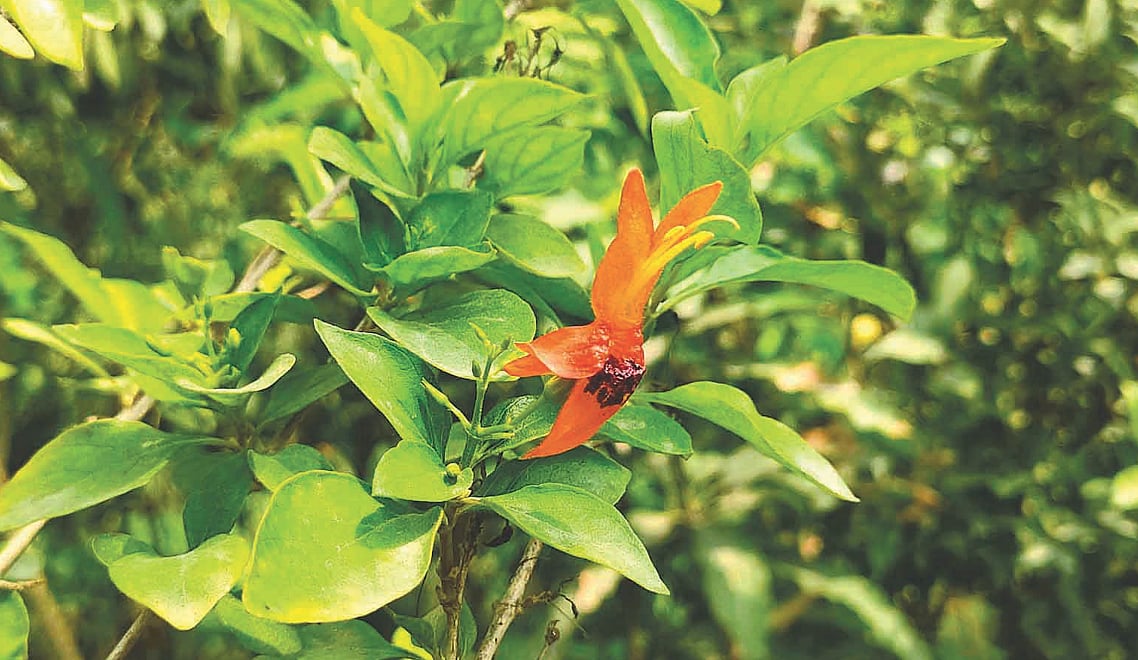
At the Jungle Nursery Agriculture Centre in Boyra, Khulna, an unfamiliar flower caught the eye on April 4 last year — each of its petals looks different. At times it resembles a bird, at other times a molten stream of glowing lava or a flame of fire. The fiery-orange flower looks like a flying bird, which is why its English name is 'Orange Bird'.
The same flower has many other names. Its flame-like appearance earned it the name 'Lava Flowers'. A shiny black mark near the flower's mouth gave it the name 'Jammy Mouth' — as if blackberry jam were smeared on bread. Two upright petals look like a rabbit holding up its two cautious ears, hence the name 'Rabbit Ears'. Hummingbirds and sunbirds come to drink its nectar, so it is also called the 'Hummingbird Plant'.
The plant belongs to the Acanthaceae family and its species name is Ruttya fruticosa. The first part, 'Ruttya', is named after the English physician and Irish naturalist Dr John Rutty (1697–1775). The second part, 'fruticosa', comes from Latin and means 'bushy' — the plant was named so because of its bushy growth habit.
It is an evergreen or semi-deciduous, fast-growing shrub that can grow up to 3 metres tall. Its bark is silvery or grey-brown, smooth, with a few small bumps. Many branches grow out of the stem in a sprawling manner, and some branches sometimes show a climbing habit. Altogether, the plant eventually takes on a quite bushy form.
The leaves grow in opposite pairs on the branches. They are simple, oval to elliptical, 6 to 10 centimetres long, with smooth or unbroken edges and tips ranging from pointed to somewhat blunt. The leaves are glossy — dark green on the upper surface and pale green below — with a small stalk.
Flowers bloom in clusters at the tips of branches, with up to five flowers in a cluster. The flowers are tubular and two-lipped, about 5 to 7 centimetres long. Their colour is bright orange or yellowish-orange, and the throat or base of one petal carries a dark maroon or black dotted mark. The flower has two lip-like petals above and three lip-like lobes below; the middle lobe of the lower lip bends downward and forward.
The beautiful flowers are full of nectar, which drips from them. Many people pluck the flowers and suck the sweet nectar. Flowers bloom almost all year round, but mainly in spring, summer and autumn. The flowers have no fragrance, but they have a varied form.
Its fruit is an oval or elliptical brown capsule. When ripe, the fruit splits and scatters the seeds far away; each fruit contains four seeds. Seedlings grow from the seeds. Cuttings can also be made by cutting mature stems at the start of spring or summer. A plant grown from seed takes three to four years to flower, but a plant grown from a stem cutting flowers the following year.
The plant is native to north-eastern and eastern tropical Africa, especially Ethiopia, Kenya, Somalia, Tanzania, Uganda, Djibouti, Oman and Yemen. It is hardy — it survives with little care, and it brings variety to any garden.