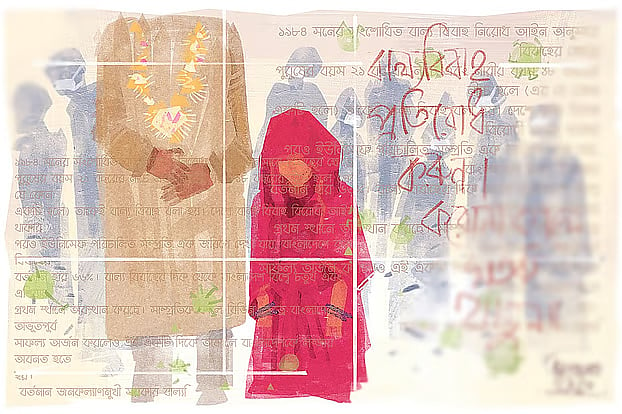
Reports of child marriage fall by up to 40 percent, fears grow of secret marriages rising
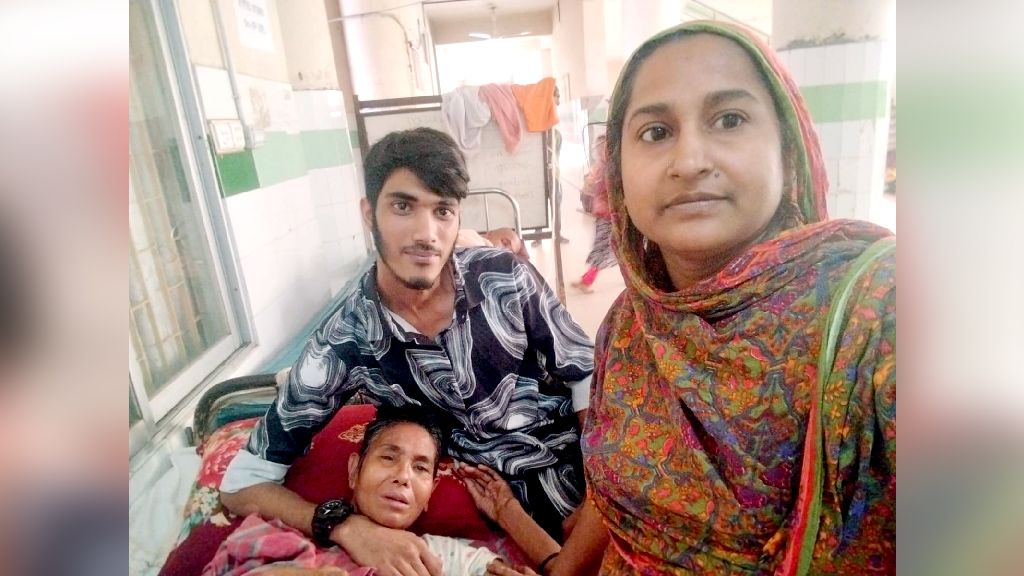
"I wanted to study. I did not agree to the marriage. I said, I am an adolescent. I am not old enough." The words are those of a girl who was a victim of child marriage. Her name is being withheld for her protection.
The schoolgirl was president of an adolescent club in her own area. She used to make other girls aware of the harms of child marriage, and every three months she held meetings in their home courtyard to raise awareness against violence against women and child marriage. Last year, three months before she was due to sit her SSC examination, her parents forced her into marriage.
The girl, from Rangabali upazila in Patuakhali, spoke yesterday, Thursday. She comes from a poor family. Hearing of her eagerness to study, the groom's side had said they would bear her education costs after the marriage. But within a month of the wedding, her husband began pressuring her for dowry for his business. Facing abuse, the marriage ended in divorce within three months.
The club she led is run by the local NGO Village Education Resource Centre (VERC) with support from the Manusher Jonno Foundation. VERC project officer Kaniz Sultana said the girl was taken to her grandmother's house and married off suddenly; they had received no news of it. She said that even knowing it is a punishable offence, many people arrange child marriages in secret, and do not even pass on news of another family's child marriage arrangements.
Several people speaking from field-level experience said news of many child marriages is not reaching government offices, and fewer complaints are being made to the national emergency service as well. Comparing the last three years, complaints and preventions have fallen by up to 40 percent.
According to the Department of Women Affairs, 1,846 child marriages were prevented in 2023, 1,474 in 2024, 968 in 2025, and 479 in the six months from January to June 2026. Figures for preventions after June have not yet been compiled. Three years ago, an average of five complaints arrived per day; the number is falling every year.
Figures from the national emergency service '999' show that calls reporting child marriage have also steadily declined. There were 6,499 such calls in 2023, 4,109 in 2024 and 3,045 in 2025, while 2,548 calls came in from January to August this year. Comparing three years, calls that once averaged 18 a day now average 11 a day.
People who work on child marriage say fewer complaints and fewer preventions do not mean child marriage itself has fallen. Rather, the rate of secret child marriages may be rising. They have called on the government to take further initiatives to prevent child marriage.
Against this backdrop, today, 27 November, the 'International Day for the Elimination of Child, Early and Forced Marriage' is being observed for the first time. On 4 September, the UN General Assembly adopted a resolution declaring 27 November as this day.
According to the Multiple Indicator Cluster Survey (MICS) report published last November by the Bangladesh Bureau of Statistics (BBS) and UNICEF, one in every two girls in the country is a victim of child marriage. The rate of marriage among girls under 18 across the country is 56 percent, and Bangladesh has the highest child marriage rate in South Asia.
According to the report, adolescent motherhood has also risen because of child marriage. The rate of adolescent mothers giving birth is 92 per thousand. At the current pace, it will take more than 64 years to end child marriage.
On 3 November, at his office, Women and Children Affairs Minister Abu Jafar Md Zahid Hossain said the government has plans to take effective steps to prevent child marriage, and that local people's opinions will be taken for this purpose.
Yesterday, a mother in Rangabali upazila spoke who has married off two daughters in child marriages without any prevention. The mother has three daughters and a son; her husband is a day labourer. Last year she married off her daughter who was an SSC candidate. Hearing news of the wedding, local representatives and NGO workers came and prevented the child marriage once. Because of that, two months later she took the girl to her aunt's house and married her off there. About three years earlier she had married off another daughter who was in class nine; that girl now has a child. In her words: "I will not marry off the next girl in a child marriage. She is in class eight. Let her study."
Catherine Breen Kamkong, the UNFPA representative in Bangladesh, said government services have no integrated database, so a fall in complaints at one office does not mean complaints have fallen overall. One reason complaints are falling is that people are now complaining less. Stopping one child marriage does not end the risk. There is no monitoring after a child marriage is stopped, and in many cases families take the girl elsewhere and marry her off. Complainants feel there is no benefit in complaining, and they are afraid if their identity is not protected.
In July this year, Layla Khandakar, convener of the organisation 'Shishurai Shob', went to the Kunder Para char area of Gaibandha and the Haluakandi char area of Sirajganj to understand the child marriage situation. She said: "Going there, I felt the child marriage situation is at an alarming level. The most worrying thing is that everyone is taking child marriage as normal, and giving up, thinking it cannot be eliminated. As a result, complaints are not coming in proportion to how much it is happening." She added that adolescent groups used to phone in reports and go together to stop child marriages; that is no longer seen. Instead, groups have been opened on social media campaigning in favour of child marriage.
Soma Dutta, programme manager at the Manusher Jonno Foundation, says field experience shows child marriage has not decreased. Working on the reasons why child marriage happens, not just raising awareness, would reduce it, she said. She added that many girls in remote areas have to travel long distances for secondary education after finishing primary school, leaving families feeling insecure. Addressing that insecurity, alongside social customs and poverty, would bring child marriage down.
Under the Child Marriage Restraint Act 2017, a marriage is a child marriage if the girl is under 18 and the boy under 21. The law provides for up to two years' imprisonment for contracting, solemnising or conducting a child marriage. However, under the special provision in section 19, in special circumstances, in the best interest of the minor, with a court order and the consent of parents or guardians, such a marriage will not be considered an offence.
UNFPA representative Catherine Breen Kamkong has called for amending section 19, saying it gives child marriage a route to legitimacy. Child marriage, she said, is harmful to a girl's health, education and safety.