Defying the ban, Indian viewers are hooked on Pakistani drama 'Dar-e-Nijat'
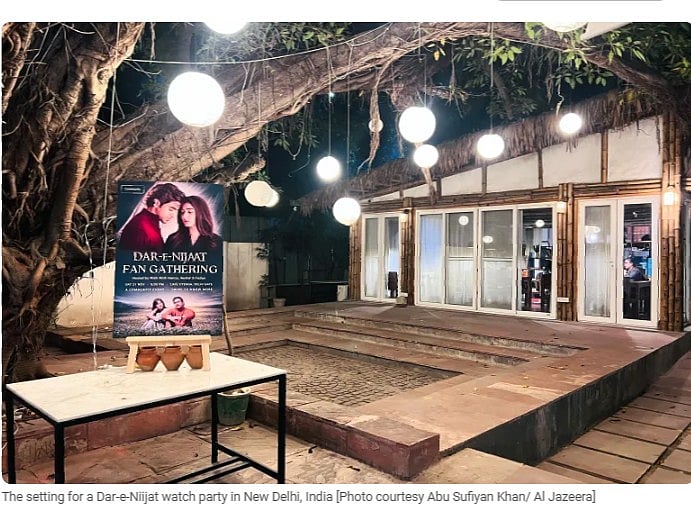
Cultural entrepreneur and curator Abu Sufiyan Khan recently organised a screening in India's capital New Delhi of the Pakistani romantic drama 'Dar-e-Nijat'. It was a private event. He had expected at most 45 viewers, but more than 700 people applied to attend. Sufiyan was astonished by the response.
Like all other Pakistani dramas and songs, 'Dar-e-Nijat' is officially banned in India. Yet every weekend Indian viewers exchange clips of scenes from the serial on Instagram and discuss its episodes. Their enthusiasm is especially strong for Abu Bakar, one of the drama's main characters.
The story centres on a young woman, Zariab, and Jamil, the love of her childhood. After distance grows between her and Jamil, Abu Bakar enters Zariab's life and fills the emptiness.
It is not only online: group viewings of the drama are being organised in different parts of India. At least two screenings had been arranged for next weekend in the southern city of Bengaluru, but they were cancelled after the event posters came to the authorities' attention. As the drama's popularity grows, a kind of cat-and-mouse game is under way between police and organisers trying to stop such events.
Despite the restrictions, Indian viewers' interest has not waned. A line has become popular on fan pages and in comment threads: 'Sabr ka phal nahi, Abu Bakar chahiye' — 'I don't want the fruit of patience, I want Abu Bakar.' The line playfully alters a familiar Urdu proverb.
Bengaluru resident and fan Rakshanda Mujib said: 'We were all waiting for someone like Abu Bakar. I am deeply taken with the character, because he understands other people's feelings. That quality is missing in most men these days.'
Abu Sufiyan Khan said: 'Indians cannot contact Pakistani artists on Instagram. They cannot listen to Pakistani songs on Spotify. And without a VPN or proxy they cannot watch Pakistani dramas on YouTube either.' Yet for many, the appeal of banned Pakistani culture is so strong that they are willing to risk violating the government ban.
India and Pakistan have fought several wars and relations between the two neighbours have remained tense almost throughout. Despite that, cultural exchange between the two countries has continued for decades, although both sides have imposed restrictions on cultural activities at various times. Over the past decade, an unofficial ban on Pakistani artists' work and performances in India has steadily grown, especially after Prime Minister Narendra Modi's government adopted a policy of reducing contact with Pakistan to almost the lowest level.
The situation deteriorated again in April 2025, when gunmen killed 26 tourists in Pahalgam in Indian-controlled Kashmir and India blamed Pakistan for the attack. The craze for 'Dar-e-Nijat' is the latest example of the popularity of Pakistani entertainment in India, and attempts to remove Pakistani entertainment from Indian screens have not reduced people's interest.