Proposed new U.S. tariffs put pressure on garments, footwear and home textiles, exporters warn
If new U.S. tariffs are imposed, three of Bangladesh's export sectors could come under pressure: ready-made garments, footwear, and home textiles and terry towels. Entrepreneurs in these sectors say they are worried.
They say garment makers are currently negotiating to raise prices because wages have gone up. At such a moment, U.S. buyers will not want to pay more if new tariffs are cited. And if a competing country's tariff rate ends up lower than Bangladesh's, that country will move ahead. Pakistan is in an advantageous position in this respect; the United States has not announced new tariffs on it.
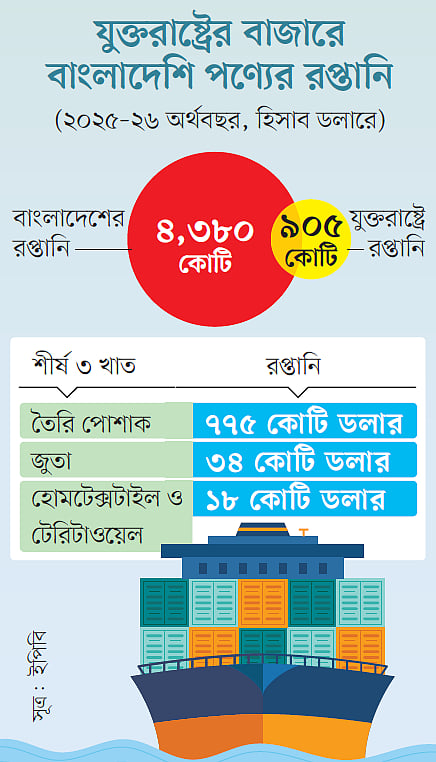
According to the Export Promotion Bureau (EPB), Bangladesh exported goods worth $43.80 billion in fiscal 2025-26. The largest share, $9.05 billion, went to the United States — 20 percent of total export earnings.
About 86 percent of Bangladeshi goods exported to the United States are ready-made garments. Footwear and home textiles and terry towels account for nearly another 6 percent.
The Office of the United States Trade Representative (USTR) on November 25 proposed tariffs at various rates on goods from 14 countries, including Bangladesh, over allegations of excess industrial production capacity. For Bangladesh the proposed rate is 18 percent. If talks and commitments are not satisfactory, the rate could also be 20 percent.
The Bangladesh government can submit written comments on the USTR proposal by January 5. The tariffs will take effect after a hearing at the U.S. International Trade Commission in Washington on January 25.
Under Section 301 of U.S. trade law, the USTR began investigations in March into two matters: excess production capacity, and failure to properly enforce the ban on goods produced with forced labour. In July, tariffs of 10 and 12.5 percent were imposed on 60 countries, including Bangladesh, over the second allegation; Bangladesh's rate was 10 percent.
With July's 10 percent, the current average tariff on Bangladeshi goods entering the United States is 25 percent. If a further 18 percent is imposed, the total average tariff will stand at 33 percent.
According to USTR documents, the proposed new tariff will not apply to 2,207 products, including tea, spices, vegetables, fruit, medicines, jute and handicrafts, and wood products. But Bangladesh exports very little of these to the United States; pharmaceutical exports there last fiscal year were worth $16.7 million.
U.S. President Donald Trump announced reciprocal tariffs on various countries, including Bangladesh, in April last year; Bangladesh's rate was 37 percent. Countries negotiated and signed agreements with the United States to reduce those tariffs. Three days before Bangladesh's 13th parliamentary election, on February 9, the former interim government led by Professor Muhammad Yunus signed a reciprocal trade agreement (ART) with the United States. U.S. courts have declared Trump's reciprocal tariffs illegal; Bangladesh's rate under them had last stood at 19 percent.
Under that agreement, Bangladesh will import about $15 billion worth of U.S. LNG over the next 15 years. It is also to buy at least 700,000 metric tons of wheat a year for five years, and up to $1.25 billion or 2.6 million metric tons (whichever is lower) of soybeans, soybean products and cotton in a year. Biman Bangladesh Airlines has signed a deal to buy 14 Boeing aircraft.
India was long Bangladesh's second-largest trading partner. After 16 years that position has changed; the United States has overtaken India. Imports from the United States rose by about 32 percent last fiscal year, to $3.6 billion. But although duty-free access was promised for garments made from U.S. cotton, the United States has not yet granted it.
Garment entrepreneurs say the average FOB price of woven and knit garments in the United States is $3.50 to $4. While reciprocal tariffs were in force, many buyers had to be given discounts of 1 percent of FOB, or 4-5 cents. A 36-43 percent rise in garment workers' wages will add 15-20 cents to the production cost of each piece. If buyers do not raise prices citing the extra tariff, Bangladesh will fall at least 15 cents behind per piece in competitiveness.
Shovon Islam, managing director of Sparrow Group of Industries, said: "Because of the wage increase, we had proposed taking 8-10 cents or more extra from many U.S. buyers. But because of the new tariff proposal, that may become almost impossible. Naturally, buyers will point to the added tariff cost." He said: "This will put us in a difficult situation. If the government negotiates properly, the tariff could come down."
According to the EPB, footwear exports to the U.S. market were worth $340 million last fiscal year, 12 percent more than the year before. Footwear entrepreneurs say that while reciprocal tariffs were in force, some U.S. buyers shifted orders for non-leather shoes from China to Bangladesh, and more buyers are preparing to buy shoes from Bangladesh. In such a situation, the new tariff proposal could have a negative effect.
Riad Mahmud, managing director of Npoly Footwear, said: "Last fiscal year we exported $38 million worth of shoes, 16-17 percent of which went to the United States. Several new U.S. buyers are in talks to make shoes at our factory. If those are finalised, half of our total production would go to the United States. The new tariff proposal may make buyers think again. If that happens, we will be in trouble."
Home textile and terry towel exports were worth $180 million last fiscal year, compared with $165 million the year before.