Bangladesh will go to the World Court if India does not return Hasina, Speaker Hafiz Uddin says
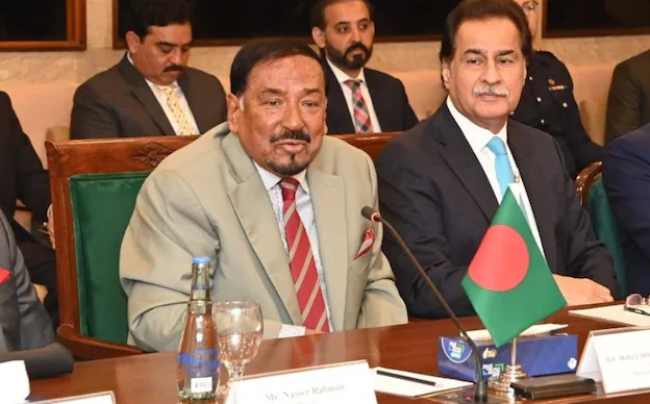
Bangladesh will go to the International Court of Justice (ICJ) if India does not extradite Sheikh Hasina, the prime minister ousted in a mass uprising, National Parliament Speaker Hafiz Uddin Ahmad (Bir Bikrom) has warned.
The Speaker, who is visiting Pakistan, made the remarks on Wednesday (25 November) while speaking to local journalists during a visit to the country's parliament building in Islamabad. His comments were published in Pakistan's local media.
During the conversation he commented on the 1971 Liberation War, Bangladesh's democratic journey, relations with India and the possible return of ousted former prime minister Sheikh Hasina, among other issues.
Saying Sheikh Hasina had taken refuge in a 'Muslim-hostile country', the Speaker said that if India does not hand her over to Bangladesh, the government in Dhaka will approach the International Court of Justice.
On a possible announcement of Sheikh Hasina returning home next December, he said that if she returns to Bangladesh she will have to go straight to prison. In his words, 'The announcements of Sheikh Hasina's return are only to keep her activists active; she will not return to Bangladesh in the next 10 years either.'
The Speaker said that over the past 15 years Bangladesh had been turned into a 'colony' of the neighbouring country, as a result of which the people of the country suffered greatly.
On 1971, he said India had not helped the Bengalis at the time, but rather played a role in weakening Pakistan. Referring to the Bengalis' democratic spirit, he said Bengalis are a democratic nation and do not tolerate any kind of authoritarian rule; in 1971 too the Bengalis demanded democracy, but they were not given that right.
Noting that after independence in December 1971 the country experienced both military and civilian rule, he said, 'I want to tell you, the authoritarianism of our civilian dictators was of the most terrible kind. A one-party system of rule was imposed.'
Noting that the parliamentary systems of Pakistan and Bangladesh are of the same kind, the Speaker said a one-party system was introduced in Bangladesh in 1975. In his account, the country did not get real democracy for a long time, but the election held in February this year was transparent.
On the sharing of waters of common rivers, he claimed that more than 50 large and small rivers enter Bangladesh from India, but India is continuously building dams and barrages that obstruct the natural flow of water into Bangladesh.
During the visit, the Bangladeshi Speaker held a bilateral meeting with Pakistan's Prime Minister Shehbaz Sharif on Wednesday night. At the meeting, the Pakistani prime minister said Pakistan attaches great importance to its brotherly relations with Bangladesh. The Speaker also visited the Pakistan Military Academy (PMA) in Kakul.
Asked about the Kashmir issue, Hafiz Uddin Ahmad said the Kashmir dispute should be resolved in accordance with United Nations resolutions. He also expressed hope that the friendly relations between Pakistan and Bangladesh will grow stronger and deeper in the future.