Not All Children Are Getting Quality Measles Vaccines, Many Get None at All: Experts Tell PM's Office Meeting
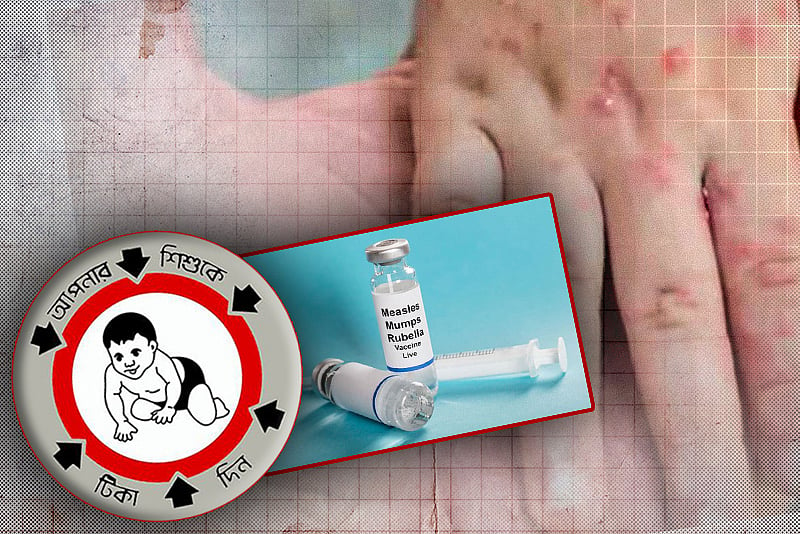
Experts believe not all children are getting measles vaccines of proper quality. They say many children are not getting vaccinated at all, and the vaccination coverage figures being publicised are not correct either. To control measles, the government must urgently launch a special crash programme.
The experts made these remarks at a meeting on measles control and prevention held at the Prime Minister's Office last Thursday. The meeting was convened by S M Ziauddin Haider, special assistant to the Prime Minister. He spoke about the meeting that evening at a roundtable on the cervical cancer vaccine held at the Prothom Alo office.
At the roundtable, Ziauddin Haider said the experts were called to hear their advice on how measles can be brought under control. Among many issues, two were important — one was vaccine quality: whether children are getting quality vaccines. And the vaccine 'cold chain' is not being maintained.
The experts said vaccines must be kept at a specific temperature. Bangladesh imports vaccines from nine countries, and the vaccines arrive by plane. Nobody checks whether they are brought in at the right temperature. Regular reports on this are supposed to be prepared, but they are not; it is only assumed that vaccines of the right quality are arriving in Bangladesh.
The discussion revealed that the special carriers used to transport vaccines to vaccination centres are very old, and many are not fit to maintain the temperature properly. Besides, at many centres workers take vaccines out of the carriers and leave them in the open, and those vaccines are given to children four to five hours later. Some photographs of this were shown at the meeting.
Ziauddin Haider said the issue of immunity gaps also came up prominently at the meeting. He said many children missed vaccines during the Covid-era campaigns and in 2024 and 2025. And the vaccination figures being given now are also flawed.
The 12 experts present at the Prime Minister's Office meeting included child specialist Professor Abid Hossain Molla, director of the Institute of Epidemiology, Disease Control and Research (IEDCR) Professor Kazi Ahmed Zaki, director of the disease control branch of the Directorate General of Health Services Professor Halimur Rashid, director of Bangladesh Shishu Hospital and Institute Professor Mirza Md Ziaul Islam, deputy director of the Expanded Programme on Immunization (EPI) Hasanul Mahmud, former IEDCR director Professor Mahmudur Rahman and vaccine expert Tajul A Bari. The reporter spoke to five of those present at the meeting.
The experts said the vaccination statistics provided by the EPI are not correct, and in some cases fabricated. There is no logic to vaccination coverage being 121 percent. First, there is a shortage of field-level workers. Second, some workers believe the government is not sincere about field workers' demands, and some experts suspect the workers are not sincere about vaccinating either.
The meeting was told that during the 2020 national measles-rubella campaign many children did not get vaccinated, because people did not want to leave their homes then and were reluctant to go to hospitals or vaccination centres. Yet the statistics showed a high vaccination rate. Again, in 2024 and 2025, vaccination was disrupted for political reasons and by field workers' strikes, but the statistics still showed high rates. In reality, a huge number of children have remained outside measles vaccination.
Malnutrition and children's vitamin D deficiency were also discussed at the meeting. It was said that about 15 percent of children infected with measles are over five years old — they are outside vaccination. Again, 22 percent of infected children are under six months old — they have not yet reached the age for vaccination.
The measles outbreak began in the country in early March this year. Since then the Directorate General of Health Services has been reporting measles infections and deaths every day. In a press release issued last Friday, the directorate said seven people died with measles symptoms across the country in the last 24 hours (Thursday 8am to Friday 8am). This brings measles deaths to 1,378 — of them 1,272 died with measles symptoms and 106 were confirmed measles deaths.
In the same 24 hours, 1,273 people were admitted to hospital with measles symptoms. So far, a total of 235,482 people have been admitted to hospital for measles treatment.
To tackle the outbreak, the government launched a national measles-rubella vaccination campaign in April, deciding to vaccinate children from six months to five years of age. The campaign ended in May, but vaccination continued afterwards. By November 16, 21,827,307 children had been vaccinated, and the coverage rate is being shown as 121 percent — that is, 21 percent more than the target.
The experts gave several recommendations. They said the quality of vaccines must be ensured, and whether vaccination is being done properly must be closely monitored. They called for raising the vaccination age limit to bring all children under 15 under coverage, because a large share of them have not received the measles vaccine and they are spreading measles. They also called for initiatives to make all vaccine-related information and statistics accurate — if the data are wrong, vaccine procurement will be wrong and not all children will get vaccines.
One expert said measles is highly contagious, and if the government does not immediately launch a large-scale programme on an urgent basis, the situation risks becoming more complicated. Two participants in the meeting said the issues discussed and the advice or recommendations would be conveyed to the Prime Minister.