In Satkhira's Kalaroa, Masum Hossain lights up his 12-bigha dragon fruit orchard to get fruit even in winter
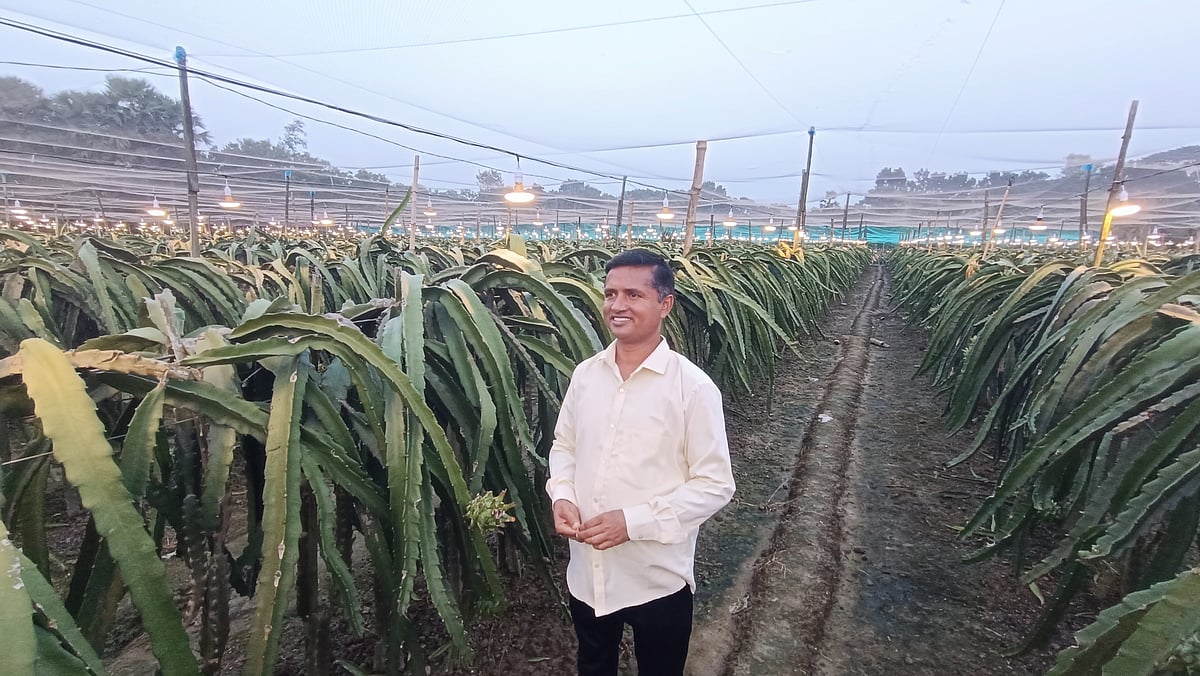
Md Masum Hossain has built a dragon fruit orchard on 12 bighas of land at Goalchatar village in Keralkata union of Kalaroa upazila, Satkhira. He has installed artificial lighting in the orchard to bring flowers and fruit on the plants even in winter.
Visiting the orchard last Wednesday afternoon, rows of dragon fruit plants could be seen growing on bamboo and cement posts. Under a protective net spread overhead, electric bulbs hang in rows; some plants carry green buds and others ripe fruit. The bulbs switch on as evening falls.
Masum's orchard has more than 3,000 posts, with an average of 12 plants per post — about 36,000 plants in total. He grows the Vietnam, Thai and Red Velvet varieties of dragon fruit.
Masum Hossain lives in the Kazirhat area of Kalaroa; his home district is Jamalpur. He has been doing business in Kalaroa since 2003 and married in the area in 2014. He runs a cosmetics and stationery business there. He had no prior experience in farming; three years ago he started dragon fruit cultivation as a hobby on five bighas and later expanded the orchard.
Twelve workers now work regularly in the orchard, four of them women. Masum says dragon fruit farming is expensive and commercial cultivation requires regular care. He has invested about Tk 3.5 lakh per bigha.
Masum Hossain says that although he earns from selling fruit, the income is still lower than the orchard's costs. Investment is still going on in his orchard, and he hopes the investment cost will be recovered from next year.
According to the Satkhira district Department of Agricultural Extension, dragon fruit is now cultivated on 27 hectares in the district, up from 25 hectares last year. The average yield is 13.95 metric tonnes per hectare. There are currently 162 dragon fruit growers in the district, and about five and a half to six hectares are under cultivation in Kalaroa's Keralkata union alone.
The Kalaroa upazila agriculture department says dragon fruit plants flower four to five times a year. Flowering and fruiting begin in April and continue through October, with the most fruit available in the orchard from April to November.
According to the department, at the start of the season dragon fruit sells for up to Tk 320 per kg. As supply increases the price falls; good-quality fruit then sells for Tk 60 and small or lower-quality fruit for as little as Tk 25 per kg. Towards the end of the season, when supply drops, good-quality fruit again sells for more than Tk 200 per kg. Yield per bigha ranges from 120 to 150 maunds, and wholesalers buy the fruit directly from the orchard.
The special feature of Masum's orchard is the use of artificial light. In winter, shorter days reduce flowering on dragon fruit plants. To lengthen the day and obtain flowers and fruit, electric lights are kept on in the orchard from 5 pm to 9 pm and again from 3 am to 7 am.
After recently visiting the orchard, Kalaroa upazila sub-assistant agriculture officer Mrinal Kanti Mondal said dragon fruit is a light-sensitive, or photosensitive, fruit, and that a day length of about 12 hours or more creates favourable conditions for flowering.
The agriculture department says dragon fruit plants rest in winter, storing energy in their roots that is used for fruit production in the following season. Depriving the plants of their natural rest by using artificial light for extra fruit can reduce the next season's yield and may even weaken the plants, so proper care and fertiliser and nutrient management are essential.
Iqbal Ahmed, deputy director of the Satkhira district Department of Agricultural Extension, said the plants' light exposure is extended in winter through artificial lighting, a method used in various countries around the world. He said dragon fruit grown on one bigha can be sold for more than Tk 2 lakh, and after deducting production costs of Tk 80,000 the profit per bigha is over Tk 1.4 lakh. With good-quality saplings and improved care, a single plant can yield 25 to 30 kg of fruit a year.