Tens of millions of red crabs leave the forest for the sea on Christmas Island
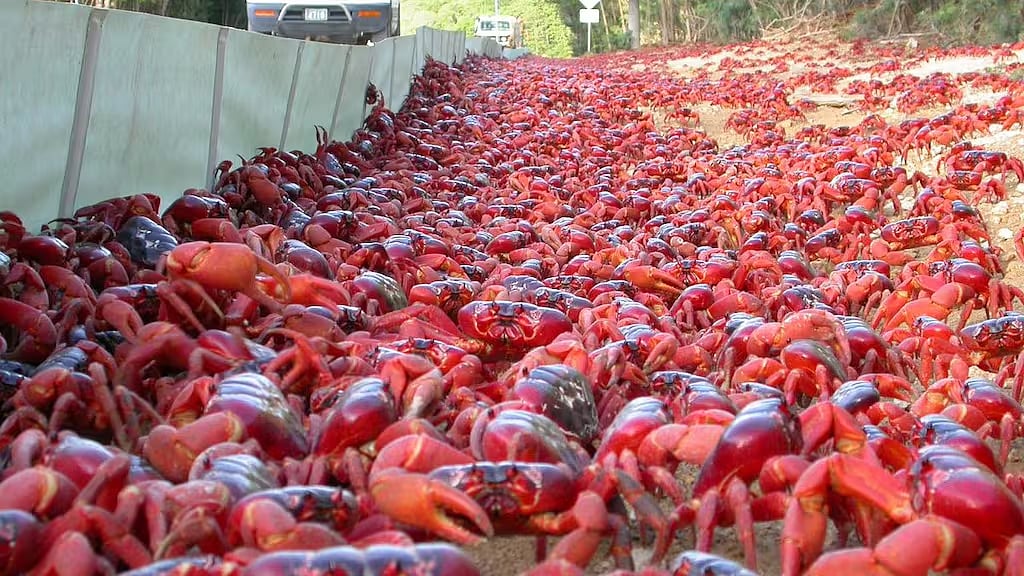
The annual mass migration of red crabs has begun on Christmas Island, a small island in the Indian Ocean. Tens of millions of the crabs have left the forests of the Australian island and set out for the sea. During the journey the island's paths, roads and even bridges are covered with crabs, looking like a vast red river flowing across the land.
The crabs are called Christmas Island red crabs. They normally live in the island's forests, but when the breeding season arrives they must travel to the sea. Once there, the males and females mate and the females release their eggs. It is for this purpose that they begin the long journey every year.
The migration usually starts after the first rain of the wet season. Most years the rain falls in October or November, although sometimes they must wait until December or January. As soon as the first rain falls, red crabs emerge from their burrows across the island and the march to the sea begins.
The male crabs set out first, and the females join them along the way. Each crab is roughly the size of a soft drink can. With tens of millions moving in the same direction, large parts of the island are covered in red.
The timing of the migration does not depend on rain alone; the phases of the moon are also involved. According to Christmas Island National Park, the speed and timing of the crabs' journey are set by the moon's phases. Park staff say the red crabs release their eggs before dawn, on a receding tide, during the moon's last quarter.
How the journey unfolds also changes with the match between the rain and the right spawning time. If the rain begins close to the ideal time, the crabs rush towards the sea very quickly. If the rain comes somewhat earlier, they are in less of a hurry, stopping on the way to feed and drink before setting off again. And if the rain falls so late that there is no chance to spawn at the set time, some crabs stay in their burrows and begin the journey again the following month.
Christmas Island is about 12 miles wide. The crabs' expedition from the forest to the sea across the small island takes about nine days to complete. With so many crabs moving at once, everything from crossing roads to people's normal movement is affected.
In 2008, naturalist and documentary maker Sir David Attenborough described this annual crab migration as one of the greatest moments of his television career.
Parks Australia is arranging for the spectacle to be watched without travelling to the island. Over the coming days the crabs' journey will be broadcast live, with each broadcast lasting about 60 minutes. When a broadcast will start cannot be fixed in advance, however, because when the crabs cross the bridge depends entirely on their movement. Park authorities said they will try to broadcast live in the mornings.
The bridge from which the scene will be filmed is called the Red Crab Bridge. Built to let the crabs cross a busy road safely, it is about 16 feet high. The crab procession will move across this bridge over three to four days.