TCB and Pakistan's TCP sign five-year MoU on trade in essential goods
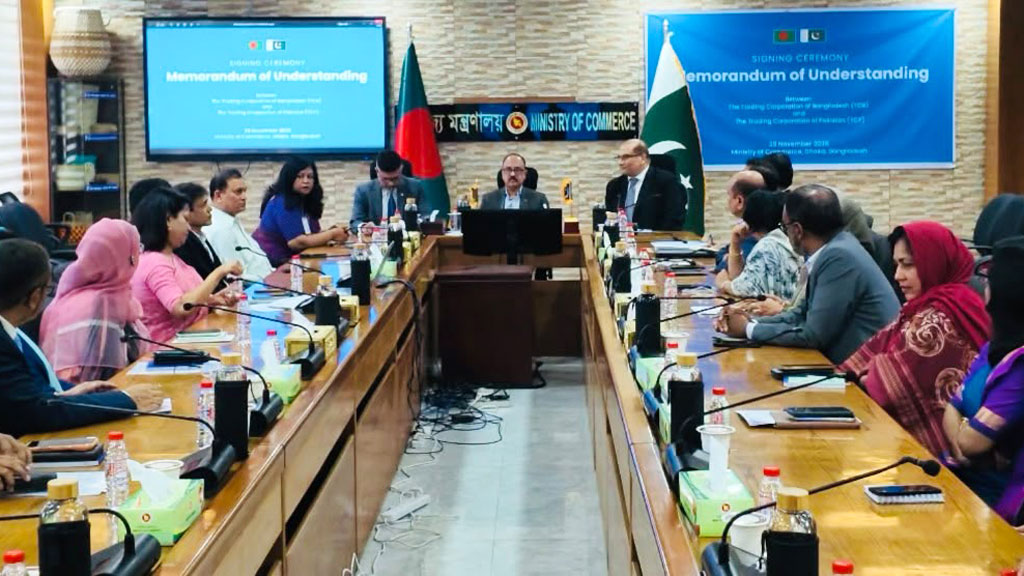
A five-year memorandum of understanding has been signed between the Trading Corporation of Bangladesh (TCB) and the Trading Corporation of Pakistan (TCP), aimed at strengthening the supply system for essential goods, ensuring food security and expanding alternative import sources. The deal opens a new channel of government-to-government (G2G) trade cooperation.
The MoU was signed on Sunday at a ceremony in the conference room of the commerce ministry at the Secretariat. TCB chairman Brigadier General Mohammad Faisal Azad signed for Bangladesh, while Pakistan's high commissioner to Dhaka, Imran Haider, signed for his country. Commerce secretary Sharaf Uddin Ahmad Chowdhury and officials from both governments were present.
Under the agreement, the two countries will be able to import and export rice, wheat, sugar, edible oil, lentils and other essential goods, as well as agricultural products and farm inputs, according to their needs. The product list includes all types of rice, wheat, refined and raw sugar, and edible oils including canola, soybean, sunflower, rice bran and palm oil.
The list also includes sesame, potatoes, onions, lentils, chickpeas, tea, pineapples, jackfruit, dates, fertiliser and various other agricultural products and inputs. The state-owned trading bodies of the two countries will be able to buy and sell these goods based on their needs and mutual consent.
The MoU will remain in force for five years from the date of signing. If neither side moves to cancel it, it will automatically be renewed for a further five years. Either side may, however, terminate it by giving at least three months' written notice through diplomatic channels.
Signing the MoU does not, however, mean that final contracts for importing or exporting these goods have been concluded immediately. If one side wishes to procure a specific product, it must send a written proposal to the other specifying the quality, quantity, specifications and possible delivery time. Separate product-based contracts will then be completed through discussion and negotiation to set the supply terms.
At the ceremony, commerce secretary Sharaf Uddin Ahmad Chowdhury said the MoU would build a direct and well-organised commercial relationship between the state-owned trading bodies of the two countries. Alongside protecting both countries' economic interests, it would create new opportunities for mutual cooperation in importing and exporting essential and agricultural goods, he said.
The commerce secretary stressed regular communication between TCB and TCP, timely evaluation of commercial proposals and overall cooperation from the two commerce ministries for effective implementation. He said the initiative would play an important role in expanding trade and economic cooperation between the two countries.
Pakistan's high commissioner Imran Haider said the MoU would create a direct institutional relationship between the two state-owned trading bodies, helping to better organise the import, export and supply of essential goods. He said Pakistan holds surplus stocks of basmati rice, onions, potatoes, spices and other agricultural products, and is ready to supply them according to Bangladesh's needs.
Highlighting progress in bilateral relations, the high commissioner added that cooperation has recently grown in trade, education, communications and other areas. Pakistan has withdrawn anti-dumping duties on hydrogen peroxide imported from Bangladesh, and has maintained a duty-free quota for importing 10,000 metric tonnes of tea a year from Bangladesh. He also noted that the first consignment of Bangladeshi pineapples from Dhaka reached Karachi last October.
TCB chairman Brigadier General Mohammad Faisal Azad said the MoU would not remain limited to a formal document or an expression of goodwill; turning its core objective into real commercial results would be the joint responsibility of the two organisations. In his view, it will serve as an important institutional platform for exploring mutually profitable trade, simplifying procurement and increasing cooperation between the two bodies.
The TCB chairman added that TCB and TCP would work closely on identifying specific products, setting competitive prices, ensuring quality and delivering goods on time according to both countries' needs. Through this, he said, a path would be created for mutual trust and realistic trade expansion between the two countries.