Jamaat to form an advisory council, panel system coming to district and city amir elections too
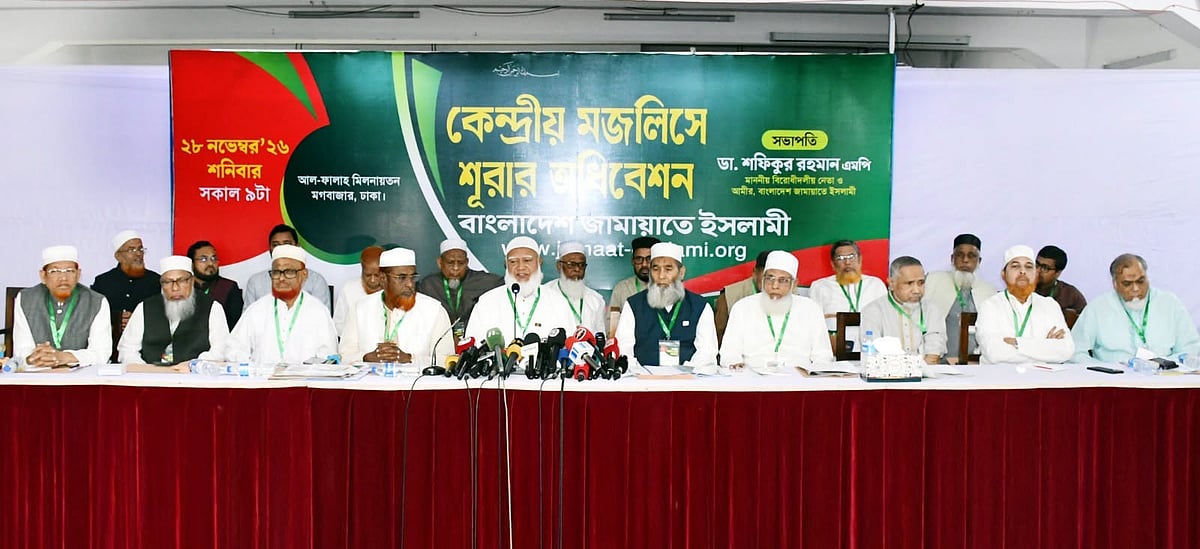
The central Majlis-e-Shura of Bangladesh Jamaat-e-Islami has given in-principle approval to forming an advisory council. A committee led by senior nayeb-e-amir A T M Azharul Islam has been formed to prepare proposals on the structure, scope and activities of this council.
On the basis of the committee’s recommendations, after discussion in the party’s central executive council, a new section or chapter named ‘advisory council’ will be added to Jamaat’s constitution. Besides, Jamaat has decided to introduce a three-member panel in district and metropolitan amir elections as well, like the central amir election; the Majlis-e-Shura has approved this too.
These organisational decisions were taken at the day-long session of the central Majlis-e-Shura held last Saturday at the Al-Falah auditorium in Moghbazar in the capital. Several responsible Jamaat leaders have confirmed this information.
Jamaat assistant secretary general and secretary of the publicity and media department Ehsanul Mahbub Zubayer said in the afternoon: "The central Majlis-e-Shura has approved the formation of an advisory council. A committee has been formed to determine the scope and activities of this council. After receiving the committee’s proposal, the matter will be included in the constitution in light of the central executive council’s decision."
Party sources say discussion on forming an advisory council in Jamaat began after the July 2024 mass uprising, and it gained pace after the 13th national parliamentary election. Under the existing system, becoming a leader of Jamaat requires being a ‘rukn’ (sworn member) of the party. But there are many experienced and expert people sympathetic to the party who are outside the organisational process; this initiative is to make use of their talent and experience.
According to the plan, the council is expected to include established figures of society including retired government officials, academics, businesspeople, economists and diplomats. There is also a proposal to include representatives from other religious communities. The advisers will be able to give opinions on the party’s policy-making matters without holding regular organisational responsibilities. However, the number of members and the powers of the council have not yet been finalised.
Although there is a provision for a three-member panel in Jamaat’s central amir election, it did not exist at the grassroots level. Until now, district and metropolitan amirs were elected for two years by the secret ballot of the rukns of the branch concerned. Under the new decision, first the Majlis-e-Shura of the branch concerned will prepare a three-member panel and send it to the centre; then the amir will be elected by the rukns’ vote based on that panel.
There has recently been discussion within the party about the same person remaining in leadership at Jamaat’s district level for years on end; the decision to change the amir election method came amid this. Jamaat has 79 organisational branches across the country, combining districts and metropolitan cities. Recently the party announced the names of elected amirs of 77 branches together for the 2027–28 term. In 51 of those branches, the previous amirs have been re-elected; among them, the amirs of at least 10 districts have been in office for a decade or more. In Jhalakathi, the same person has been district amir for 22 years.
However, this time long-standing leadership has also changed in several districts including Khagrachhari, Lakshmipur, Joypurhat, Barishal, Rajbari and Khulna.
At the meeting, besides approving Jamaat’s annual plan and budget for the coming year, the oath of the new Shura members was held. Secretary general Mia Golam Parwar presented an account of the party’s political and organisational activities from July to November. The long-march programme of the Jamaat-led 11-party unity received special importance in it. Demanding implementation of the referendum verdict and other demands, the 11-party unity marched towards Chattogram on 5 September, Rangpur on 19 September and Khulna division on 31 October; a long march towards Sylhet was scheduled for 21 November but was later postponed.
The meeting decided to place proposals before the government on various issues including implementing the July National Charter and the referendum verdict, controlling prices, improving the law-and-order situation, stopping partisan appointments in state institutions, and ensuring Bangladesh’s interests in renewing the Ganges water-sharing treaty.
In his closing speech, Jamaat amir and leader of the opposition in the national parliament Shafiqur Rahman stressed improving the moral, political and organisational standards of the party’s responsible leaders. He also emphasised preparations to take part in local government elections and increasing contact with people of different classes and professions.