On Record Turnout Day in Israel, Netanyahu Accuses Arab Voters as Opposition Reacts Sharply

Israelis flocked to the polls in record numbers on Tuesday in a tightly fought election that pits the long-serving prime minister, Benjamin Netanyahu, against a loose coalition of rivals determined to unseat his right-wing coalition.
By 6 p.m. local time, four hours before polls were scheduled to close, 66.7 percent of voters had cast ballots. It was the highest figure at that point in the day since Israel's Central Elections Committee began tracking Election Day turnout in two-hour increments in 1973, and nine percentage points higher than at the same time in 2022.
Turnout appeared to be particularly high, compared with previous elections, among Arab citizens, who make up about a fifth of Israel's population. By late afternoon, hours before the polls were set to close, turnout in some Arab-majority towns had exceeded the totals from the last election, in 2022. In Rahat, a large Bedouin town in southern Israel, turnout just before 5 p.m. was already at 60 percent — matching the town's final turnout in the previous election.
Prime Minister Netanyahu accused Arab citizens of 'trying to steal the elections' on Tuesday, as he repeatedly used racial appeals to push his right-wing base to vote. On social media he said there were buses heading to the polls and long lines in Arab towns, while right-wing strongholds had yet to wake up. He said that if they did not go to vote now, they would find themselves with a government of Arab parties.
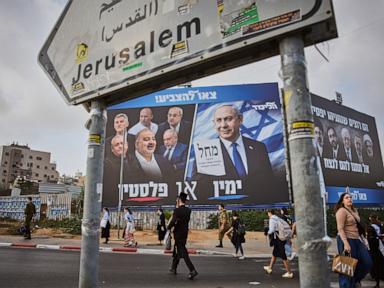
In a video statement addressing right-wing voters, Netanyahu said they say their voters are heading to the polls in droves, and that his voters too must head to the polls in droves. His Likud party released images suggesting that there had been higher turnout in the Arab city of Rahat than in Bat Yam, a Likud stronghold, which it called 'a state of emergency.' Another poster showed women in Muslim religious veils with the caption: 'Right-wing voters, don't stay home.'
Itamar Ben-Gvir, the far-right national security minister, joined the prime minister in trying to stoke fears over high Arab turnout. In a video filmed near the entrance of the Arab town of Kufr Qassim in central Israel, he said Arab voters were heading to the polls at hitherto never-before-seen rates, threatening Israel's Jewish character.
Yousef Jabareen, who leads the Joint List alliance of Arab parties, accused Netanyahu of inciting against Arab citizens and undermining the legitimacy of their vote. He said the Arab community knows how to punish him, and that today they were sending him and his bloodstained government packing.
Netanyahu has a long track record of appealing to his supporters by invoking the spectre of the Arab vote. In 2015, he called on right-wing Israelis to vote because Arabs were heading in droves to the polls. His comments were widely condemned at home and abroad, including by the Obama administration. He was accused of race-baiting and was forced to issue an apology. On Tuesday, as initial data showed high turnout in Arab cities and towns, he again used almost the same language in several statements over the course of the day.
Netanyahu also pointed to the arrests of three people suspected of planning to bribe voters for Raam, an Arab Israeli party, on Tuesday. Dean Livne, the acting director of Israel's central elections committee, told reporters that there were no reports of widespread irregularities. Election officials also said there had been no indication of widespread irregularities.
Netanyahu's Likud party said it had asked the Central Elections Committee to extend voting hours nationally beyond 10 p.m., an unheard-of move that election officials are unlikely to grant. Likud's rivals argued that the highly unusual request was intended to sow doubt about the election's integrity.
President Trump has endorsed Netanyahu, praising him as an important partner in the war against Iran and saying anyone else would be the 'wrong leader' for Israel. Analysts were sceptical that the U.S. president's intervention would sway many voters.
The election is Israel's first since the Hamas-led attacks on October 7, 2023, upended the nation and ignited three years of war. Netanyahu is seeking re-election at the helm of the most far-right government in Israeli history. His coalition of nationalists and ultra-Orthodox Jews faces an ideologically diverse group of Jewish opposition parties loosely led by Gadi Eisenkot, a former military chief of staff whose son was killed in the Gaza war. Opinion polls suggest that Netanyahu's allies and rivals are roughly tied. No party is expected to achieve a clear victory, which means assembling a governing coalition could take weeks or months.