Government Targets 10,000 MW of Renewable Power by 2030, Special Law Coming: Power Minister
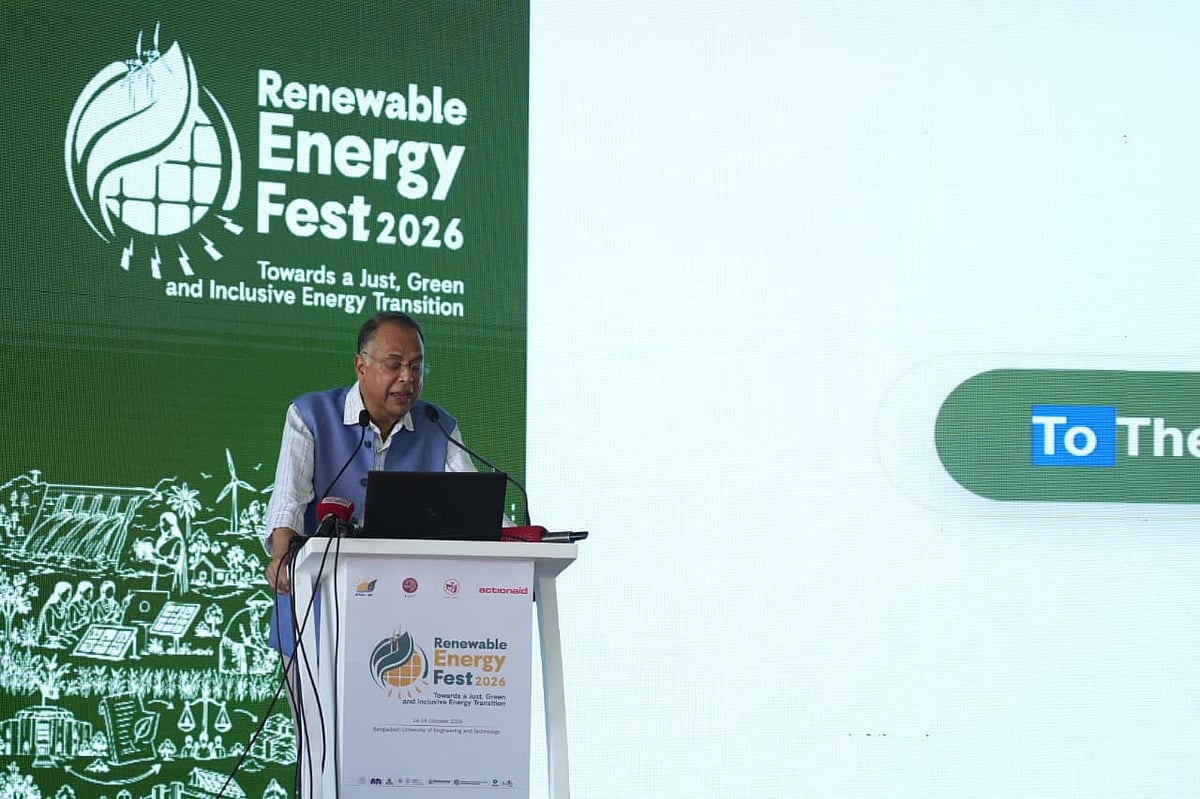
The government has set a target of generating 10,000 megawatts of the country's total electricity from renewable sources by 2030, Power, Energy and Mineral Resources Minister Iqbal Hasan Mahmud Tuku has said. He said a special law is being drafted to achieve the target and accelerate the growth of the renewable energy sector.
The energy minister made the remarks on Tuesday while taking part in the 'Renewable Energy Fest 2026' at the central playground of Bangladesh University of Engineering and Technology (BUET). The three-day event began last Monday. It has been jointly organised by ActionAid Bangladesh, BUET, Just Energy Transition Network Bangladesh (JETNet-BD) and BUET's Institute of Energy and Sustainable Development (IESD).
In his speech as chief guest, Minister Iqbal Hasan Mahmud said, 'Because of excessive dependence on fossil fuels, instability in the world market and the impact of the Middle East war have fallen on us. To ensure future energy security, we are preparing a "Special Renewable Energy Law," which will make decisions and activities taken between 2026 and 2030 easier.'
Iqbal Hasan Mahmud also said all types of duties have been removed from all solar power technology and materials to expand renewable energy. He said arrangements have been made for government incentives to install solar panels on rooftops and to purchase electricity at affordable prices.
The energy minister also noted that, as the country's power grid is not fully modern, coordinating electricity from nuclear, fossil and renewable sources is somewhat challenging. However, he said work is under way to modernise the grid of the Power Grid Company of Bangladesh (PGCB).
At the event, ActionAid Bangladesh Country Director Farah Kabir said the main cause of the world's climate crisis is greenhouse gas and carbon emissions. About 96 percent of Bangladesh's electricity is fossil fuel-dependent, which is putting the country's energy security at risk, she said. A just and inclusive energy transition is essential for the country's sustainable development. She welcomed the step to make solar power equipment duty-free and stressed the active participation of youth and women in the process.
Highlighting the importance of innovation and research, BUET Vice-Chancellor Professor Ekramul Haque said at the inaugural event that rising fuel prices in the international market are putting pressure on the economy. Universities and policymakers must work jointly to protect the environment and ensure affordable clean energy for future generations, he said.
Among international development partners, the event was attended by Tobias Biermann, First Counsellor of the European Union delegation to Bangladesh and head of its Green Economy and Public Sector Investments section, and energy expert representatives from Indonesia and Pakistan.
At the day-long technology and innovation fair, students from BUET and various other universities displayed innovative projects related to solar, wind energy, biogas and battery storage. Guests visited the stalls and exhibitions. The festival also featured theatre performances, dialogues and discussions on energy transition involving young people. The names of the winners of a reel competition organised by The Earth Society were also announced.
On the closing day on Wednesday, several high-level parallel dialogues and plenary sessions will be held considering national and regional contexts. Discussions will cover energy policy and governance for a just transition; financing and investment in renewable energy; innovation, technology and infrastructure; and social and environmental safeguards in the energy transition. Experts from South and Southeast Asia will present their countries' experiences at the sessions.
At the same time, innovators, young leaders and partner organisations that have made special contributions to the renewable energy sector will be awarded. The three-day event will end with puppet shows and cultural performances. University Grants Commission (UGC) Chairman Professor Mamun Ahmed will be present at the closing ceremony as special guest.
Co-organisers of the festival, held for the second time in the country, include the Bangladesh Energy and Power Research Council (BEPRC), Bangladesh Institute of International and Strategic Studies (BIISS), Bangladesh Solar and Renewable Energy Association (BSREA), Center for Climate Change and Environmental Research (C3ER), Greenery Energy Solution Limited, Institute for Energy Economics and Financial Analysis (IEEFA), Oxfam in Bangladesh and The Earth Society.