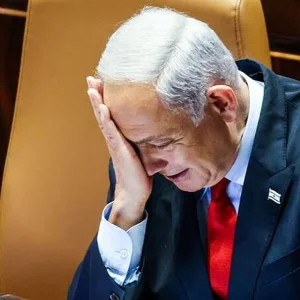
Israel Exit Polls: Netanyahu Bloc Trails on 50 Seats as Eisenkot Bloc Leads on 52-53

Exit polls published after voting ended in Israel's Knesset election show a major setback for the right-wing and religious bloc led by Prime Minister Benjamin Netanyahu. Surveys by the country's three main television channels show Netanyahu's bloc trailing the opposition bloc led by former military chief Gadi Eisenkot.
Voting on Tuesday began at 7 a.m. local time and ended at 10 p.m. It was the 26th Knesset election. The exit poll results were published as soon as voting closed.
According to the exit polls by Israel's state broadcaster Kan and the private Channel 12 and Channel 13, Netanyahu's bloc is set to win 50 seats in the 120-seat Knesset. The bloc held 68 seats in the outgoing parliament.
The centrist and Zionist opposition bloc led by Eisenkot, by contrast, is set to win 52 to 53 seats. Kan and Channel 13 put the bloc on 53 seats, while Channel 12 put it on 52.
As a single party, Netanyahu's Likud is still set to win the most seats and emerge as the largest party, all three surveys said. Kan, Channel 12 and Channel 13 all said Likud is set to win 24 to 25 seats.
But trailing as a bloc leaves Netanyahu's alliance far short of the 61 seats needed to form a government. The exit poll results therefore suggest that holding on to power will be difficult for him.
In addition, the Arab parties' Joint List and another Arab party, Ra'am, are together set to win 17 to 18 seats. Reports noted that this tally could play an important role in forming the next government.
After the exit poll figures emerged, current opposition leader Yair Lapid said in a statement: 'Don't let anyone confuse you: Netanyahu's bloc has suffered a catastrophic defeat. It has completely collapsed and the people have told them to go home.'
Election officials said turnout was set to be the country's highest in nearly 40 years. This is Israel's first parliamentary election since the Hamas-led attack of October 2023, and in the eyes of many Israelis it is one of the most consequential votes in the country's history.
Voters' reactions captured the weight of the election. Voter Naama Aaronsohn said calling the election 'important' was an underestimation and that it was 'crucial'. She said: 'I'm worried. What's going to become of our country if there's not a major change?' Nur Abu Na, a 30-year-old Arab voter, said the government was 'not good for us and not good for anyone'. Voter Itamar Ariel, by contrast, said there are problems in Israel but no one can replace Netanyahu, and that his choice is about security for Israel.
Israel's parliamentary elections use proportional representation: voters vote for a party, not a candidate, and parties receive seats in proportion to their vote share. A party must win at least 3.5 percent of the total vote to enter parliament. Because of this system, no party in Israel's history has ever won an outright majority on its own; a majority requires at least 61 seats.
The final tally is unlikely to be known before Wednesday. If no bloc wins an outright majority, it may take days or even weeks of coalition building by party leaders to determine who will be Israel's next prime minister.