Survey in three cities: dengue and chikungunya in nearly 7 of 10 families, urban children most at risk
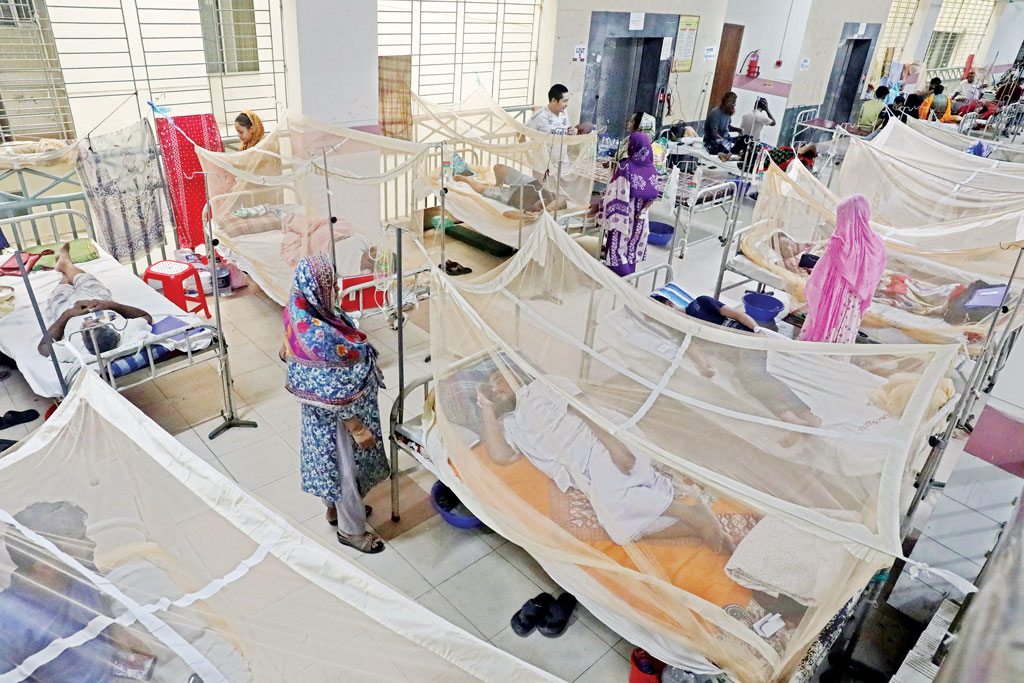
Climate change is increasing health risks for children in Bangladesh's urban areas. A field survey conducted mainly among low-income people in three urban areas found that 69 percent of participating families reported suffering mosquito-borne fevers including dengue and chikungunya.
The findings were presented on Tuesday at a presentation and civic dialogue titled 'Urban child health at risk from climate change: the crisis and what to do' at The Daily Star building in the capital. It was organised by the Children Watch Foundation.
The organisation's chairman, Shah Israt Azmeri, chief executive of the environmental research body Environmental Innovation and Research Network (EIRN), presented the keynote paper at the dialogue.
Alongside mosquito-borne fever, 18 percent of families reported skin diseases, 10 percent waterborne diseases and 3.5 percent respiratory diseases.
The survey was carried out in Dhaka's Mirpur 6, Hazaribagh, Boubazar, Baraikhali and Boatghat slums; in Rajshahi City's Nomovadra and Budhpara slums; and in Satkhira municipality's Rahmatpur Colony and Boddipur Colony.
Among climate-related stresses, heatwaves were cited as the most felt problem by 51.87 percent of families. Waterlogging was mentioned by 30.48 percent, river erosion by 17.11 percent and salinity by 0.53 percent of families.
According to the survey, 64.5 percent of families share toilets. Only 55 percent of families use tubewell water for drinking. The presentation said lack of safe water, sanitation and a healthy environment in dense settlements can further increase children's risks.
The recurrence of disasters is also alarming. 70.59 percent of families reported experiencing disasters more than three times, 19 percent two to three times and 8 percent once. Only 3 percent said they had not been through such disasters.
In this 2025 field survey, 54.5 percent of respondents believed children are the most affected family members in climate-change situations. In intense heat, children can quickly suffer dehydration and heat-related illness, and infection risks rise in polluted water and unclean surroundings.
The chief guest, State Minister for Health and Family Welfare M A Muhit, said urbanisation, the health system and climate change are closely interrelated. To ensure children's health and safety, quick, practical and coordinated steps must be taken alongside identifying the problems, he said.
Public health expert Dr Mushtaq Hossain said children are being severely harmed by air pollution and are suffering pneumonia. Children are more sensitive because of exposure to dust and harmful particles and their comparatively lower immunity; a mother's poor health can also affect a child's health. He called for strengthening primary, secondary and tertiary healthcare rather than leaning only on large hospitals.