Government Will Deliver Free, Fair and Neutral Local Elections, Says State Minister Mir Shahe Alam

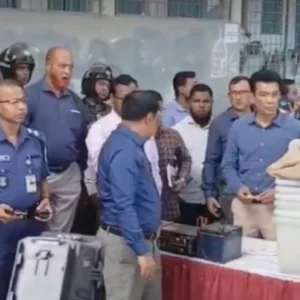
State Minister for Local Government Mir Shahe Alam has said the government will deliver peaceful, free, fair and neutral local elections. He made the remarks while speaking to journalists at Banani Bidyaniketan School in the capital on Wednesday (28 October), on World Handwashing Day.
He said the by-election in the Thakurgaon-1 constituency, vacated by President Mirza Fakhrul Islam Alamgir, is going to be held in a peaceful environment. In this seat, BNP-nominated candidate Mirza Faisal is contesting peacefully against other candidates, and there is no bias here, he said.
Shahe Alam said that in the same continuity, the local government elections starting in January will also be free, fair and neutral. He added that the government will also hold the Union Parishad elections peacefully, and that the BNP government does not want to take away the people's right to vote.
The Election Commission (EC) has already announced the outline for the Union Parishad elections. The commission plans to complete elections in about 4,300 Union Parishads across the country by 27 May next year. To that end, a roadmap has been announced to hold the voting in five phases instead of seven.
According to the roadmap, voting in the first phase will be held on 21 January 2027. The remaining four phases will follow on 4 February, 29 April, 13 May and 27 May.
Election Commissioner Brigadier General (retd) Abul Fazal Md Sanaullah gave this information to journalists on Monday (12 October) after the Election Commission's 13th meeting. Earlier, at 10:30 in the morning, a meeting was held in the commission's meeting room chaired by Chief Election Commissioner (CEC) A M M Nasir Uddin. The meeting discussed the Union Parishad election schedule, the determination of phases and the plan for conducting the elections.
At the briefing, EC Sanaullah said the number of phases for the Union Parishad elections was reduced from seven to five considering the shortage of time. The voting dates for the five phases were set on Thursday, he said. The commission has tried to keep voting days limited to Thursdays and Sundays. However, the announced dates are part of the overall plan for organising the elections; the schedules for nomination, scrutiny, withdrawal and campaigning in each area will become clear after the final schedule for the concerned area is announced.
EC Sanaullah said that under the law, the Union Parishads whose electoral terms have been completed, or which will enter the electoral cycle within the stipulated time, will be brought under this programme. In all, elections are planned in about 4,300 Union Parishads.
The election commissioner also set out the question of priority in organising the elections. According to him, the plan is to start Union Parishad elections in all districts of the country at the same time. Union Parishads adjacent to upazila headquarters will be given priority, as will those whose electoral terms have been completed or whose elections have long been overdue. For the remaining Union Parishads, the commission will try to coordinate alphabetically among the upazilas. However, the announced roadmap does not yet give a detailed list of which union in which district or upazila will vote in which phase.
Holding elections in about 4,300 Union Parishads in five phases is a major administrative undertaking for the Election Commission. At each phase, voter lists, polling centres, election officials, ballots and other materials must be kept ready, law enforcement agencies coordinated, and the voting environment ensured.
The Union Parishad is an important institution of local government at the grassroots level. It has a role in citizen services in rural areas, local development, infrastructure maintenance and the implementation of various government assistance programmes. The elections are therefore linked not only to choosing people's representatives, but also to the representation and continuity of the local government system.
Under the announced roadmap, after the first two phases of voting in January and February, the third phase will be held at the end of April, and the whole process is targeted to be completed through two consecutive phases of voting in May. The main task before the commission now will be to complete preparations according to the set schedule, announce phase-wise schedules, and ensure a fair and peaceful voting environment in every area.