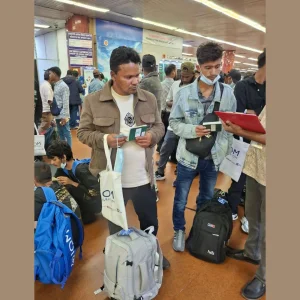
Lured by Job Offers, Bangladeshis Trapped in Cambodian Scam Centres; Some 1,400 Still Waiting to Come Home

Computer operator, data entry worker or customer service jobs paying 50,000 to more than 100,000 taka a month — believing such an offer, Tofayel Ahmed handed lakhs of taka to brokers and travelled to Cambodia. But instead of the promised job, he was sold there to a Chinese fraud syndicate, stripped of his freedom and forced to work in online scams.
Tofayel told The Daily Star that, hoping for a data entry job, he had paid Bangladeshi brokers 770,000 taka. After receiving a smart card from the Bureau of Manpower, Employment and Training (BMET), he travelled to Cambodia on April 30. Yet although he had been promised data entry work, the invitation letter for his recruitment mentioned construction work.
On arrival, a man received him and arranged three days of accommodation. He was then taken at night to a place some 300 kilometres away. Once there, Tofayel realised he had been brought to be put to work in online fraud.
At the scam centre, his English skills, typing and ability to lure people into investing were tested. He failed the first time but passed at the second attempt. Tofayel alleges that when he refused to work, he was told he had no choice; the brokers had sold him to the Chinese syndicate for about 2,000 dollars, and he was told he would have to repay that money himself to win his freedom.
Tofayel spent about one month and 27 days at the scam centre, working from 10pm to 10am. He says that if he failed to meet his work targets he was physically and mentally tortured; there were also incidents of electric shocks being given and food being withheld.
His chance to escape came one night when the power went out. At about 2:30am he climbed over a wall roughly 11 feet high, ran barefoot for three and a half kilometres and took shelter under a tree. But his ordeal did not end with the escape. The brokers had promised a one-year visa and work permit but never provided them, so he was forced to stay in Cambodia without valid papers. Later, learning through social media about help from the Bangladesh mission in Thailand, he used a waiver of overstay fines, arranged a ticket and returned home on June 14, 2026. He is now receiving support from BRAC's migration programme.
Tofayel says the brokers tell people about one kind of job, take them abroad and force them into another. He wants a strong role from the media so that ordinary people in the villages do not fall into the same situation as him.
Tofayel is not alone. To lure Bangladeshis to Cambodia with job offers, brokers talk of computer operator, data entry and customer service jobs. Attracted by promises of 50,000 to more than 100,000 taka a month, many have paid brokers between 200,000 and 700,000 taka. But after reaching their destination, some have their passports and mobile phones seized and, kept under strict guard, are forced into online fraud work. There are also allegations of torture for refusing to work and of money being demanded for release.
According to Touch Sokhak, deputy spokesperson of Cambodia's interior ministry, from September 1, 2023 to September 13, 2026 a total of 72,426 foreign nationals from 96 countries were sent back from the country. Among them were 3,364 Bangladeshis, of whom the Cambodian authorities identified 852 as involved in online fraud.
A report by the country's immigration department says that in the first nine months of 2026, 52,039 nationals of 87 countries were detained and expelled. Law enforcement agencies carried out 3,104 raids in that period, and the number of expulsions rose by 41,685 compared with the same period of 2025. Among those expelled were about 23,000 Chinese nationals, followed by more than 8,000 Indonesians, more than 4,000 Vietnamese and more than 3,000 Bangladeshis. More than 2,500 Pakistanis, about 2,000 Myanmar nationals and more than 1,500 Thais were also expelled. Citing the immigration department, Cambodia-based BTV News Global reported that in the anti-online-fraud drive from January to September 2026, more than 3,000 Bangladeshis were expelled from Cambodia. However, no specific account was published of how many of the expelled Bangladeshis were directly involved in fraud and how many had been trafficked and forced into the work.
BRAC's migration programme, citing BMET data, says that from January 1, 2025 to September 30, 2026, 15,963 Bangladeshis took permits or clearance for work in Cambodia. According to the organisation, by June this year 583 Bangladeshis had been brought back from Cambodia, 109 of them rescued from scam centres. There is no complete picture of how many more remain trapped as trafficking victims beyond these figures.
Some 1,796 people have applied to the Bangladesh mission in Thailand for help in returning home from Cambodia. According to BRAC, 300 to 400 of them have already returned; an estimated 1,300 to 1,400 Bangladeshis are still waiting to come back. On October 20, another 30 Bangladeshis returned home; they had been detained while trying to leave Cambodia and were freed after the Bangladesh mission intervened.