Where Does the Tk 776 Government LPG Go? Uneven Allocations and Black-Market Allegations
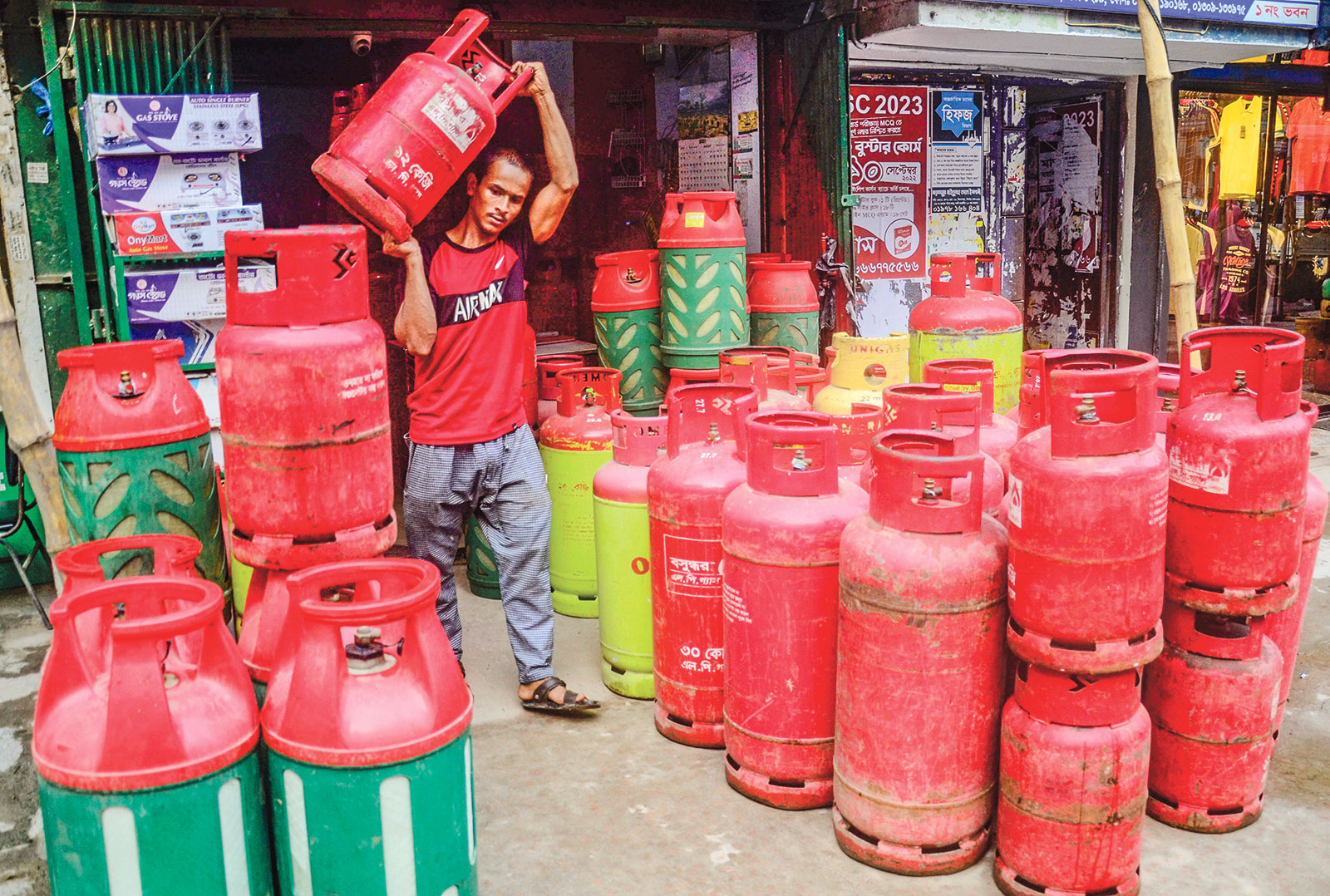
While the government has set the retail price of a private 12.5 kg LPG cylinder at Tk 1,913, amid international price rises and other factors, the same product from the government's own company, LP Gas Limited, is priced at just Tk 776.93. Yet this cheap government LPG always remains beyond the reach of ordinary people.
In practice, a private 12 kg LPG cylinder has recently cost as much as Tk 2,400 in Dhaka. Inquiries found that the huge price gap for the same product in the market is giving rise to theft, black-marketing and other crimes, while only a limited section of society benefits from the government's low price. The volume supplied by the state company is also quite small.
With shortages of pipeline gas and growing urbanisation and economic activity, demand for bottled LPG rises every year. Monthly demand now fluctuates between 130,000 and 150,000 tonnes — a daily demand of 4,000 to 5,000 tonnes. The state firm LP Gas Limited's annual capacity is only 15,000 to 20,000 tonnes. In other words, government LPG can meet just 1.3 percent of annual demand, or three to five days of the whole country's demand.
A large share of government LPG is supplied to various state forces. The rest is distributed through listed dealers of the BPC's oil marketing companies Padma, Meghna and Jamuna. An official of Padma Oil Company's marketing department said cylinders outside the forces are distributed among listed dealers through rationing. A dealer receives a minimum of 5 and a maximum of 1,400 cylinders.
Citing distribution data from 5 August, the official said that on that day dealers received 900 cylinders in the Chattogram region, 1,500 in Cox's Bazar, 800 in Feni, 350 in Cumilla and 340 in Noakhali. In September the company sold 40,000 cylinders of 12.5 kg through dealers.
An analysis of the state distributors Padma, Meghna and Jamuna's cylinder distribution shows there is no discipline in how listed dealers receive supplies, and no policy for setting priorities. On 5 August, one dealer in Sylhet received 1,400 cylinders in a single day, while other dealers there received only 10 or 15 each. Padma Oil's marketing officials could not properly explain this difference between dealers.
On the same day, the total allocation for the entire Khulna region was only 500 cylinders. Listed dealers there received a minimum of 5 and a maximum of 25 cylinders each.
LP Gas Limited itself has written to the regulator, the Bangladesh Energy Regulatory Commission (BERC), complaining that government LPG released at cheap prices is being black-marketed. To solve the problem, it has proposed raising the product's price close to private LPG, demanding that the international market price be considered rather than production cost. Experts fear, however, that this would reduce to near zero what little chance genuinely low-income people now have of getting cheap gas.
In its application to BERC, the company said that because BPC cylinders are far cheaper than private ones, government gas is filled into private cylinders — a process known as "cross filling" — and sold at far above the set price, so marginal consumers do not get government LPG at low prices. The company proposed that since LP gas is made at the country's only state refinery, Eastern Refinery Limited (ERL), by mixing propane and butane at a 35:65 ratio, the price of government LPG too should be set on the Saudi CP prices of the two components, as in the private sector. The Saudi CP (Contract Price) is the official global LPG trading price index announced monthly by Saudi Aramco.
LP Gas Limited's managing director, Engineer Md. Amir Masud, said their production capacity is far too low to meet consumer demand. He said about 16,000 tonnes come from ERL and about 5,000 tonnes from the Jalalabad gas field at Kailashtila. Once ERL's capacity doubles after renovation, LPG supply capacity will rise somewhat. In his view, implementing plans to increase the participation of BPC or any state fuel company in the LPG market will take at least two years.
Nazir Ahmed Molla trades in Dhaka's Jatrabari area as a listed dealer of the state distributor Jamuna. He said he receives at most 70 government LPG cylinders a month in total. But the cylinders are very old and in poor condition; some leak gas, so household customers do not take them and they mainly have to be sold to hotels and restaurants. On the uneven allocations, he said that around 2009 dealers received cylinders according to demand, but allocations later shrank, and for two straight years no government LP gas was available at all; now some is available again. On allegations of filling government gas into private bottles and selling at higher prices, he said: "This is heard not only about government LP gas; similar things are said about other companies too."
Another dealer, the director of Sonali Enterprise in Narayanganj, said government LPG cylinders reach him once or twice a month, and they go to consumers the same day.
Shahe Alam, a limited-income employee living in Dhaka's Mohammadpur who depends on cylinder gas, said: "I have only heard the name of government LPG. I have never seen this cylinder in the market. I have no idea who sells them where, or who gets the chance to buy them."
Professor M Shamsul Alam, energy adviser of the Consumers Association of Bangladesh (CAB), believes proposals to sell cheap government LPG to low-income people through special initiatives have been repeatedly ignored, which is why the benefit of this domestic product has not reached the public. Saying that raising prices is no solution to irregularities, he said: "If you sit with only a small share of the market, various irregularities will happen — that is natural. But if the government were sincere, this product could have been used to meet the needs of many poor people."