Registration made mandatory for e-rickshaws: fee up to Tk 10,000, top speed capped at 25 km/h
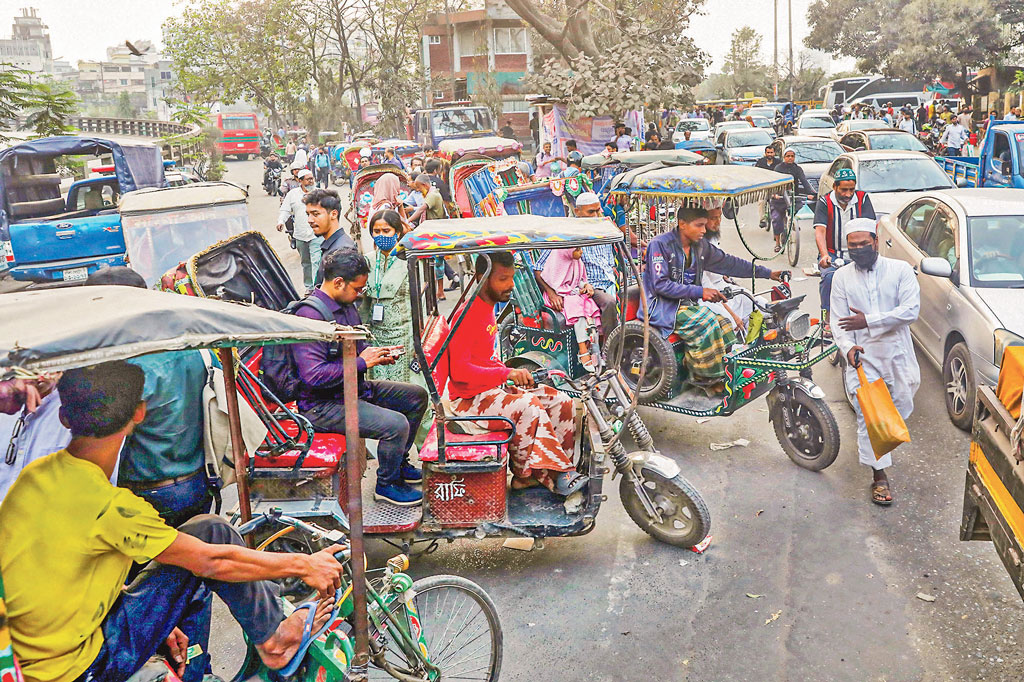
The government has issued new rules to regulate three-wheeled, low-speed battery-run rickshaws, or e-rickshaws, in city corporation areas. Under the new rules, registration has been made mandatory for every e-rickshaw.
The Local Government Division issued the 'Three-Wheeled Low-Speed Battery-Run Rickshaw (E-Rickshaw) Operation Rules, 2026' on Thursday (29 October). The rules will apply to battery-run rickshaws operating in all city corporation areas of the country. They set out directions on fixing the number of e-rickshaws, registration, routes, speed limits, parking and charging arrangements, and safety.
With the new rules taking effect, the e-rickshaw operation rules issued on 14 December 2025 have been repealed.
Under the rules, the one-time registration fee for a two-passenger e-rickshaw is Tk 8,000 and the annual renewal fee is Tk 4,000. For a four-passenger e-rickshaw, the registration fee is Tk 10,000 and the renewal fee Tk 5,000. The fitness certificate fee has been set at Tk 10,000. Registration will be valid for five years, but renewal must be done every year.
Each city corporation will fix the number of e-rickshaws in its area with the government's prior approval and in consultation with the relevant traffic department. If needed, the number can also be fixed area-wise or zone-wise.
To obtain registration, an applicant must be a Bangladeshi citizen and at least 18 years old. An attested copy of the national identity card, two photographs, the fee payment receipt and the prescribed fitness certificate must be submitted with the application. The authority will issue registration within 30 working days of receiving an application; if an application is rejected, the reason must be given in writing within seven working days.
A maximum of five e-rickshaws can be registered against one national identity card from one or more city corporations. However, an e-rickshaw registered in one city corporation cannot be operated commercially in another city corporation area. No e-rickshaw can run on the road without registration or renewal.
Every registered e-rickshaw will be given a unique registration number with a QR code and a number plate. The plate must carry the city corporation's name, the zone code and the vehicle number in white letters on a prescribed background colour, and the number must be displayed in a visible place on the vehicle. The fitness certificate must meet the technical standards and safety features set by the Bangladesh University of Engineering and Technology (BUET); registration and renewal cannot be done without the countersignature of the relevant traffic department.
The rules set the economic life of an e-rickshaw at 12 years. Once that period ends, the vehicle's registration and number plate must be cancelled. Fitting a speedometer or odometer on every e-rickshaw has been made mandatory. The rules also speak of gradually bringing e-rickshaws under insurance coverage.
E-rickshaws will not be allowed on national highways, expressways, elevated expressways, Bus Rapid Transit (BRT) corridors, or roads banned by the administration. Running on footpaths is also prohibited. Drivers must follow the left lane of the road; using a mobile phone while driving, improper overtaking and lane changing are not allowed.
The maximum speed of an e-rickshaw has been set at 25 kilometres per hour. Near schools, hospitals, places of religious worship and crowded areas, however, the maximum speed will be 15 kilometres per hour. No more than two or four passengers, depending on size, can be carried besides the driver. Carrying commercial goods other than hand-carried luggage of passengers is prohibited. Horn sound intensity cannot exceed 40 decibels.
Routes will be fixed jointly by the city corporation and the traffic department to control e-rickshaw movement. The city corporation area will be divided into zones, and for each zone the number of e-rickshaws, their routes and a specific colour will be finalised. An e-rickshaw of one zone cannot operate in another zone.
The authority will designate necessary parking areas in each ward or at suitable places in consultation with the traffic department. Batteries may be charged only at approved and licensed charging points or designated garages, and charging points and garages have been directed to arrange renewable energy or solar power. Government approval will be required to set up charging stations, and using electricity illegally to charge batteries will be punishable under the relevant law.
Old or unusable batteries, or parts of them, cannot be dumped or burned in open places, soil, water bodies or general waste. When selling a new battery, the seller must collect one old battery from the buyer and ensure it is sent to an approved recycling factory. Batteries cannot be broken or melted without clearance from the Department of Environment; old batteries must be handed over to approved agents, dealers or collectors.
The rules provide for a committee to recommend approval of e-rickshaw manufacturing companies. Headed by an additional secretary of the Local Government Division, the committee will include representatives of the relevant city corporation, traffic police, the mechanical and electrical departments of BUET or an experienced institution, and the district administration. The relevant authority will issue manufacturing licences based on the committee's recommendation and the government's approval.
Driving an e-rickshaw without registration, exceeding the approved speed limit, carrying excess passengers, using unauthorised batteries, changing the motor or structure, operating in prohibited areas, dangerous driving, violating signals and fleeing after an accident have been treated as offences. Legal action can be taken against these offences.