Climate Health Risks Cost Bangladesh $20.7 Billion a Year, 4.6 Percent of GDP: KHI Report
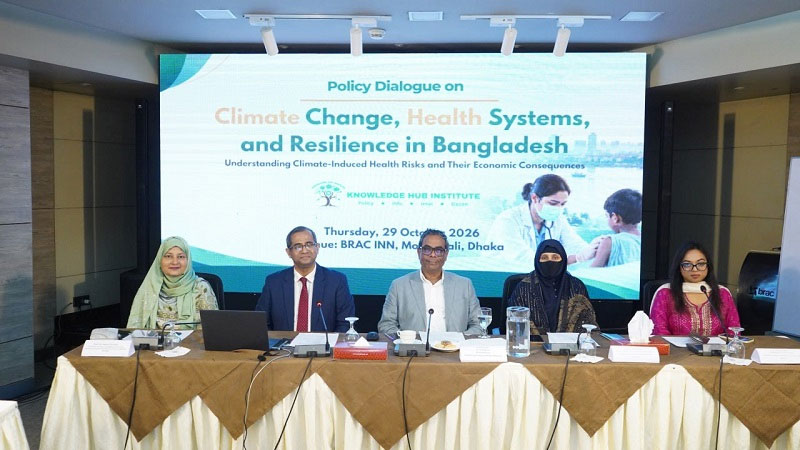
Heat and other climate-related health risks are causing Bangladesh economic losses of 20.7 billion dollars a year. The amount is equal to 4.6 percent of gross domestic product (GDP).
The estimate was made by taking into account lost working capacity, premature deaths and the economic value of various health risks. The findings appear in a report by the private research organisation Knowledge Hub Institute (KHI).
The report was released on Thursday (29 October) at the BRAC Centre in the capital. Its title is 'Multi-Dimensional Health Impacts of Climate Change in Bangladesh: Pathways, Costs and Policy Implications'. State Minister for Health and Family Welfare M A Muhith was the chief guest, and KHI president Khandker Golam Moazzem presented the research findings.
The report says the number of days with temperatures of 36 degrees Celsius or more in the country's eight divisional cities has almost doubled in the 2020s compared with the 2000s. Rising humidity alongside temperature is hampering the body's natural cooling process.
This is increasing health risks including heart disease, kidney and respiratory problems. Favourable conditions for the spread of dengue are also being created, the report said.
According to the research, about 293 billion potential working hours were lost in Bangladesh in 2024 because of excess heat. The economic value of those lost hours is about 15.8 billion dollars. About 64 percent of the lost hours were in the agriculture sector.
In intense heat, construction workers and others in physically demanding outdoor occupations are also losing working capacity and income, the report said.
According to a model-based estimate cited in the report, about 16,000 people died in the country in 2023 from various causes linked to high temperatures. A model-based estimate also linked about 263,000 deaths in the same year to particulate air pollution.
The costs of air pollution and of illnesses that are not fatal were not included in the 20.7 billion dollar figure. The overall economic burden could therefore be even higher, the report noted.
The report says that when temperatures were 1 degree Celsius higher over the previous four weeks, dengue hospital admissions two weeks later were found to be about 21 percent higher. In 2023, treating dengue patients admitted to hospital alone cost about 154 million dollars; outpatient treatment costs were not included.
In addition, natural disasters killed an average of 416 people a year between 2019 and 2024. The report also raised the risks of drinking water contamination in floods, breakdown of sanitation systems and disruption of medical services.
The research said families bore about 79 percent of the country's total current health expenditure out of their own pockets in 2023. And in the 2024-25 fiscal year, the health services division was able to spend only 24 percent of the money allocated for climate-related activities.
KHI president Khandker Golam Moazzem said, 'Climate-change health risks are putting significant pressure on the country's economy and public health. To reduce these losses, a national action plan to tackle heatwaves, district-level health initiatives and adequate financing for adaptation activities in the health sector are needed.'
State Minister M A Muhith said, 'Climate change is affecting public health in various ways. An effective early warning system needs to be built in coordination with relevant agencies including the Meteorological Department to tackle rising temperature and humidity. Specific steps must also be taken to protect vulnerable groups including women, children and persons with disabilities.'
KHI recommended formulating a national heat and health action plan before the next hot season, taking priority activities in 16 at-risk districts, and financing implementation of the health sector's national adaptation plan. It also stressed hospital emergency preparedness, rest and drinking water arrangements at workplaces, early dengue warnings, use of clean fuel, and regular publication of climate-related health expenditure accounts.