Five parties’ central offices attacked in Dhaka in two years, raising questions over democratic rights
Since the political changeover of 5 August 2024, the central offices of five political parties in the capital alone have been attacked multiple times over the past two years. The Gulistan central office of the banned Awami League and its president’s office in Dhanmondi have been attacked and set on fire repeatedly. The offices of the Communist Party of Bangladesh (CPB), Jatiya Samajtantrik Dal (JSD) and Bangladesh JSD have also been attacked. The Jatiya Party’s Topkhana Road office has been vandalised several times. There have even been incidents in which attacked party workers were instead handed over to the police.
Questions have been raised about what these attacks actually signal, and whether they are creating a situation of de-politicisation. Politicians and analysts say Article 39 of the Constitution guarantees everyone the right to freedom of expression and to practise politics freely. Obstructing a party’s programme or attacking its office is entirely contrary to democracy and could call healthy politics into question in the future. In their view, the attacks raise the question of how protected the right to dissent will remain in the political system after the July movement. They have compared such acts to “mob” behaviour, and some have also questioned the role of law enforcement agencies.
Nagorik Oikya convener and political analyst Mahmudur Rahman Manna said, “Every legitimate political party has the right to express its views freely. Despite ideological differences, attacking the office of another political party cannot be supported. If this continues, it is an ominous sign for healthy politics in the future.” In his view, the role of law enforcement agencies in these incidents is also questionable.
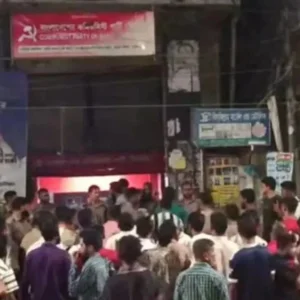
The CPB office has been attacked twice in the past two years. During the interim government, in April 2025, the party’s central office at Mukti Bhaban in Paltan was vandalised for the first time. Various religious organisations were blamed for that incident at the time.
Most recently, after the second attack on Monday night (26 October), police detained two leaders of the party’s affiliate Juba Union, Iran Molla and Sohel Fakir. They were released late at night. The CPB alleges the attack was led by leaders and activists of the Paltan thana BNP. The BNP has denied it. Police claim that “Joy Bangla” slogans were raised from inside.
The situation originated that afternoon when cultural activists called a human chain in Dhanmondi to protest the obstruction of female Baul singers in Sunamganj. Accordingly, they gathered in the Dhanmondi 27 area. From there, police detained former Chhatra Union president Dipak Shil. He was released around 9 pm. The chain of events began from that incident.
On 26 September this year, the JSD was holding a representatives’ conference at its central office in Gulistan. On hearing the news, several individuals alleged that Awami League leaders and activists were conspiring against the government there and that “Joy Bangla” slogans had been raised from inside. The office’s collapsible gate was shut, trapping the leaders and activists inside. The JSD blamed BNP and Juba Dal leaders and activists for the incident. Police detained 289 JSD leaders from the office. Later, 27 were shown arrested and the rest were released that night. Through legal process, all 27 were later released on bail.
During the previous interim government, the Jatiya Party’s central office on Topkhana Road was attacked and set on fire several times. A portrait of the party’s founder H. M. Ershad was also vandalised. Jatiya Party leaders blamed Nurul Haque Nur’s Gono Odhikar Parishad for the repeated attacks there, and clashes between the two sides every few days were a regular occurrence. On 12 October, the Uttara home of party chairman G. M. Quader was also attacked.
From the afternoon of 5 August 2024, the Gulistan central office of the banned Awami League was set on fire and vandalised in phases. The party president’s Dhanmondi office was not spared either. On the night of 5 February 2025, centring on the announcement of Sheikh Hasina’s online speech, Bangabandhu’s house at Road 32 was extensively vandalised and set on fire. Later, a large part of the house was demolished with cranes and excavators. A recent on-site visit to the party’s Gulistan central office found one part of the building burnt, with vagrants and outsiders staying in another part, and banners and festoons of several organisations formed around the July movement hanging in front.
On 15 August, centring on a programme to pay respects on Bangabandhu’s death anniversary, police took position at the Bangladesh JSD central office on Topkhana Road. Several youths then tried to attack the party, labelling it a collaborator of fascists. Party general secretary Nazmul Haque Pradhan said at the time that they had left the Awami League-led 14-party alliance after the one-sided election of 2018. Even so, one side was trying to harass them with various tags. He said an attack on a political party’s office by police or by a party of a different opinion is contrary to democracy.
A political party’s office is the only shelter for its leaders and activists to conduct activities freely; it is their democratic right. When someone attacks it, that amounts to interfering with the country’s right to freedom of expression, politicians believe. Many see the trend as a ploy of de-politicisation, because if it continues, the democratic environment may be disrupted in the future.
Former CPB president and former DUCSU vice-president Mujahidul Islam Selim said, “An attack on a political party’s office by another party’s leaders and activists, or by the police, is in no way acceptable. Preaching democracy while trying to suppress dissent is a kind of duplicity. Through this, freedom of expression may shrink. Whether it is indirectly a ploy of de-politicisation also needs to be examined.” He added that alongside attacks on party offices, the eviction of hawkers and the beating of rickshaw pullers on the streets at this time are also worrying.
National Citizen Party (NCP) joint convener and political council member Sarwar Tushar said no attack on any political party’s office can be supported. However, he does not consider one or two isolated incidents to be a ploy of de-politicisation. He said it is true that if the democratic environment is disrupted in any country, a different force can emerge.
Bangladesh Jamaat-e-Islami central executive council member and Dhaka-12 MP Saiful Alam Khan Milon said, “Our position is in favour of not undermining anyone’s democratic rights. Now it is the government’s responsibility to see who attacked whose office.” He said, “Throughout the previous Awami League government, our central office was kept locked and our offices were burnt down in various places. No one protested then. We believe attacks are still happening in that continuity. We never want to interfere with anyone’s freedom of expression, because doing so can benefit undemocratic forces.”
BNP standing committee member Selima Rahman said, “We are always in favour of democracy. Our party’s founder Ziaur Rahman was the proponent of multi-party democracy. So there is no instance of an attack on anyone’s political office from our side.” She said they believe that without political freedom, extremism can rise.
Some believe that if attacks by opponents on political party offices continue, undemocratic or extremist forces may rise in the country. Their fear is that if this is not resolved, more such incidents may occur in the future, which a third party could exploit.