Secondary textbook printing lags with inspection done on only 37 percent of books, classes nine-ten furthest behind
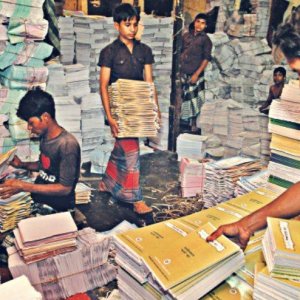
The National Curriculum and Textbook Board (NCTB) is under pressure over printing, quality checking and field-level supply of new textbooks for the 2027 academic year. Printing of pre-primary and primary books is well advanced, but progress at the secondary level is comparatively slow. Several printing firms are behind in particular on books for class eight and classes nine-ten.
According to the NCTB's production report up to 28 October, 92.94 percent of books for the pre-primary and primary levels combined have been printed. For the ebtedayee and secondary levels combined, printing has been completed for 57.66 percent of books. But finishing printing is not the same as being ready for supply after quality checks — at the secondary level, pre-delivery inspection, or PDI, has been completed for only 37.05 percent of books.
The government's target is to deliver all quality-approved books to upazila-level distribution centres by 30 November. Supervision of the printing firms has been strengthened to carry out this programme of printing and supplying books for nearly four crore students.
By level, at pre-primary, 5,628,153 of a total 5,730,640 books have been printed — printing is complete for 98.21 percent of books. PDI at this level has been completed for 88.48 percent of books.
For primary classes one to five, 66,629,173 of a total 76,097,096 books have been printed, a printing progress of 87.67 percent. PDI at this level has been completed for 77.79 percent of books. NCTB member (textbooks) Professor Mohammad Abu Naser Tuku says there will be no problem in delivering primary books to the upazila level in full within the set time.
At the ebtedayee level, 26,710,784 of a total 41,639,574 books have been printed. Printing progress at this level is 64.15 percent and PDI has been completed for 51.11 percent of books.
For secondary classes six to ten, the printing target is 179,543,018 books. Of those, 91,817,056 books have been printed, which is 51.18 percent of the total target. In other words, printing of nearly half the secondary books is still outstanding, and quality checks on a large part of the books already printed also remain to be finished.
Under the NCTB's contracts, 50 percent of the books for class eight and classes nine-ten are due to reach the upazila level by 3 November. But the board's monitoring report noted that in several lots there was no significant progress up to 27 October. Abu Naser Tuku said the firms will supply the 50 percent by then, and if they do not, they will have to pay fines — so it is hoped everyone will supply 50 percent of the books within the set time.
According to the monitoring report, the firms lagging on class eight and classes nine-ten books include Anindya Printing Press, Alif Printing and Publishing, Anupam Printers Limited, Aristocrats Security Printing and Packaging Limited, Amin Art Press, Doyel Printers and Barnamala Press.
NCTB chairman Professor Mohammad Fakhrul Maula recently told reporters that 32 printing firms have been served show-cause notices for the slow pace of work. If necessary, the contracts of the lagging firms will be cancelled and the work finished through other firms. He said printing of class eight and classes nine-ten books slowed because fresh tenders had to be invited for several lots.
To ensure book quality, 53 monitoring teams comprising the NCTB and the Education Ministry are at work. Around 950,000 substandard printed forms from 36 printing firms and about 12,000 books have been rejected for failing to meet the standards. This time, district and upazila education officers and heads of institutions have been given direct responsibility for quality checks when receiving books; the NCTB says action will also be taken against the officers concerned if quality deficiencies are found after receipt.
Professor Mohammad Abu Naser Tuku said, 'Book printing and supply work is going on according to the set roadmap.' He hopes primary-level printing will reach 95 to 96 percent within October and that more than 95 percent of secondary books can be supplied by 30 November, though the effort will be to finish by 30 November. The government's goal is to put the new textbooks in students' hands before the 2027 academic year begins.