
'Reparations now': King and Burnham face protests at Antigua Commonwealth summit over slavery
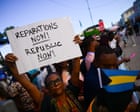
King Charles and the UK prime minister, Andy Burnham, will be greeted with reparations messages as they travel through Antigua's capital, St John's, to attend meetings at the Commonwealth leaders' summit next week, where protests are being prepared.
On billboards, placards and T-shirts, in letters and at a candlelight vigil for the thousands of Africans trafficked to Antigua and Barbuda during the transatlantic slave trade, the message from the Caribbean will be pervasive: slavery reparations is not an issue they are going to be able to dodge.
Activists see the meeting as an opportunity to demand that the UK confront its role in transatlantic enslavement.
Citizens for Reparatory Justice, which is organising some of the demonstrations, said through James Knight that the king and UK government had made protest necessary.
Knight said it was necessary to make known a deep sense of indignation in response to what had been announced ahead of the meeting by the British government and King Charles — that there will be no apology and no reparations — and that making that announcement when coming to a meeting where people have been asking to have the matter discussed was extremely insulting and insensitive.
On Friday, Burnham went further than any previous British prime minister in a newspaper article, writing that a structured dialogue was being offered with those affected by the transatlantic slave trade, that listening to calls for a formal apology on behalf of the British state would form an important part of the process, and that he was open to them.
While that does not pass the threshold Knight set out, it will be viewed by some as a significant development.
The Commonwealth heads of government meeting, known as Chogm, is usually a collegial gathering of leaders from the bloc's 56 member countries, but this one will be surrounded by reparations events.
Though outside the official agenda, protests, a beach vigil to remember the enslaved and the launch of a global reparations caravan — described by organisers as an international movement combining reparations advocacy, demonstrations and culture — are intended to ensure the issue is difficult to ignore.
For campaigners, this Chogm is the culmination of more than a decade of calls from Caribbean leaders for Britain to acknowledge its role in the enslavement of millions of Africans and the colonisation of African and Caribbean countries, and to address the enduring consequences.
Last week, Hilary Beckles, chair of the Caribbean Community (Caricom) reparations commission, emphasised that the absence of a dedicated official event did not mean reparations would remain peripheral, describing the gathering as the Chogm of reparations and the first round of reparations negotiations.
Beckles said this is the meeting of the Commonwealth in the Caribbean, and the number one item in the Caribbean as far as this gathering is concerned is reparatory justice.
Organisations and groups supporting the reparations movement are expected to get together outside the main meeting to discuss the issue, including representatives from the Repair Campaign, the UK law firm Leigh Day, the Open Society Foundations, the African philanthropic organisation TrustAfrica and the UK's all-party parliamentary group for Afrikan reparations.
Caribbean leaders are also expected to push the issue during closed-door meetings.

