National University to revise syllabuses of 19 pass-course subjects as OBE curriculum work begins
The National University has taken an initiative to modernise the syllabuses of 19 subjects of the three-year Bachelor (Pass) degree programme at its affiliated colleges. To that end, work has begun on developing an Outcome Based Education (OBE) curriculum framework following the Bangladesh National Qualifications Framework (BNQF).
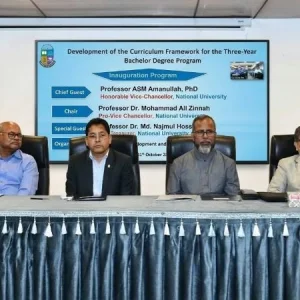
The programme was inaugurated on Saturday (31 October) at the Senate Hall of the university's main campus in Gazipur. The second phase of the work will begin next week.
Joining the event online as chief guest, Vice-Chancellor Professor Dr ASM Amanullah said the university has taken up a broad reform programme to improve the quality of education and institutional capacity. Initiatives are under way to ensure the quality of the university's nearly 4 million students and the five to six hundred thousand graduates it produces every year. Work is also under way on curriculum development for subjects including Law and BEd, and on solving affiliation-related problems, he said.
Seeking the cooperation of the academics taking part in the curriculum development work, the Vice-Chancellor said: "Model question papers for different subjects must be prepared and modern syllabuses developed. Despite various surrounding pressures, the university authorities are committed to building a discrimination-free and up-to-date education system. If this initiative succeeds, the young generation will be able to enter the job market with the necessary skills."
Pointing to the contribution of National University students to employment, he said: "Students of this university make a notable contribution to the country's informal employment sector. But they lack the necessary professional skills. If students can be given proper skills and the quality of education ensured with the cooperation of all stakeholders, building a prosperous Bangladesh will become easier."
Calling the National University an asset of the entire nation, the Vice-Chancellor added: "All stakeholders in the education sector must come forward for the qualitative change of the university and the improvement of education quality."
Chairing the event, Pro-Vice-Chancellor Professor Dr Mohammad Ali Jinnah said: "Every stage of curriculum formulation, verification and implementation is challenging. The university is working tirelessly to implement these initiatives. It is a long-term process; no overnight change is possible. We must move forward through continuous effort and refinement."
He said: "To make students skilled, the stagnation of the conventional system must be broken. If timely subjects and opportunities to acquire necessary skills are added to the curriculum, skilled human resources can be created."
Also speaking at the event were Jahangirnagar University Pro-Vice-Chancellor Professor Dr Md Shamsul Alam, Islamic Arabic University Pro-Vice-Chancellor Professor Dr Mohammad Shahidul Islam, National University's acting Dean of the School of Undergraduate Education Professor Dr Ashek Kabir Chowdhury, acting Dean of the Centre for Postgraduate Education, Training and Research Professor Dr Fakir Rafiqul Alam, and acting Dean of the Curriculum Development and Evaluation Centre Professor Dr AHM Ruhul Quddus.
Academics and researchers from universities across the country, including Dhaka, Jahangirnagar, Rajshahi and Chattogram universities, also took part in the syllabus development programme.