Australian philosopher Peter Singer receives BRAC University's first honorary fellowship
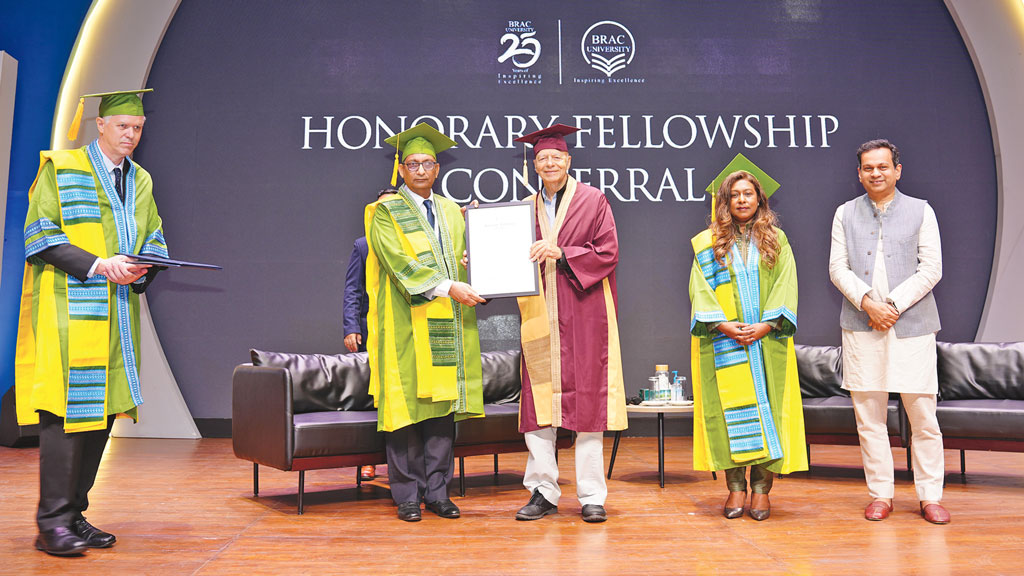
BRAC University has awarded its first-ever honorary fellowship to Australian philosopher Professor Peter Singer. The honour recognises his worldwide contribution to ethics, altruism and animal rights.
At a ceremony held on October 29 at BRAC University's Merul Badda campus, the honour was presented to him by Tamara Hasan Abed, chairperson of the university's Board of Trustees, and Vice-Chancellor Professor Syed Ferhat Anwar.
The fellowship, considered the university's highest honour, was conferred in tribute to the memory of Sir Fazle Hasan Abed. At the ceremony, Vice-Chancellor Professor Syed Ferhat Anwar read the citation setting out Professor Singer's contributions.
Professor Singer's notable works include the 1972 essay 'Famine, Affluence and Morality', the 1975 book 'Animal Liberation', and the founding of 'The Life You Can Save', whose board of directors he also chairs. He has written more than 50 books.
Professor Anwar said the honour reflects BRAC University's commitment to excellence in education and research and to creating a positive impact on society. Tamara Hasan Abed said, 'We feel deeply honoured to welcome you, for the first time in Bangladesh and at BRAC University, as one of our own.'
Accepting the honour, Professor Singer said recognition from a university founded on the ideals of Sir Fazle Hasan Abed holds special significance for him. He also noted that BRAC University offers the opportunity to seek truth and knowledge, and to think freely, ask questions and express opinions.
In 1971, Singer was working at Oxford as a young philosopher. Bangladesh's Liberation War and the sheltering of millions of refugees in India affected him deeply. It was in response to those events that he wrote 'Famine, Affluence and Morality'.
At the ceremony, Singer said people's aims should not be confined to self-interest alone; rather, they need to be guided along the path of morality.
Highlighting the potential of artificial intelligence (AI), Singer said that with an internet connection, people anywhere in the world can obtain high-level healthcare advice. But AI will bring major change to employment. Care must be taken, he said, so that workers' reduced income does not flow into the hands of technology companies in wealthy countries. To address the problem, he proposed obliging the technology companies responsible for job cuts to contribute to a universal basic income system. At the same time, he said, work is not only a source of income; it keeps people occupied and gives life purpose. The social importance of jobs that machines cannot do must therefore be preserved.
Australia's High Commissioner to Bangladesh, Susan Ryle, members of BRAC University's Board of Trustees, teachers and students, and members of the BRAC family attended the ceremony.