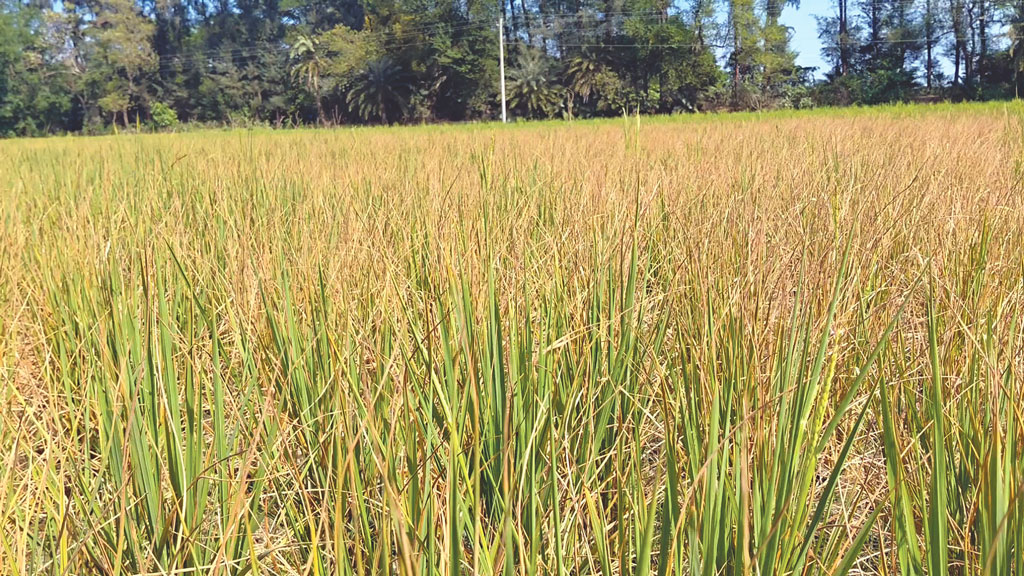
Quick harvest, better price: why farmers are turning to murikata onions

Md Enamul Haque, a farmer in Pirganj, Rangpur, has planted murikata onions on 50 decimals of land this season. He says the crop reaches the market at the start of winter, so it fetches a good price.
Enamul Haque says the crop comes home in a short time and the profit is good too. The problem, he notes, is that because it is cut while still raw, it must be sold within fifteen days. He says farmers plant murikata onions on 90 percent of the land in his area at this time of year.
Another farmer, Md Ismail Hossain, says they produce up to about five maunds of murikata onions from every two and a half decimals of land. He says the onions are sold with leaves, and even with stems, within 45 to 60 days of planting. The small onions used for planting are brought from Pabna or Kushtia, and each one yields up to four onions.
Suman Ahmed, the upazila agriculture officer in Pirganj, says local farmers have planted murikata onions on about two thousand hectares of land in that upazila alone this year. Planting is already done, he says, and the leafy onions will be visible in the fields within 35 to 40 days. Some farmers will sell them with leaves and some after cutting the tops. Here, small but whole onions are planted, unlike the onions usually seen in the market, which are grown from seedlings raised from seed.
Dr Md Alauddin Khan, former chief scientific officer of the Spice Research Centre in Faridpur, explains what a murikata onion actually is. The onion produced by cultivating onion sets, he says, is the murikata onion. Cutting off the top part of the plant is what 'murikata' means: the set is first collected with its leaves, then the part above the neck of the set is cut, and the full-sized onion that later grows from that set is the murikata onion.
According to Dr Khan, Bangladesh produces about 750,000 tonnes of murikata onions a year, and they account for roughly 30 percent of all onions produced in the country.
Onions are generally cultivated in Bangladesh in three ways: transplanting seedlings, planting sets, and sowing seed directly. Onions grow best where winters are colder. Murikata onions are cultivated in Pabna, Faridpur, Rajbari, Rangpur, Kushtia, Jhenaidah, Shariatpur and Madaripur, among other districts, and the cultivation is increasing every year.
Md Jahangir Alam Pramanik, deputy director of the Department of Agricultural Extension in Pabna, says murikata onions are being cultivated on about nine thousand hectares in that district this year. When a whole onion is planted in a special way, new onions grow from its root, and that is how it became known as the murikata onion, he says. Planting is finished in most places and still going on in some. The onions are harvested with their leaves and cannot be stored.
Agriculturists say the onions are ready to harvest within 90 days of planting, so farmers can then grow chillies, potatoes and other crops on the same land. October and November are generally the right months for planting murikata onions. Slightly high or medium-high loam soil suits the crop, and it cannot be cultivated if water stands in the field. Within three months of planting, when the leaves grow tall and bend slightly, the crop is ready to lift.
Farmers usually lift and sell the onions with their leaves. To store them, the plant must be lifted with its roots and the top cut off. But murikata onions are still somewhat raw inside when lifted from the field and cannot be kept for long, so they must be sold quickly.
Timing matters too. Dr Alauddin Khan says the main onion season begins in December-January and reaches the market around March-April. Because murikata onions arrive before that, they also help keep onion supplies normal in the market.
The crop is also tied to the climate. Dr Khan says that because it is a winter crop, the timing of murikata cultivation is very important for avoiding future climate-change risks. Climate change has begun to affect the main season of the conventional onion, so by growing murikata before the main season, farmers can benefit while market supplies stay steady. Given its link to the weather, he believes cultivation must begin on time.
There are risks as well. Some farmers say onions are sometimes imported from abroad in winter, and then, even after producing murikata onions as a winter crop, they face the risk of losses. On the other hand, because it arrives in the winter season, the murikata onion tends to command a somewhat higher price.
It is prized for taste too. Farmers Enamul Haque and Ismail Hossain both say murikata onions taste better to them. Dr Alauddin Khan says there is considerable demand for murikata onions with their tender green leaves, and their tender flower stalks are separately valued as a vegetable and salad ingredient.