Awami League used Rakkhi Bahini for political purposes, speakers say at July Museum seminar
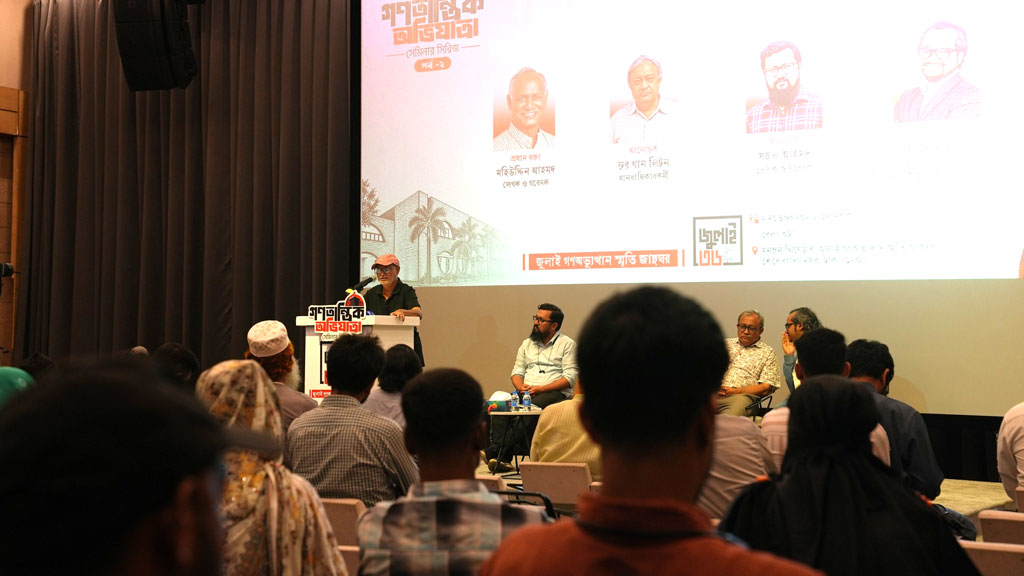
Speakers at a seminar organised by the July Mass Uprising Memorial Museum have said that after 1972 the Awami League used the Rakkhi Bahini to oppress opposition political parties and for its own other political purposes.
They made the remarks on Monday (November 2) at the July Museum during the second episode of the 'Democratic Journey Seminar Series', titled 'Rakkhi Bahini and Extrajudicial Killings'.
Keynote speaker writer and researcher Mohiuddin Ahmad said many identify the January 1975 killing of Siraj Sikder as the first extrajudicial killing in independent Bangladesh, but that this denies the hundreds of extrajudicial killings carried out by the Rakkhi Bahini since 1972.
Mohiuddin Ahmad said the Awami League used the Rakkhi Bahini for its own political purposes after the Liberation War, turning it into a force for oppressing opposition political leaders, and that the biggest victims of that oppression were the leaders and activists of JASAD.
Saying a culture of impunity keeps extrajudicial killings alive, he said the Rakkhi Bahini should have been brought to justice after 1975, but although everyone did politics with them, no one spoke of trials.
Human rights activist and former member of the Commission on Enforced Disappearances Nur Khan Liton said the Rakkhi Bahini carried out severe torture on men and women alike, and its activities were most visible in areas where JASAD and other opposition parties had a presence.
Nur Khan Liton also said that between 1972 and 1975 many unidentified bodies were found on the road between Rokeya Hall and Shamsun Nahar Hall at the University of Dhaka, and there was a strong possibility the Rakkhi Bahini left them there to spread fear among people.
Discussant writer and researcher Sohul Ahmad said a truth commission on extrajudicial killings is essential, through which the truth about extrajudicial killings over the past fifty years since 1972 can be known.
Chairing the session, July Mass Uprising Memorial Museum director general Ehsan Mahmud said Rakkhi Bahini was the most feared name for ordinary people after independence, alongside BAKSAL. The first episode of the seminar series was on BAKSAL and the second on the Rakkhi Bahini, he said.
Ehsan Mahmud said the July uprising showed the dream of a future Bangladesh and that building that future requires looking back, adding that the museum will continue these discussions.
Teachers from various universities, researchers, lawyers, students and representatives of civil society took part in the second episode. The museum said the next episodes of the seminar series will be held in succession.