Wage movement disrupts production at 681 factories as government warns of outside instigation

The ongoing wage-increase movement by garment workers disrupted production at at least 681 factories in various industrial areas on Monday. Most of them are ready-made garment factories. The previous day, on Sunday, production was disrupted at 529 garment factories.
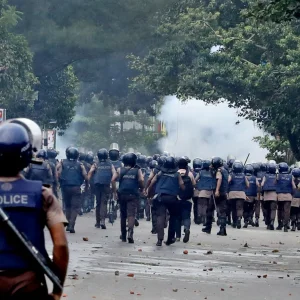
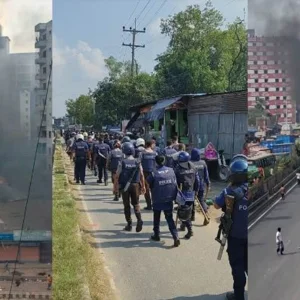
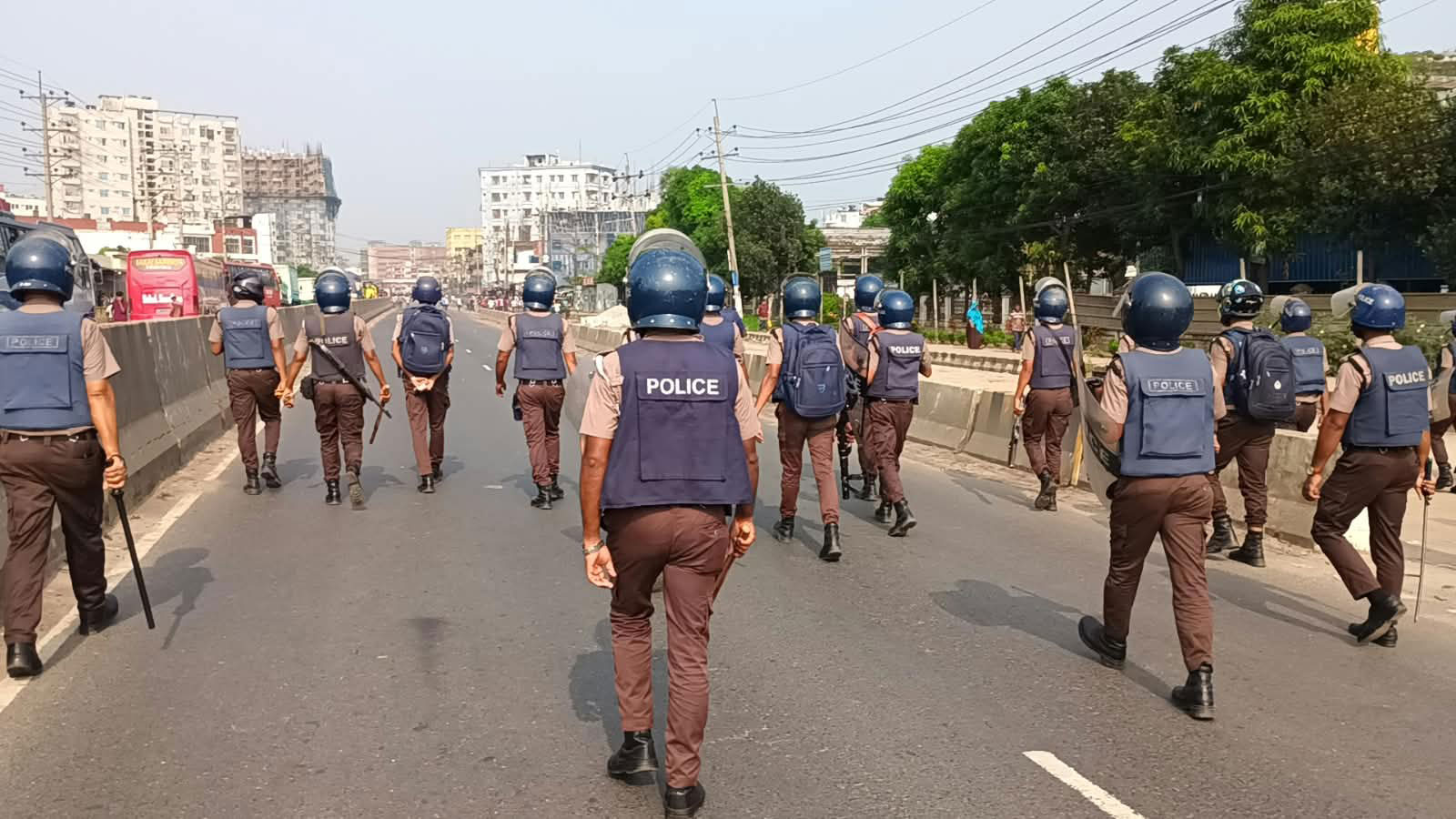
Workers in Savar, Gazipur and other industrial areas of the country have been protesting since last week demanding higher wages. On Sunday, the Ministry of Labour formed a minimum wage board to raise garment workers' wages. That same day, workers demonstrated in Gazipur, Savar, Ashulia and Mirpur; roads were blockaded, clashes took place with police, and a police box and a police vehicle were set on fire. On Monday, workers demonstrated in Gazipur, Savar, Ashulia and Narayanganj, and chases and counter-chases took place with police.
The garment owners' organisation BGMEA said 679 ready-made garment factories saw their workers walk out without working on Monday. Among them are 65 factories in Mirpur and 382 in Gazipur. A total of 1,692,782 workers are employed at these factories.
At a domestic shoe factory in Kaliakair, Gazipur, production began in the morning but by nine o'clock the authorities were forced to give workers leave under pressure from protesters. Production at Picard Bangladesh in Ashulia was also disrupted.
Home Minister Salahuddin Ahmed met owners' leaders at the Secretariat on Monday morning over the garment sector's ongoing situation. In the afternoon, the Home Minister and Labour Minister Ariful Haque Chowdhury met worker leaders. BGMEA president Mahmud Hasan Khan and BKMEA president Mohammad Hatem attended the owners' meeting; the prime minister's adviser Mahdi Amin and worker leader and MP Shimul Biswas were present at both meetings.
At the meetings, the government warned that outsiders were being infiltrated into the movement. The government believes that former ministers, state ministers and MPs of the Awami League — whose activities are banned — and some garment owners linked to the party's politics are trying to create unrest by exploiting the movement. Information is being gathered about some fugitive leaders linked to the party.
According to meeting sources, it was discussed, citing intelligence agencies, that at least 50 Awami League leaders and activists are trying to create this unrest. A former state minister owns a garment factory in Kaliakair upazila of Gazipur, from where workers are being instigated, it was said. A former MP from Savar is also instigating workers from abroad, the discussion heard, and the involvement of a former mayor of Gazipur City Corporation also came up.
At a press conference after the meeting with owners at the Secretariat, Home Minister Salahuddin Ahmed said: 'The government does not want any factory to remain closed even for a moment. Attempts are being made to create an unstable situation in the country through anti-worker activities in the name of a movement. Real workers are not involved in these activities.' He alleged that some industrialists linked to Awami League politics had also worked behind creating the unrest, and that former MPs and a state minister were involved.
The Home Minister said some owners had deliberately closed factories, and owners' organisation leaders had been asked to provide a list of those owners. A list of worker leaders and organisations involved in creating unrest had also been sought. A control room has been ordered to be set up at police headquarters to monitor the garment factory situation; the government has decided on 24-hour surveillance, and the situation will be monitored through the Surokkha app.
On the wage board, the Home Minister said there is a demand to form a minimum wage board for workers every three years. The government had begun the initiative to form the board several weeks earlier; the owners' representatives' names had been received, but worker organisations took a few days to submit names. The wage board was formed once their names were received.
The owners, for their part, said they are worried about factory security. Their position is that if the government has specific information against anyone, legal action should be taken against them. They sought steps on three points — increasing intelligence activity, action against the real culprits, and normalising the law and order situation. The owners fear that if the situation does not improve by Tuesday, they may have to consider announcing factory closures from Wednesday under labour law. Earlier, at an emergency BGMEA meeting on Sunday, factory owners had also spoken of deciding to close factories if the movement did not stop.
BGMEA president Mahmud Hasan Khan said: 'It is not true that we are not running the factories. The truth is we cannot run them. We will try to keep factories open tomorrow, Tuesday. If we cannot, we will have to move towards a decision to keep them closed.' As reasons for being unable to keep them open, he cited processions in front of factories and stones being thrown at factories from outside; in his view, after the wage board was formed there is no reason for labour unrest. Asked how much money is being lost each day from closed factories, he said they have no such calculation.
Worker leaders, however, say the government's delay in forming the wage board complicated the situation. After the afternoon meeting, Salauddin Swapan, general secretary of the IndustriALL Bangladesh Council, said worker leaders had held a press conference on 19 September demanding the formation of the wage board; a memorandum was announced for 4 October and, as announced, was submitted that day. Even then the government delayed forming the wage board; had it been formed earlier, the situation would not have become this bad.
Swapan said frequent meetings are now needed to calm workers and set the minimum wage quickly. He also demanded arrangements for the new wage to take effect from next January. The movement is being held with a demand for a minimum wage of Tk 30,000.
The wage board's worker representatives have also demanded, alongside quick wage determination, the release of detained and arrested workers and the withdrawal of cases. At a press conference at the Labour Building, the board's worker representative Babul Akhtar said: 'We will work in the wage board in such a way that workers receive the increased wage in hand from next January. There is no reason for delay in this.' He demanded the immediate release of workers and worker leaders detained or arrested over alleged links to the ongoing movement, and the withdrawal of harassing cases.